
Basic subtraction Addition Worksheets for Ages 4-7
5 filtered results
Difficulty Level
Grade
Age
-
From - To
Subject
Activity
Standards
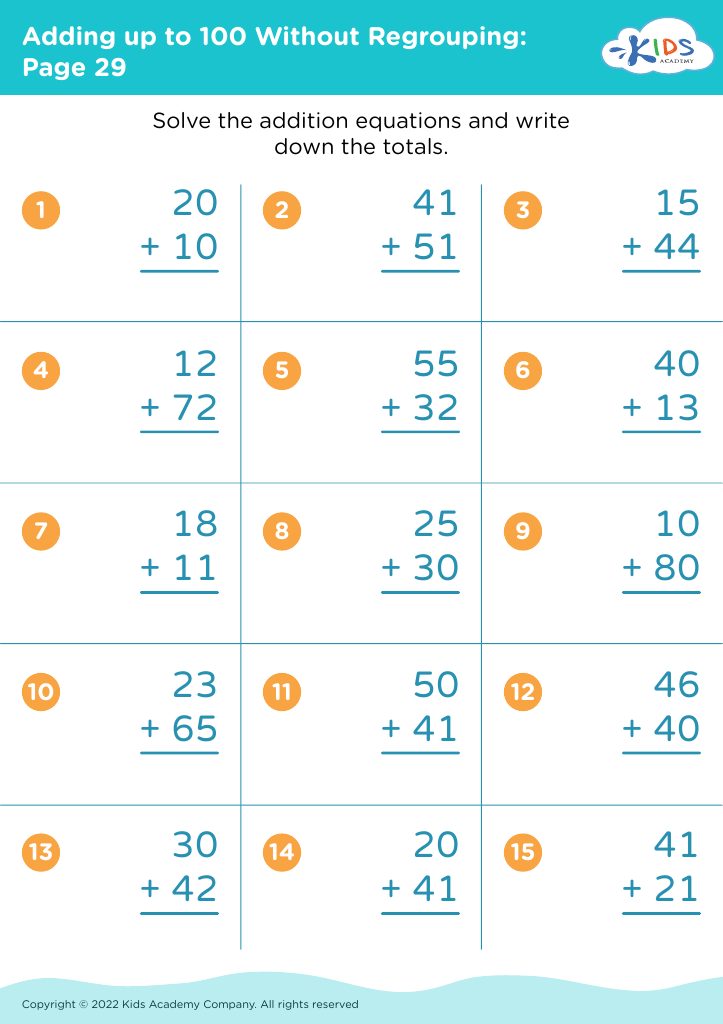
Welcome to our collection of basic subtraction and addition worksheets designed for children ages 4-7! These engaging resources are perfect for introducing young learners to fundamental math concepts in a fun and interactive way. Our worksheets feature vibrant illustrations and age-appropriate exercises that foster essential skills such as number recognition, counting, and basic arithmetic. As children complete these activities, they will build confidence and a solid foundation in math. Ideal for both home and classroom use, our worksheets provide valuable practice that makes learning enjoyable. Explore our printable worksheets today and watch your little ones excel in arithmetic!
Favorites
With answer key
Interactive
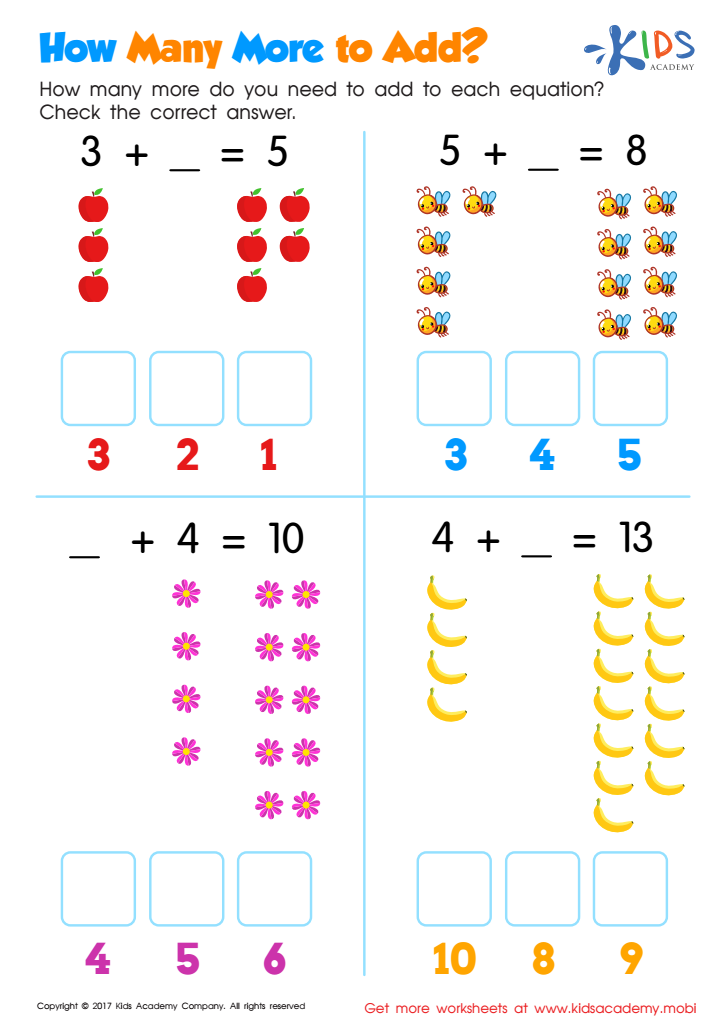
How Many More to Add Worksheet
Sharpen your child's math skills with this pdf worksheet. Help them figure out how many apples, bees, flowers and bananas are needed to reach the answer given. The possible answers are provided at the bottom of the boxes. Have some fun doing some addition and subtraction magic together and get those math skills sharpened!
 Assign to My Students
How Many More to Add Worksheet
Worksheet
Join Kids Academy for Free
Who is primarily going to use this learning content?








Understanding basic addition and subtraction is essential for children aged 4-7 as it lays the foundation for their mathematical skills and overall cognitive development. At this age, children are naturally curious and eager to explore the world around them. By introducing them to these fundamental concepts, parents and teachers foster critical thinking, problem-solving abilities, and logical reasoning.
Basic addition and subtraction enhance children's number sense, enabling them to recognize numbers, understand quantities, and relate them to real-life situations, such as sharing snacks or counting toys. Mastering these skills also builds their confidence, as achieving success in math-related tasks encourages a positive attitude toward learning. Additionally, these early mathematical experiences prepare children for more complex concepts like multiplication and division, which they will encounter later in their education.
Moreover, nurturing these skills at an early age promotes cognitive connections that are crucial for future academic success. Moreover, fostering an enthusiastic environment around math makes learning enjoyable, which can instill a lifelong appreciation for education. Ultimately, attention to basic addition and subtraction equips children with essential tools for understanding the world, leading to success in math and other fields as they grow.








