Pattern recognition Geometry Worksheets for Ages 4-7
3 filtered results
-
From - To
Enhance your child's early learning with our Pattern Recognition Geometry Worksheets designed for ages 4-7. These engaging and educational worksheets help young learners develop crucial skills in identifying and creating patterns using geometric shapes and vibrant colors. Perfectly tailored to their developmental stage, each worksheet offers fun activities that stimulate cognitive development and improve logical thinking. By practicing with these worksheets, children gain a solid foundation in geometry and pattern recognition, setting the stage for future mathematical success. Ideal for both classroom use and home learning, these resources are a valuable addition to any early educational toolkit.
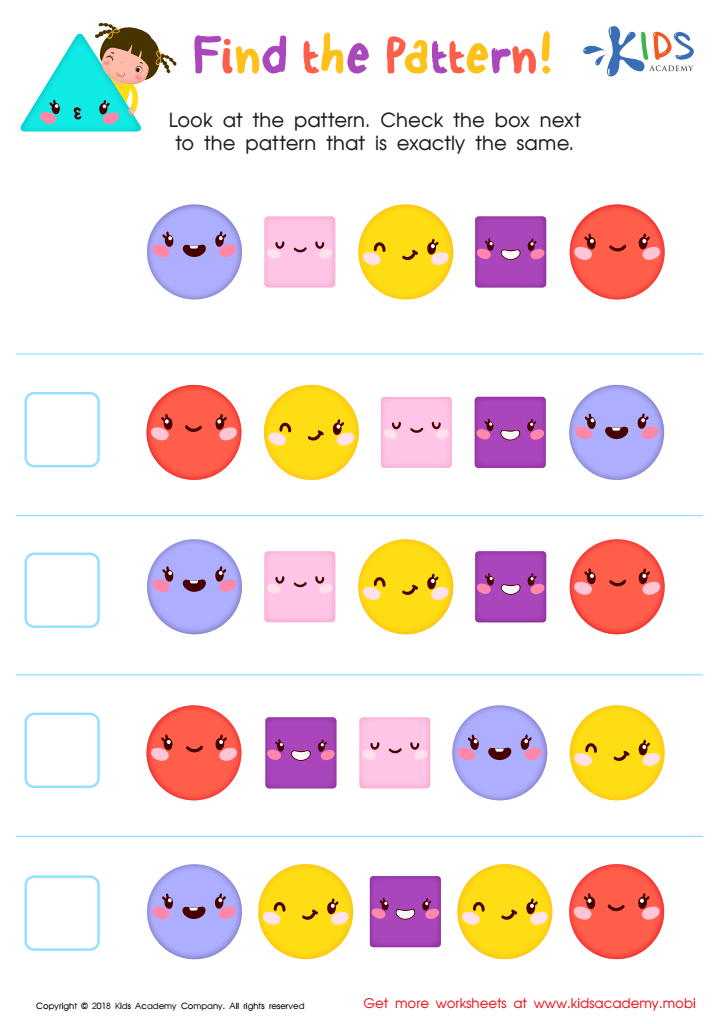
Find the Pattern Worksheet
 Assign to My Students











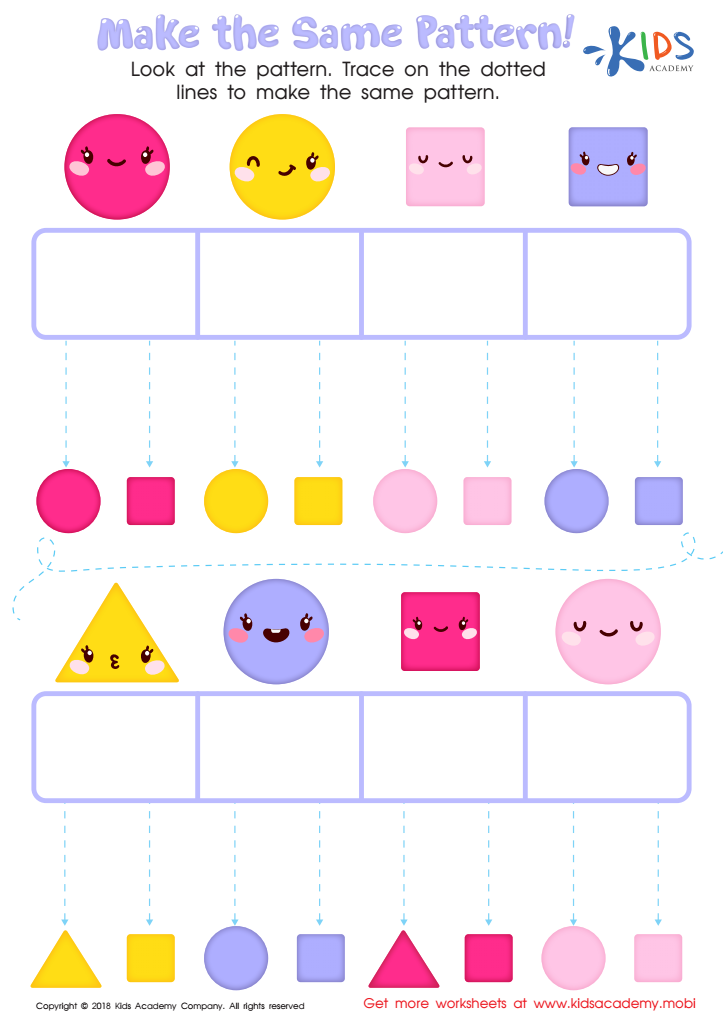
Make the Same Pattern Worksheet
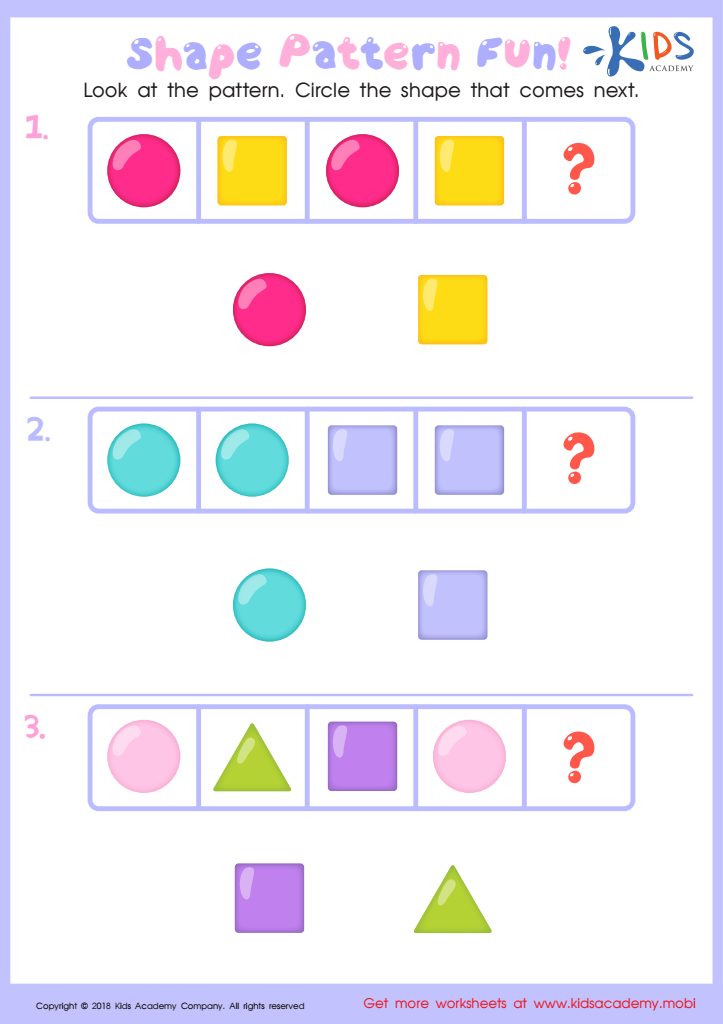
Shape Pattern Fun Worksheet








Parents and teachers should prioritize pattern recognition and geometry for ages 4-7 because these skills form foundational cognitive abilities essential for early development. Pattern recognition fosters children's ability to identify and predict sequences, improving problem-solving, logical thinking, and mathematical concepts. Recognizing patterns aids in understanding more complex ideas later, such as number sequences, algebra, and coding.
Geometry assists children in understanding shapes, spatial relationships, and the properties of objects around them. Mastery of basic geometric concepts helps enhance visual-spatial skills, which are critical in everyday tasks, such as reading maps and engaging in physical activities. These skills also boost fine motor development—important in writing, drawing, and coordination.
Furthermore, these concepts are closely linked with language development. Engaging with patterns and shapes requires vocabulary expansion and verbal explanations, thus promoting better communication skills. Teachers can incorporate pattern recognition and geometry into playful activities like building blocks, drawing, or simple puzzles. Doing so not only makes learning fun but also integrates it into children's natural play, leading to deeper understanding.
By nurturing these skills at an early age, parents and teachers ensure children have a strong academic and cognitive foundation, setting them up for future success in both school and daily life. The benefits extend beyond academics, fostering critical lifelong problem-solving skills and creative thinking abilities.








