Counting skills Numbers Worksheets for Ages 4-7 - Page 8
170 filtered results
-
From - To
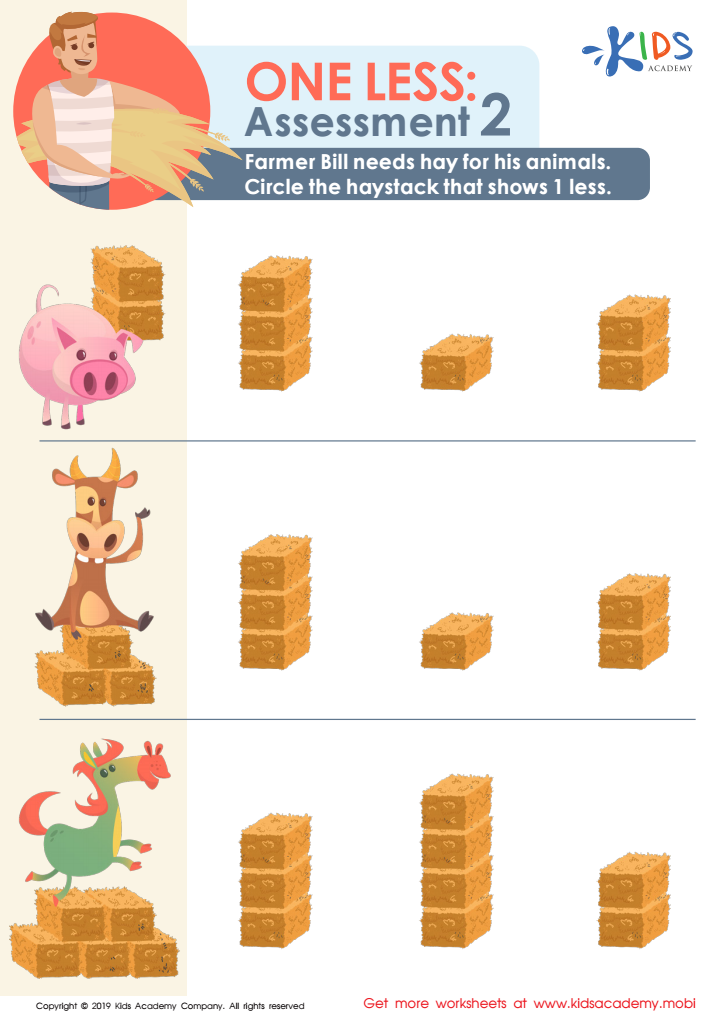
One Less: Assessment 2 Worksheet
 Assign to My Students

Night Sky Numbers Worksheet








Counting skills are foundational to a child's mathematical understanding and critical for their overall academic success. For children aged 4 to 7, developing strong counting abilities enhances their cognitive skills and prepares them for more complex math concepts in later years. Parents and teachers should prioritize counting skills as they foster number recognition, basic addition and subtraction, and an understanding of quantity.
At this age, children are naturally curious and eager to learn. Engaging them in counting activities—like counting objects, chanting rhymes, or using everyday scenarios—makes learning fun and reinforces these skills in a practical context. Mastering counting lays the groundwork for recognizing patterns, understanding shapes, and even solving problems.
Moreover, these skills extend beyond mathematics; they help children build confidence and critical thinking abilities, traits valuable in all areas of learning. Parental involvement and teacher encouragement can create a supportive environment where children feel comfortable exploring numbers without fear of making mistakes. Children who develop a strong counting foundation will have a better chance of excelling in school, ultimately instilling a lifelong appreciation for learning and problem-solving. Thus, parents and educators should actively invest time and resources to cultivate counting skills among young learners.








