
Analog Clock Understanding Math Worksheets for Ages 4-7
3 filtered results
Difficulty Level
Grade
Age
-
From - To
Subject
Activity
Standards
Unlock the joy of learning time with our engaging "Analog Clock Understanding Math Worksheets" for kids ages 4-7! These worksheets are designed to introduce young learners to the concept of telling time using analog clocks. With fun and colorful illustrations, children will practice recognizing clock faces, understanding hour and minute hands, and solving simple time-related problems. Each activity promotes critical thinking and mathematical skills in a playful and interactive way. Ideal for classroom or home use, these worksheets provide a solid foundation in time-telling skills, ensuring children gain confidence as they master this essential life skill. Start their time-telling adventure today!
Favorites
With answer key
Interactive
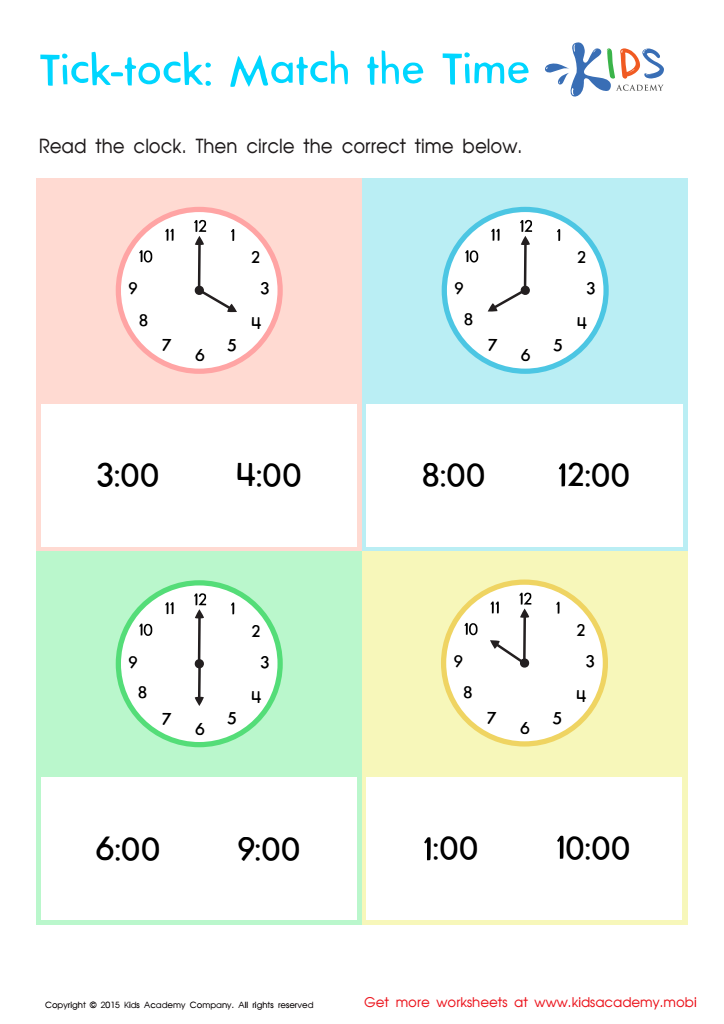
Telling The Time Worksheet: Part 4
Test your skills in telling the time! Circle the right time on 4 analog clock faces.
 Assign to My Students
Telling The Time Worksheet: Part 4
Worksheet
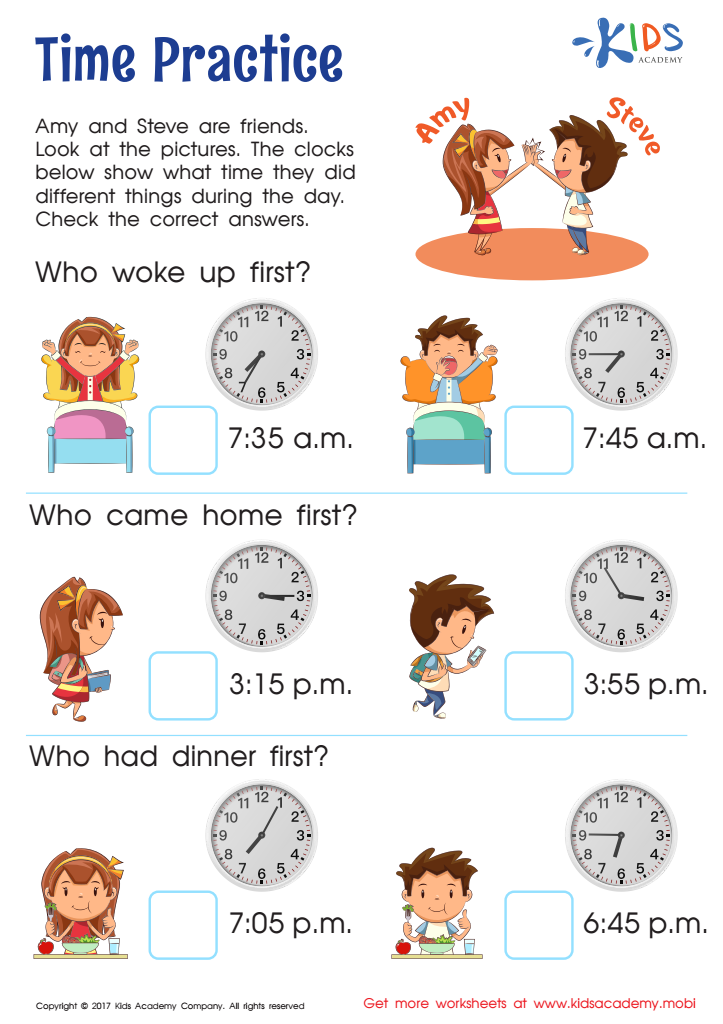
Time Practice Worksheet
It's perfect for 2nd graders as they gain a better understanding of time. Get them to tell the time on analog clocks, improve their math skills, and boost their confidence!
Second graders can brush up on timekeeping with our time practice worksheets. They'll learn to read minutes on analog clocks, honing math and confidence. Perfect for mastering this tricky concept!
Time Practice Worksheet
Worksheet
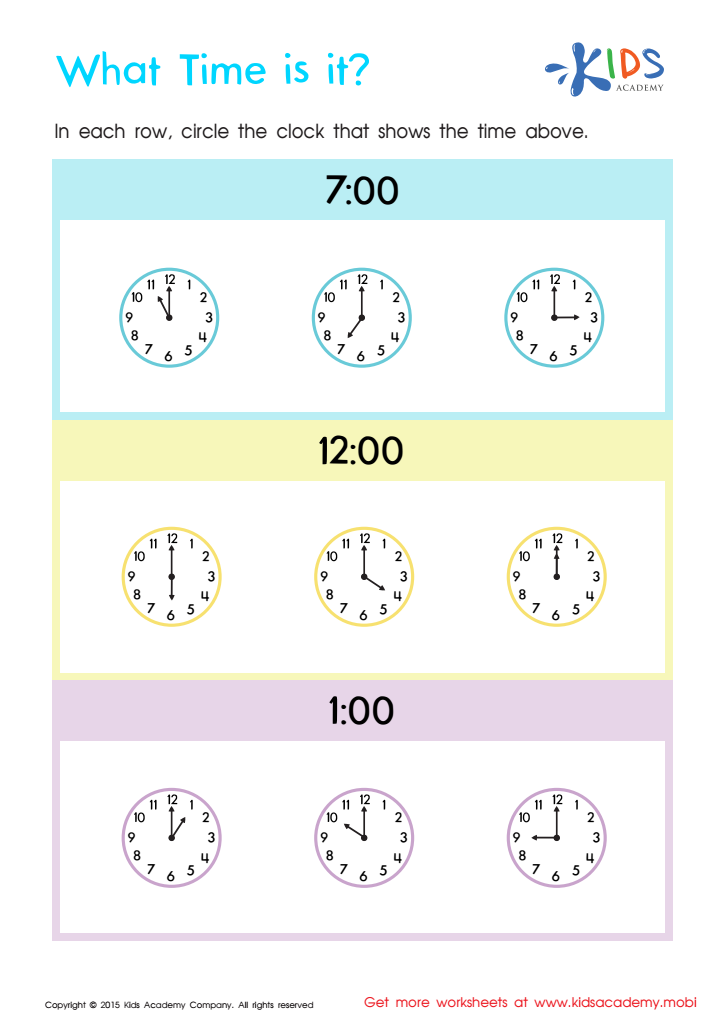
Telling The Time Worksheet: Part 3
Make learning to read clocks fun with our free printable worksheets! Have kids circle the clocks that show the time, remembering that the short hand is for hours and the long one is for minutes. For more worksheets, visit Kids Academy and explore the wonderful world of math with your little learners.
Telling The Time Worksheet: Part 3
Worksheet
Join Kids Academy for Free
Who is primarily going to use this learning content?







%20(1).jpg)
Understanding analog clocks is an essential skill for children aged 4-7, and both parents and teachers should prioritize it in early education. First, learning to read an analog clock fosters number recognition and reinforces counting skills, providing a practical application for these foundational concepts. Children not only learn to tell time, but they also develop a deeper understanding of numbers as they visualize how they relate to one another.
Furthermore, analog clock understanding promotes critical thinking and problem-solving as kids navigate time intervals, such as calculating how long until an event or how much time has passed. These skills contribute to their cognitive development and prepare them for more complex mathematical concepts in the future.
Additionally, knowing how to read an analog clock encourages a sense of responsibility and time management. Kids gain awareness of scheduling and the importance of punctuality, skills that are vital for their academic and everyday lives.
Ultimately, fostering an understanding of analog clocks not only enriches children's mathematical abilities but also equips them with practical life skills. Therefore, parents and teachers should embrace opportunities to teach this knowledge, ensuring a well-rounded foundation in both math and time-related concepts for young learners.








