Fine motor skills development Math Worksheets for Ages 4-7
5 filtered results
-
From - To
Enhance your child's fine motor skills with our engaging Math Worksheets designed specifically for ages 4-7. These worksheets combine essential math concepts with fun, hands-on activities to develop dexterity and coordination. Each resource fosters creativity and critical thinking while encouraging little ones to practice counting, sorting, and shape recognition. With colorful illustrations and interactive exercises, children will enjoy improving their fine motor skills alongside their math abilities. Perfect for school or home learning, these worksheets are a valuable tool for preschool and early-grade educators aiming to support holistic development in young learners. Start your child's journey to math mastery today!

Trace The Circles Worksheet
 Assign to My Students
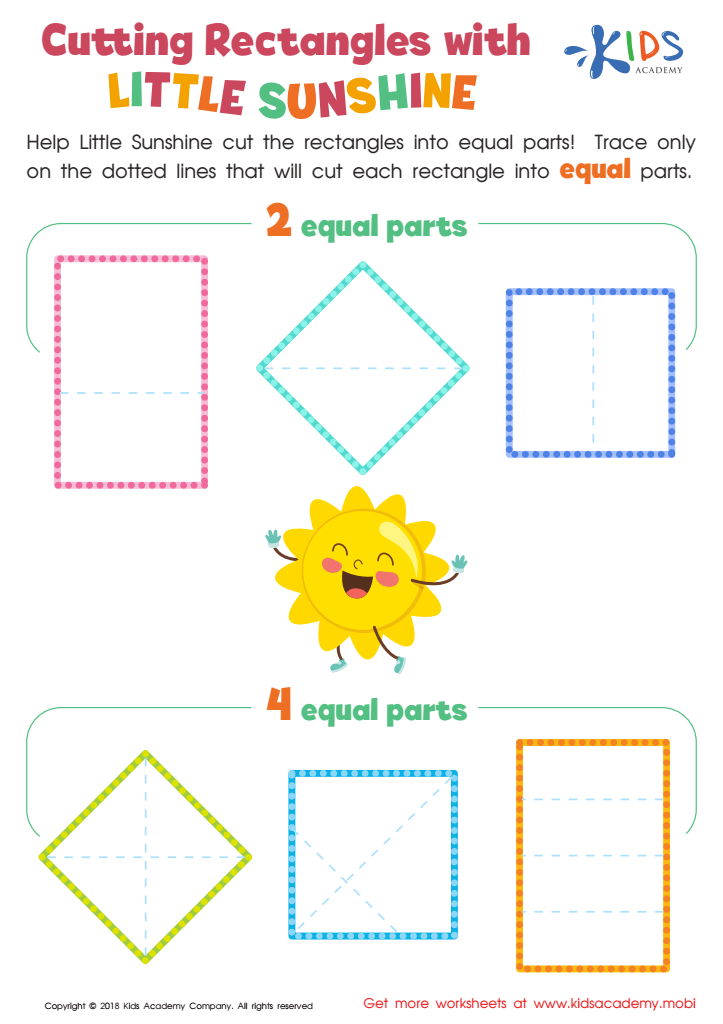
Cutting Rectangles with Little Sunshine Worksheet








Fine motor skills are crucial for young children, particularly in the context of early math learning for ages 4-7. These skills involve the coordination of small muscle movements, especially in the hands and fingers, which are essential for a range of tasks, including writing, cutting, and manipulating small objects. Mastering fine motor skills supports children's ability to engage with math through hands-on activities like counting with manipulatives, drawing shapes, and measuring—with each task optimizing their tactile coordination and cognitive understanding.
For parents and teachers, fostering fine motor development is linked to cognitive growth. Children who struggle with these skills may find challenges in engaging with math concepts effectively. Activities such as threading beads, playing with playdough, and using scissors not only bolster fine motor skills, but also enhance problem-solving, focus, and perseverance—all vital components of mathematical thinking.
Moreover, a strong foundation in fine motor skills can lead to greater confidence, encouraging children to participate in math-related activities and pursue further learning. Hence, by prioritizing fine motor skill development, parents and teachers can lay the groundwork for children's academic success and a positive attitude towards learning, thereby nurturing both skill and enthusiasm for math at a crucial developmental stage.








