
Vocabulary enhancement Tracing Letters Worksheets for Ages 4-8
3 filtered results
Difficulty Level
Grade
Age
-
From - To
Subject
Activity
Standards
Boost your child's vocabulary with our Vocabulary Enhancement Tracing Letters Worksheets, designed for ages 4-8. These engaging, printable worksheets help young learners improve their handwriting skills while expanding their vocabulary. Each worksheet combines fun tracing activities with new word introductions, fostering familiarity with letter forms and a growing word bank. Suitable for preschool and early elementary students, these resources provide a solid foundation for language development. Our worksheets make learning enjoyable and productive, setting the stage for academic success. Download them now to give your child the tools they need to thrive in their reading and writing journey.
Favorites
With answer key
Interactive
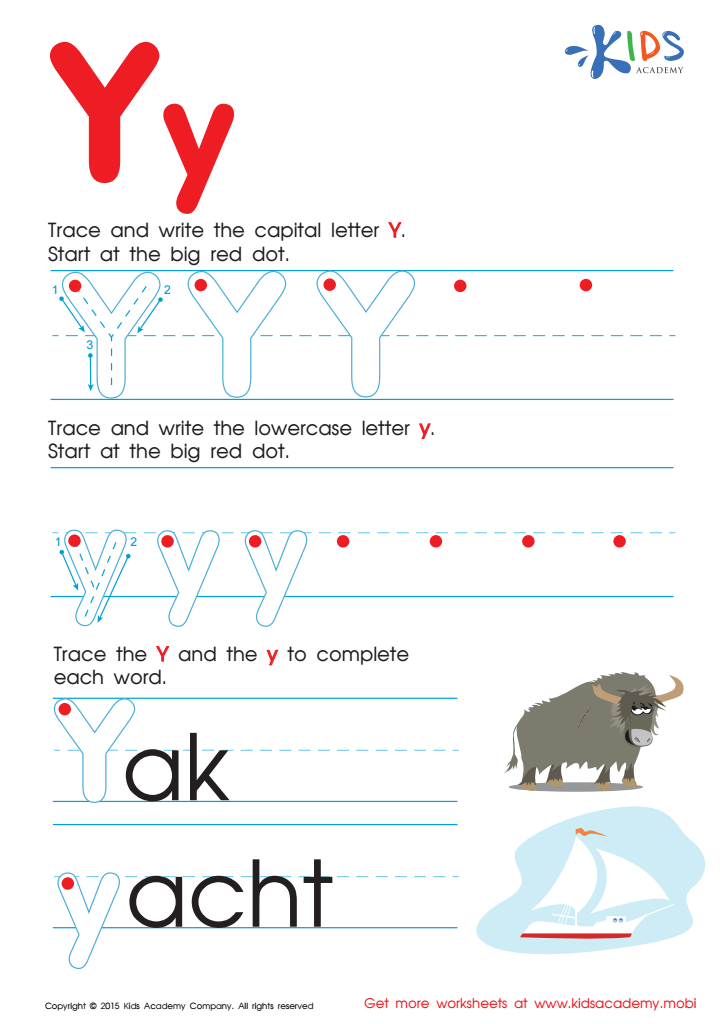
Letter Y Tracing Page
Trace the capital letter "Y" on the red dot, then trace and write the lowercase letter. Complete the words to help the Yak walk and the yacht swim. More worksheets at Kids Academy.
 Assign to My Students
Letter Y Tracing Page
Worksheet
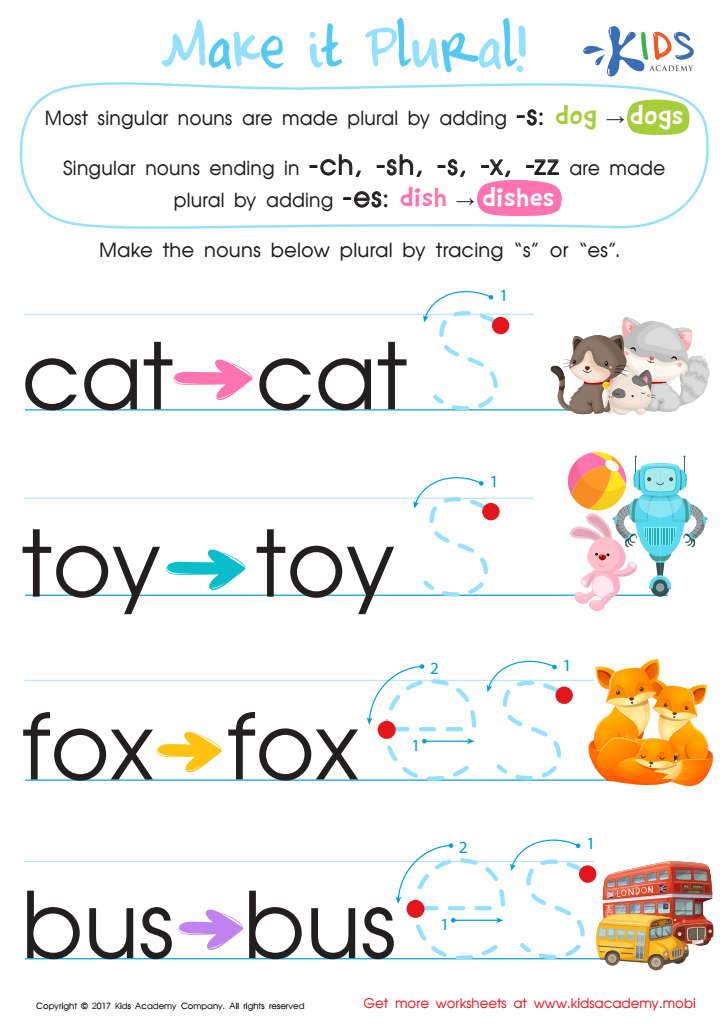
Make it Plural Worksheet
Changing words from singular to plural can be tricky as there are many word endings with special rules. Most words just need an -s, while endings like -ch, -sh, -s, -x or -zz need -es. This worksheet helps kids read words and trace the correct ending for each, making it easier to master these rules!
Make it Plural Worksheet
Worksheet
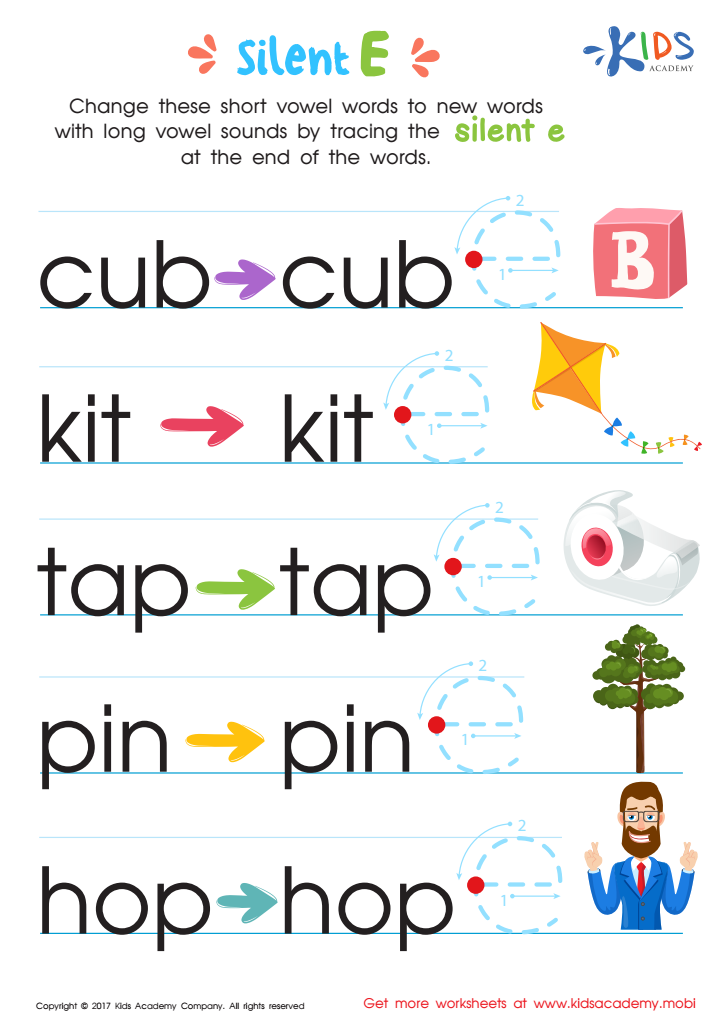
Silent E Words Worksheet
The letter e is amazing - it changes words without making a sound! Boost spelling and phonics with this Silent e worksheet from Kids Academy - fun and colorful!
Silent E Words Worksheet
Worksheet
Join Kids Academy for Free
Who is primarily going to use this learning content?








Vocabulary enhancement and tracing letters for children aged 4-8 play a critical role in childhood development, making it important for parents and teachers to prioritize these activities. During the early years, children's brains are rapidly developing and are highly receptive to learning new languages and skills. Enhancing vocabulary improves children's ability to communicate effectively, understand complex instructions, and succeed academically across various subjects.
Tracing letters serves as a foundational exercise in developing fine motor skills and muscle memory, essential for writing. This activity helps children recognize each letter's shape, linking visual recognition with physical movement, which reinforces learning. As children's letter recognition improves, they become more confident and enthusiastic about reading and writing, fostering a positive attitude toward literacy.
Moreover, combining vocabulary enhancement with tracing exercises accelerates language acquisition. Children who engage in these activities typically have a richer vocabulary, better comprehension, and improved expressive language skills. This preparation equips children to handle the progressively challenging linguistic demands of school curriculum.
Therefore, investing time in vocabulary enhancement and letter tracing for young children sets them on a path for greater academic achievement, critical-thinking skills, and emotional intelligence, laying a strong foundation for lifelong learning and effective communication.








