Comparing Fractions Worksheets for Ages 4-8 - Page 5
137 filtered results
-
From - To
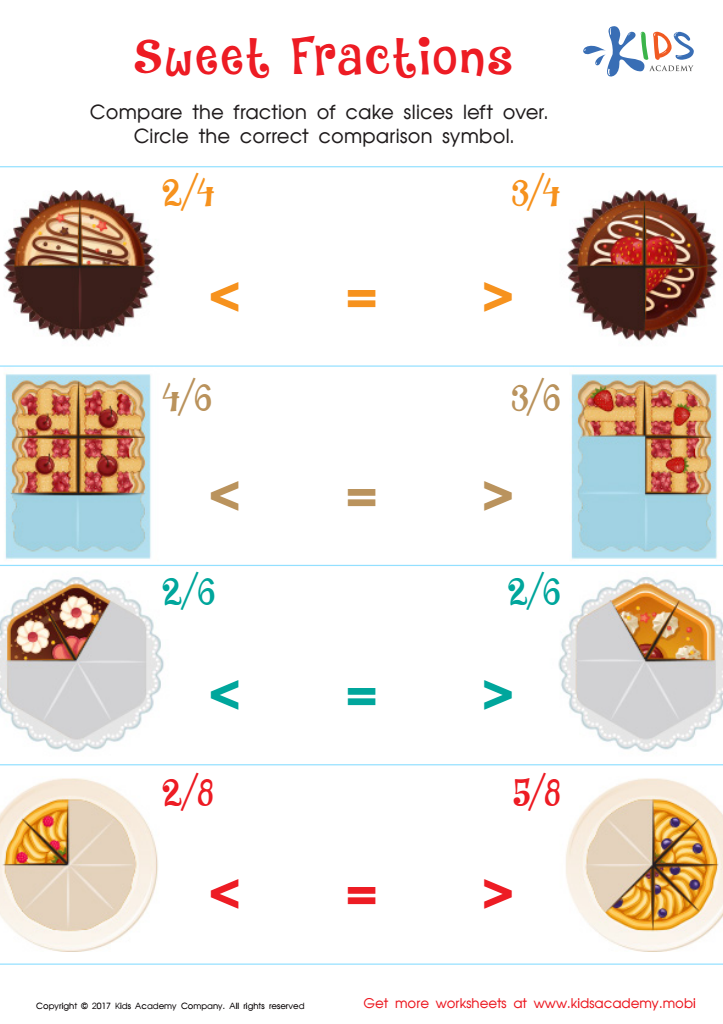
Compare Fractions Worksheet
 Assign to My Students







Understanding fractions from a young age is essential as it lays the foundation for more advanced mathematical concepts later on. For children aged 4-8, learning to compare fractions helps develop critical thinking and problem-solving skills in a fun and accessible way.
During this formative period, children are highly impressionable. Introducing them to fractions through comparisons enables them to grasp complex ideas such as equivalency, order, and proportion early on. These skills are not only vital for their future math education but also have practical everyday applications—like understanding portions during meals or dividing toys equally among friends.
Parents and teachers can foster a love for math by presenting it engagingly and contextually. By focusing on comparing fractions, such as which is bigger or smaller, kids exercise numerical reasoning that improves their ability to comprehend and navigate the world. This sets the stage for success in higher-level mathematics, where fractions figure prominently in subjects like algebra, geometry, and data interpretation.
Furthermore, competence in math is linked to improved academic performance overall. Early familiarity with comparing fractions can build confidence in young learners, encouraging a positive attitude towards school and learning as a whole. Encouraging these skills will benefit children's cognitive development and academic achievement, making it crucial for parents and teachers to care about this area of early education.








