
Counting skills enhancement Worksheets for Ages 4-8
3 filtered results
Difficulty Level
Grade
Age
-
From - To
Subject
Activity
Standards
Enhance your child's numerical proficiency with our counting skills enhancement worksheets designed for ages 4-8. Featuring engaging activities and colorful illustrations, these worksheets help young learners to practice counting, number recognition, and sequencing in a fun and interactive way. Perfect for preschool to early elementary students, our printable materials cater to various skill levels, ensuring every child can build a solid mathematical foundation. Make counting practice enjoyable and effective with exercises that turn learning into an adventure, laying the groundwork for future academic success. Download now and watch your child’s confidence soar!
Favorites
With answer key
Interactive
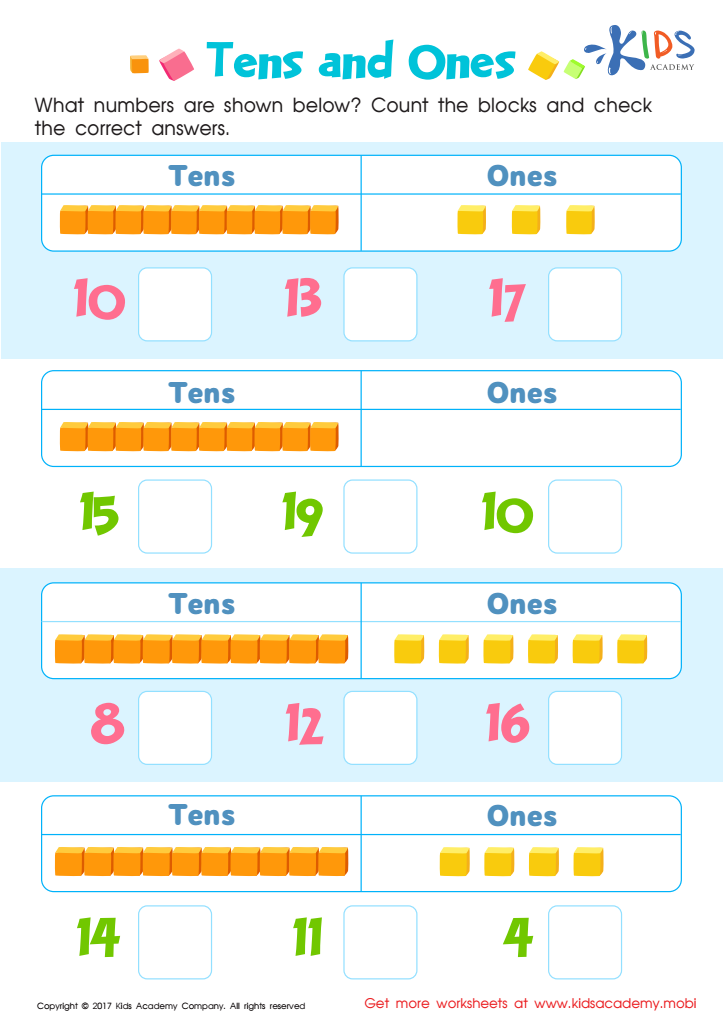
Tens and Ones Worksheet
Help your child make math fun with this worksheet! Count the blocks on both sides and enter the total in the box below the figures. This will help them overcome any math-related anxieties they might have and let them enjoy the learning process.
 Assign to My Students
Tens and Ones Worksheet
Worksheet
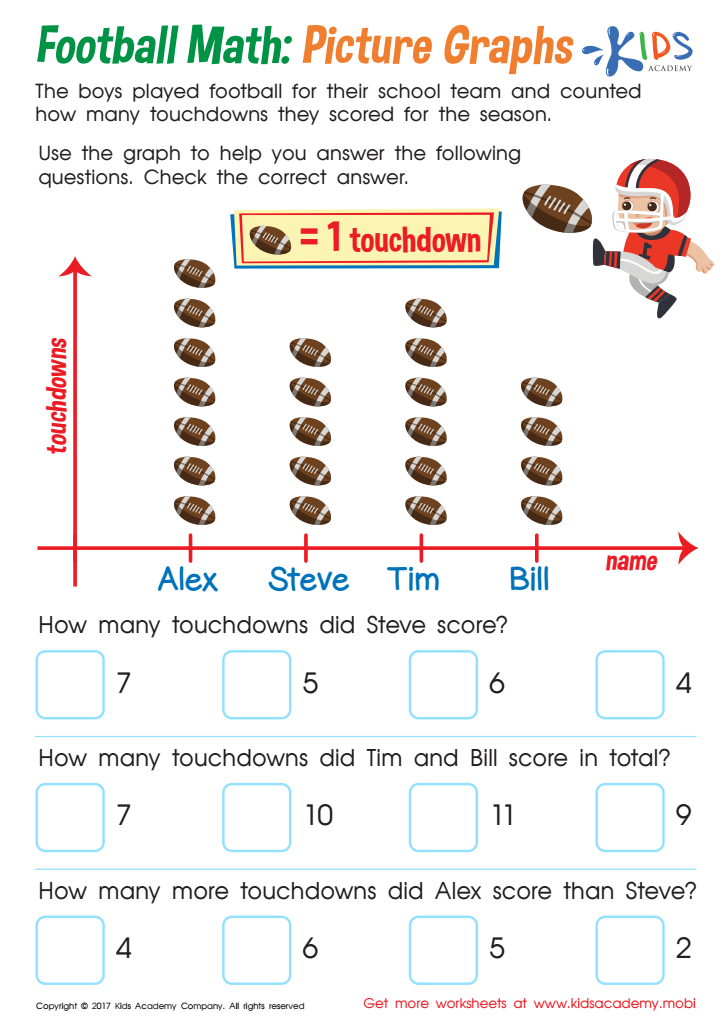
Football Math Worksheet
It uses football-themed data to compare teammates' touchdowns. Perfect for motivating your child and helping them learn to read graphs in a fun way!
Motivate your child to learn to read graphs with this fun and sporty picture graph worksheet! Football-themed data is used to compare teammates and their touchdowns, sure to delight your little sports fan. Perfect for teaching data analysis in an engaging way!
Football Math Worksheet
Worksheet
Join Kids Academy for Free
Who is primarily going to use this learning content?







Counting skills are foundational to a child's overall mathematical development and play a pivotal role in cognitive growth. For ages 4-8, enhancing counting skills is critical as it sets the stage for more advanced mathematical concepts such as addition, subtraction, and problem-solving. Here’s why parents and teachers should prioritize counting skills:
-
Numeracy Foundation: Proficiency in counting helps children understand basic numerical concepts, which is essential for progressing to more complex mathematics.
-
Cognitive Development: Counting activities engage and stimulate brain function, improving memory, concentration, and logical thinking skills.
-
Daily Life Skills: Understanding numbers is crucial for everyday tasks such as telling time, managing money, and following sequences, like steps in a recipe or directions.
-
Confidence and Curiosity: Mastering counting can boost a child's confidence. When kids feel successful in counting, they are more likely to tackle new challenges and show curiosity towards learning math.
-
Academic Success: Early math skills, particularly counting, are strong predictors of future academic success. Students who enter school already comfortable with numbers have an academic edge.
-
Problem-Solving and Critical Thinking: Early counting fosters problem-solving skills and logical reasoning, which are essential for success not just in math, but across all subject areas.
Parents and teachers should integrate fun and engaging counting activities into daily routines to help children develop these essential skills, setting them up for future success and a positive attitude toward learning.








