
Encourage attention to detail Worksheets for Ages 4-8
3 filtered results
Difficulty Level
Grade
Age
-
From - To
Subject
Activity
Standards
Welcome to our "Encourage Attention to Detail Worksheets for Ages 4-8"! These engaging, print-ready worksheets are designed to enhance young minds’ observational skills and attention to detail during essential developmental years. Our activities include matching games, picture puzzles, and coloring tasks that promote careful observation and critical thinking. Perfect for home or classroom use, these worksheets help children strengthen their ability to notice nuances and concentrate on intricacies in various subjects. Join us in making learning fun while cultivating essential skills that benefit your child's cognitive development. Explore a world of creativity and focus as your children learn to see the bigger picture!
Favorites
With answer key
Interactive
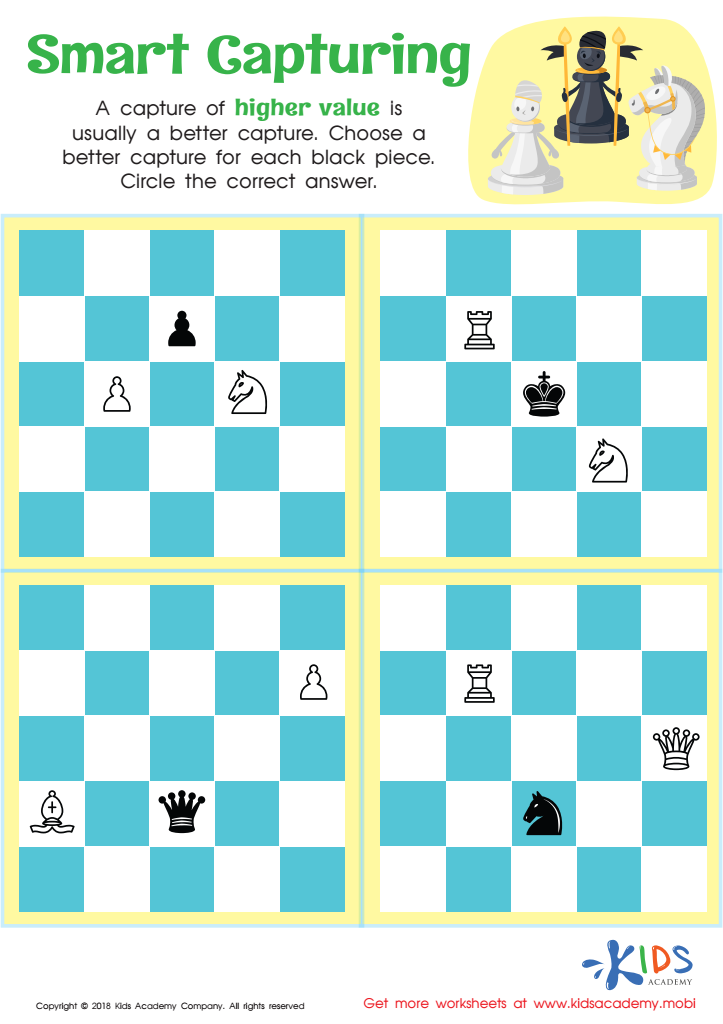
Smart Capturing Worksheet
Chess is a game of strategy and calculation. When presented with two captures, a player should always go for the one that yields the highest value. For example, taking a knight over a pawn. In this worksheet, your children will choose the best capture for each black piece. Ask them to circle the correct answers. (80 words)
 Assign to My Students
Smart Capturing Worksheet
Worksheet
Join Kids Academy for Free
Who is primarily going to use this learning content?








Encouraging attention to detail in children aged 4-8 is crucial for their overall development and learning. At this stage, children are naturally curious and eager to explore the world around them. By fostering careful observation and attention to detail, we help them develop critical thinking skills and enhance their ability to make connections between concepts. This attentiveness not only supports cognitive development but also lays the groundwork for problem-solving abilities as they learn to notice subtle differences and patterns.
Moreover, honing attention to detail assists in improving literacy and numeracy skills. When children pay attention to the intricacies of letters, numbers, and shapes, they increase their chances of academic success. This skill also plays a vital role in social interactions; as children become more observant, they learn to read body language and understand emotional cues, which deepens their relationships with peers and adults.
Parents and teachers who prioritize fostering attention to detail create environments that value curiosity and meticulousness. This encourages children to develop a sense of pride in their work, ultimately boosting their confidence and resilience. By nurturing these skills early on, we equip children with essential tools for lifelong learning and success.








