
Learning subtraction Worksheets for Ages 4-8
4 filtered results
Difficulty Level
Grade
Age
-
From - To
Subject
Activity
Standards
Introduce your child to the world of subtraction with our engaging Learning Subtraction Worksheets for Ages 4-8. Designed to build foundational math skills, these printable worksheets are packed with colorful graphics and fun activities tailored to young learners. Children will enjoy practicing subtraction through a series of enjoyable exercises, including simple word problems and visual aids. Our worksheets support gradual skill development, enhancing kids' problem-solving abilities and mathematical understanding in a playful way. Ideal for both classroom learning and home practice, these subtraction activities make math fun and accessible. Set your child on a path to math success today!
Favorites
With answer key
Interactive
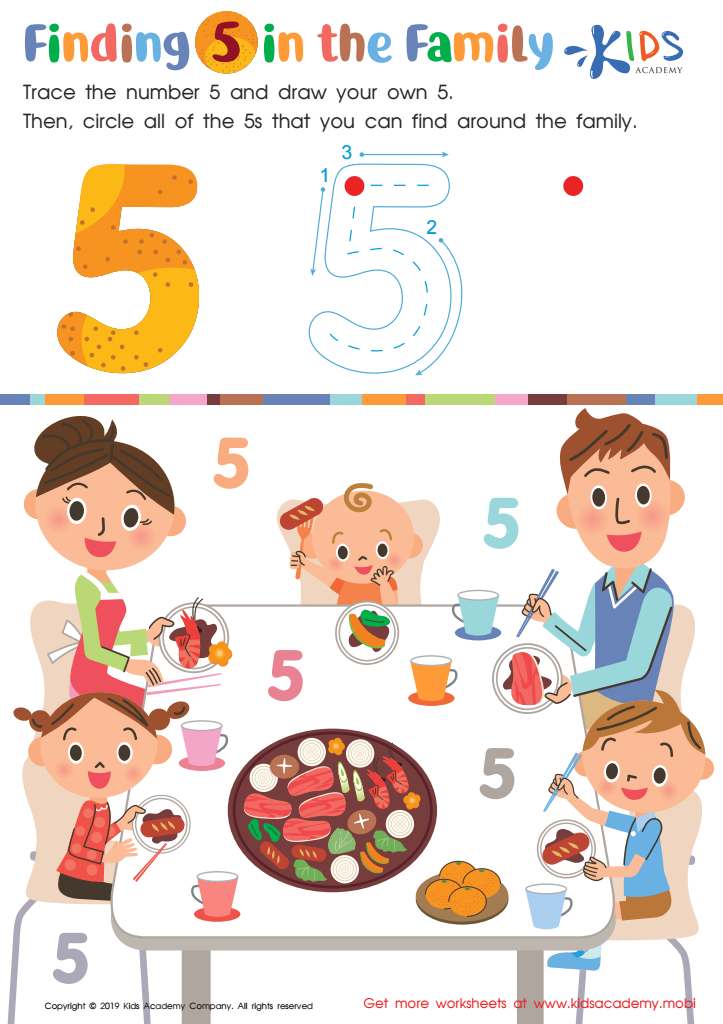
Finding 5 in the Family Worksheet
This worksheet helps kids identify and write the number 5. Ask what the family is doing and who the family members are. Help them trace and draw the 5, then have them circle all 5s in the picture.
 Assign to My Students
Finding 5 in the Family Worksheet
Worksheet
Join Kids Academy for Free
Who is primarily going to use this learning content?







Learning subtraction at an early age is a critical foundational skill for children ages 4-8, and both parents and teachers play crucial roles in this development. Subtraction is one of the four basic operations in mathematics, and mastering it early prepares children for more complex mathematical concepts they will encounter later in their academic journey. Moreover, understanding subtraction helps children grasp the idea of taking away, comparing quantities, and recognizing numerical relationships.
Beyond just math, the cognitive benefits of learning subtraction extend to problem-solving and logical thinking skills, which are essential for everyday tasks and decision-making. Early exposure fosters confidence and reduces math anxiety, creating positive attitudes toward learning.
Parents' and teachers' support in learning subtraction assists children in numerous ways. Hands-on activities, visual aids, and encouraging practice can make the learning process engaging and enjoyable. By incorporating subtraction exercises into daily routines, like counting toys or slices of pizza, adults can contextualize math in a way that is relatable and fun.
Ultimately, laying a strong foundation in subtraction during these formative years sets the stage for future academic success and empowers children with skills crucial for their overall development. Hence, it is essential for both parents and teachers to recognize and support the importance of early subtraction learning.








