
Practicing division Worksheets for Ages 4-8
3 filtered results
Difficulty Level
Grade
Age
-
From - To
Subject
Activity
Standards
Help your child master the basics of division with our engaging "Practicing Division Worksheets for Ages 4-8"! Designed specifically for young learners, these fun and educational worksheets foster the development of essential early math skills. From simple introduction exercises to more challenging problems, each worksheet provides clear instructions and colorful illustrations to keep children motivated. Our resources support a smooth transition into more complex math concepts, promoting confidence and problem-solving abilities. Perfect for both classroom and at-home learning, these printable worksheets align with age-appropriate learning standards, ensuring a comprehensive educational experience for your budding mathematician.
Favorites
With answer key
Interactive
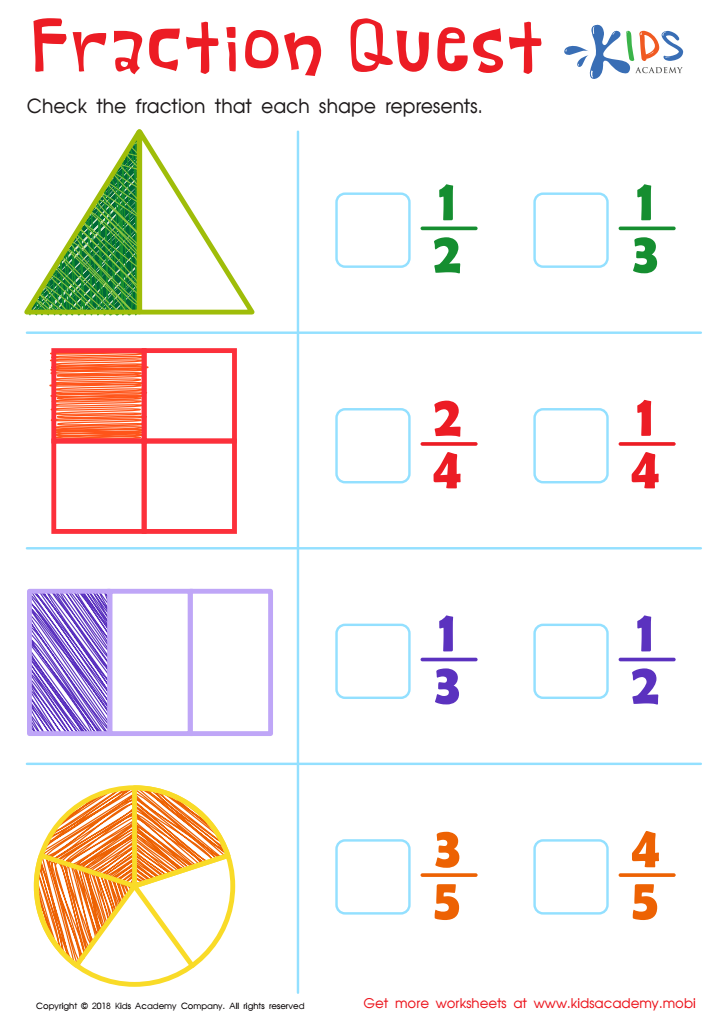
Fraction Quest Worksheet
This colorful and educative worksheet can help kids conquer their fractions struggles. Ask them to identify the four shapes, then the fractions they represent. They can then check the correct answers from the options given.
 Assign to My Students
Fraction Quest Worksheet
Worksheet
Join Kids Academy for Free
Who is primarily going to use this learning content?







Practicing division at an early age, particularly between 4-8, offers substantial benefits that can set a strong foundation for a child's mathematical understanding and overall cognitive development. At this impressionable age, children are especially receptive to learning new concepts, and introducing them to division helps instill critical thinking and problem-solving skills early on.
Learning division encompasses grasping the idea of sharing equally and understanding proportions, both of which are fundamental concepts not only in mathematics but in everyday life. By practicing division, children develop number sense, improve their ability to perform arithmetic operations accurately and help them understand the relationships between numbers, setting them on the right path for more complex math topics later on.
Implementing division exercises can also enhance children's logical reasoning abilities and encourage them to think analytically. This practice fosters patience and persistence, cultivating a disciplined mindset essential for tackling challenges in all walks of life. Most importantly, early mastery of division can boost a child's confidence and interest in math, reducing anxiety and creating a positive attitude towards learning.
Both parents and teachers have a pivotal role in nurturing these skills, guiding their children through interactive, fun, and supportive learning experiences that make division an integral and enjoyable part of their education journey.








