Telling time Worksheets for Ages 4-8
4 filtered results
-
From - To
Discover our engaging "Telling Time Worksheets for Ages 4-8," perfect for young learners! Our expertly crafted worksheets help kids grasp the crucial skill of reading clocks while having fun. Featuring bright, child-friendly designs and varying difficulty levels, our sheets cover everything from recognizing hours and minutes to understanding concepts of time. Ideal for teachers and parents, these printable resources support diverse learning styles and create enjoyable educational experiences. Enhance your child’s confidence and mastery in telling time with our comprehensive, easy-to-use worksheets today! Visit Kids Academy for a delightful learning adventure in one of life's essential skills.
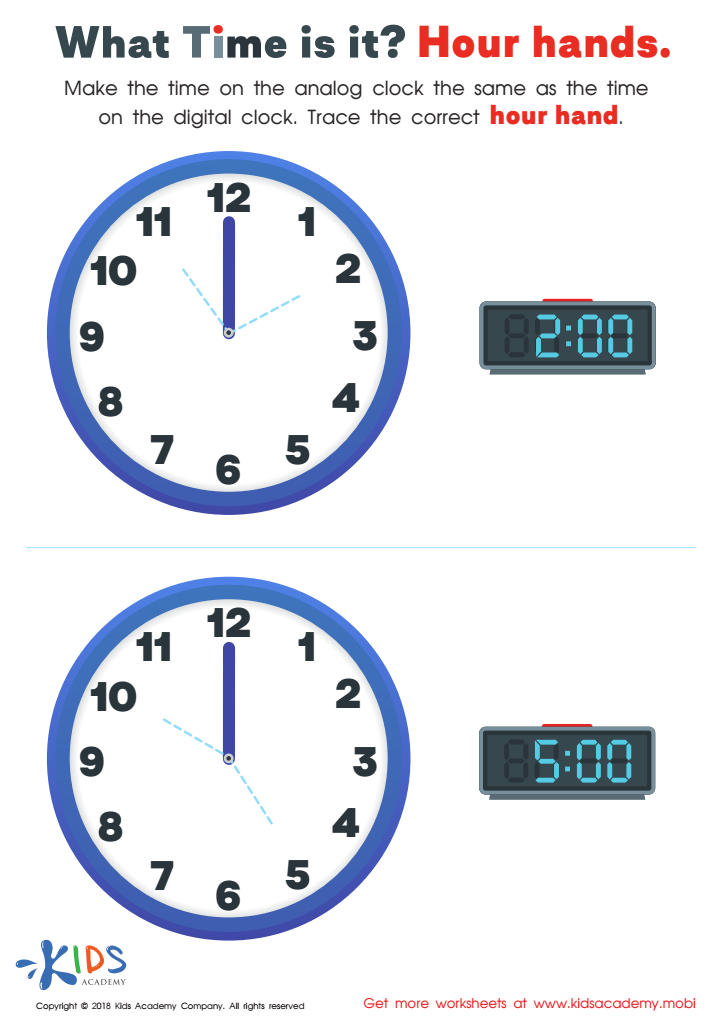
What Time Is it? Hour Hands Worksheet
 Assign to My Students








Telling time is a fundamental life skill that serves as a foundation for a child's cognitive and social development. For children ages 4-8, learning to tell time not only encourages numeracy and mathematical understanding but also fosters essential concepts of sequencing and scheduling. When parents and teachers emphasize time-telling skills, they help children develop a sense of structure and independence. Knowing how to read a clock allows kids to understand daily routines, which can make transitions smoother and reduce anxiety.
Moreover, the process of learning to tell time can enhance problem-solving and critical thinking abilities. As children practice distinguishing between different times and understanding the concepts of hours and minutes, they improve their fine motor skills and attention to detail. By integrating storytelling and interactive activities around time, educators can make the learning process engaging, which promotes better retention.
Finally, mastering time-telling sets children up for academic success. It is intricately linked to other subjects like science and history where timing and chronology are important. Whether coordinating playdates or adhering to school schedules, the ability to tell time enables young learners to navigate the world with confidence and responsibility, making it an invaluable skill that parents and teachers should prioritize.








