
Time-telling practice Worksheets for Ages 4-8
3 filtered results
Difficulty Level
Grade
Age
-
From - To
Subject
Activity
Standards
Help your child master time-telling skills with our engaging Time-telling Practice Worksheets designed for ages 4-8. These worksheets offer a variety of exercises to make learning to read analog and digital clocks fun and interactive. From identifying numbers on the clock face to setting the correct time, your learner will boost their confidence and accuracy in telling time. Perfect for classroom use or extra practice at home, our resources are tailored to build foundational time skills through colorful illustrations and challenging activities. Support your child's journey to becoming a time-telling pro with Kids Academy’s expertly crafted materials!
Favorites
With answer key
Interactive
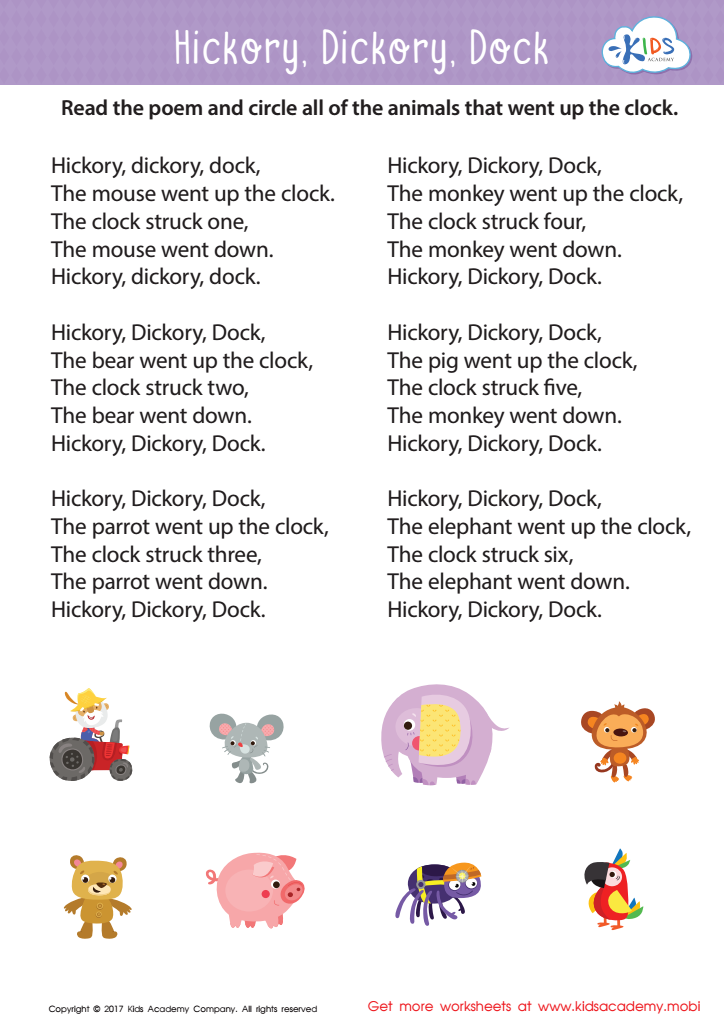
Hickory Dickory Dock Sequencing Worksheet
Help your child boost their reading skills with this fun Hickory Dickory Dock sequencing worksheet! They'll read and identify the animals in the right order, strengthening their story sequencing and comprehension skills.
Hickory Dickory Dock Sequencing Worksheet
Worksheet
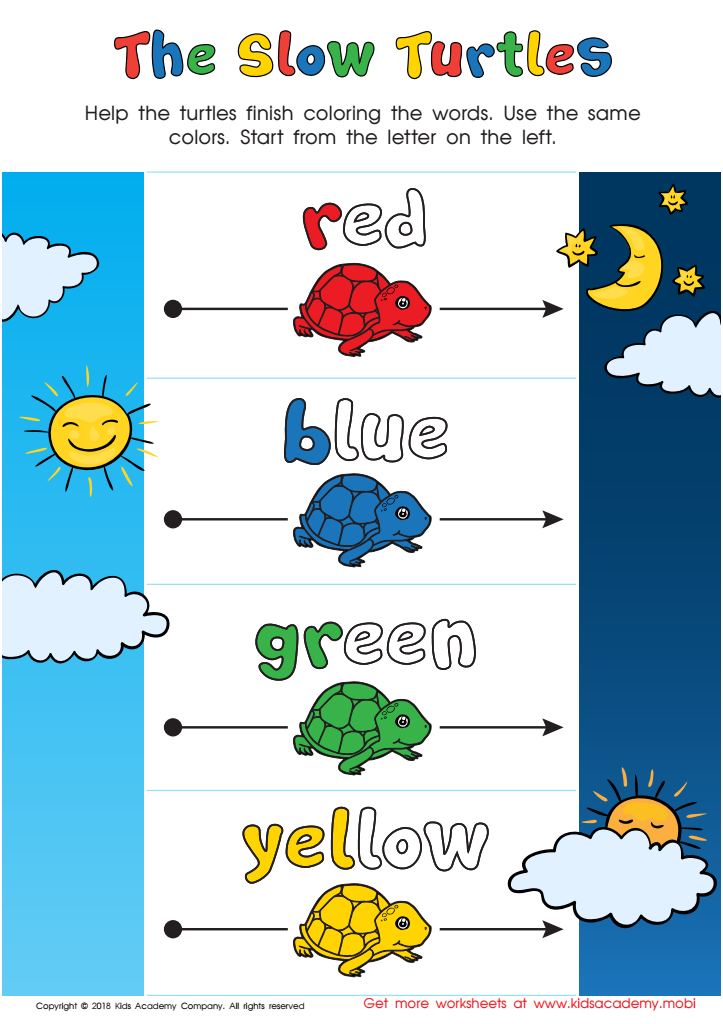
Read from Left to Right: Slow Turtles Worksheet
Can your students identify the animals in this worksheet? They're turtles! Ask if they know their characteristics – slow and living in shells. Guide them to color the words in the picture, starting from the letters on the left and using the turtles' color. Check they know turtles are slow and live in shells!
Download (PDF)
 Assign to My Students
Assign to My Students
Read from Left to Right: Slow Turtles Worksheet
Worksheet
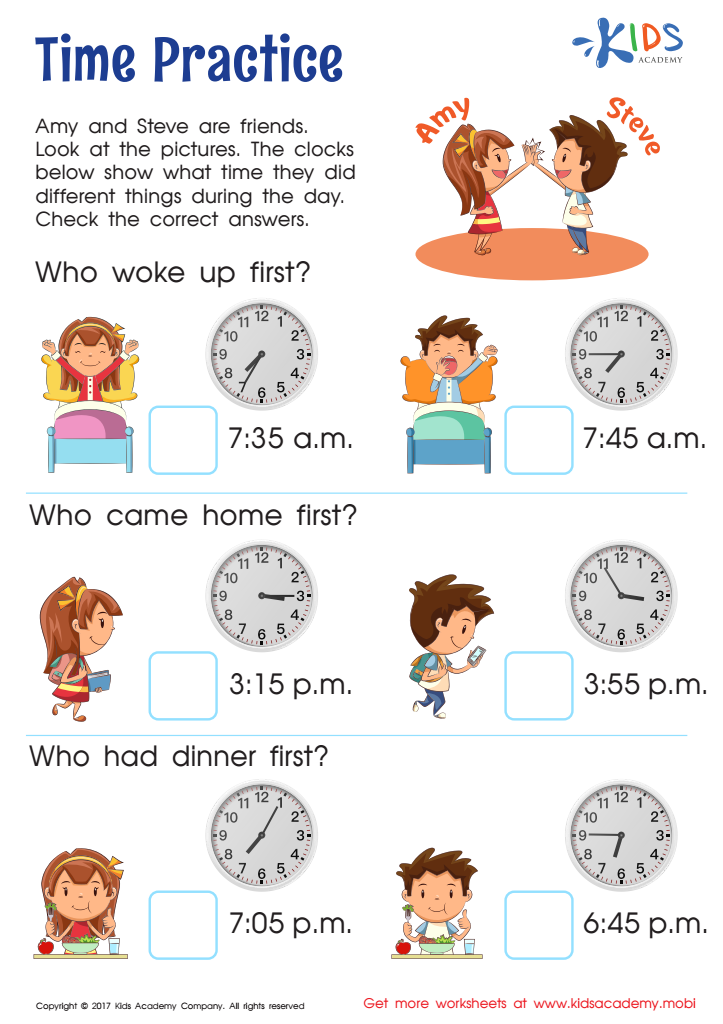
Time Practice Worksheet
It's perfect for 2nd graders as they gain a better understanding of time. Get them to tell the time on analog clocks, improve their math skills, and boost their confidence!
Second graders can brush up on timekeeping with our time practice worksheets. They'll learn to read minutes on analog clocks, honing math and confidence. Perfect for mastering this tricky concept!
Time Practice Worksheet
Worksheet
Join Kids Academy for Free
Who is primarily going to use this learning content?





Time-telling practice for children aged 4-8 is incredibly beneficial for several reasons, making it essential for both parents and teachers to actively support and encourage this skill. For starters, learning to tell time helps children grasp fundamental math concepts such as counting, sequencing, and the understanding of fractions—like a half-hour or quarter-hour. This aids in their overall numerical literacy, an important academic skill foundational for more advanced math later on.
Moreover, knowing how to tell time fosters a sense of responsibility and time management in young children. It empowers them to follow a schedule independently, which is crucial for school routines as well as day-to-day activities, including meal times, play sessions, and bedtime. When children understand time, they can better predict events and transitions, making them feel more secure and reducing anxiety associated with the unknown.
Practicing time-telling also enhances cognitive development, including spatial-temporal reasoning, which is crucial for subjects like science and technology. These skills are fundamentally linked to a child’s ability to problem-solve and think critically.
From a social perspective, time-telling aids in social interactions. It helps children to be punctual, an attribute that reflects respect for others' time and fosters healthier relationships.
Therefore, encouraging time-telling practices from an early age sets a strong educational foundation, nurtures important life skills, and promotes responsible, well-rounded development in children.








