Mathematical reasoning Adding up to 100 Worksheets for Ages 4-8
3 filtered results
-
From - To
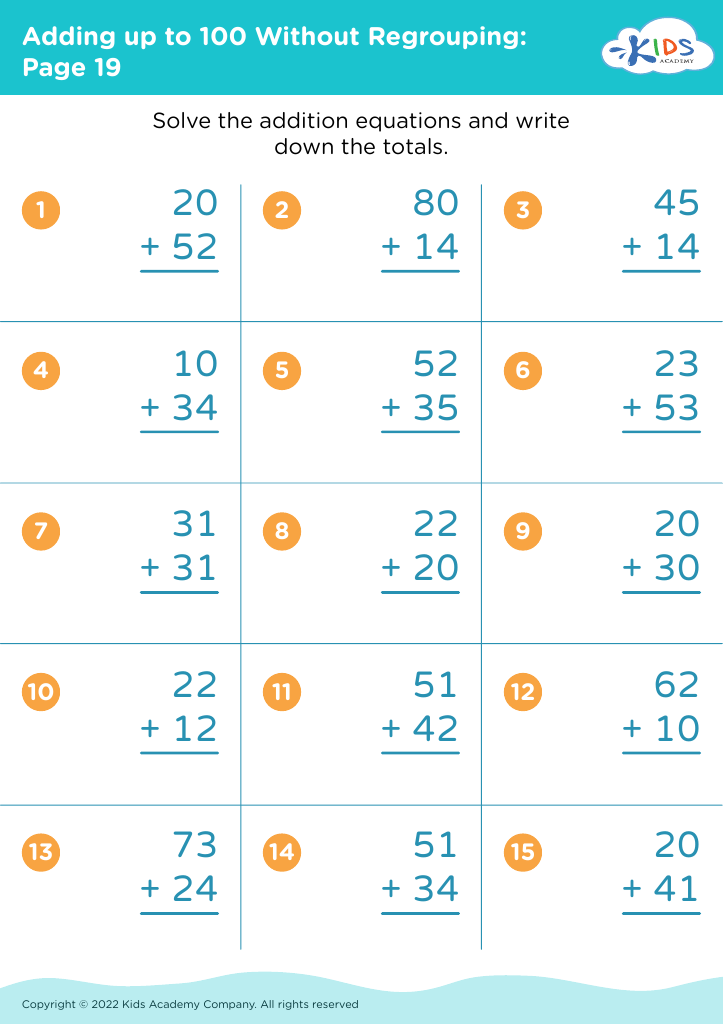
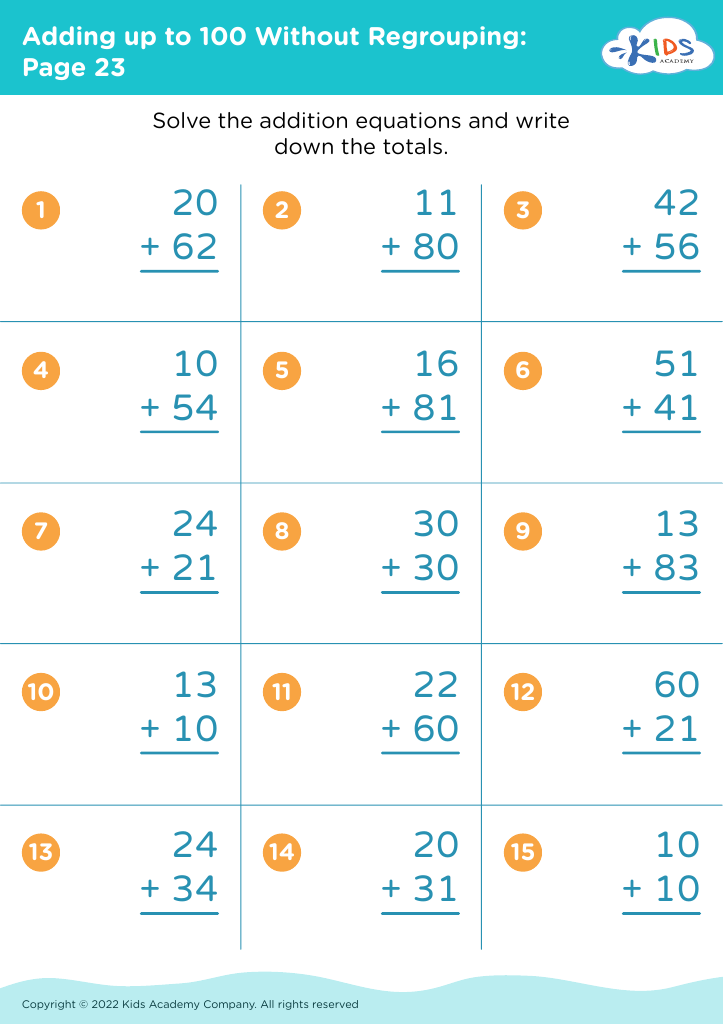
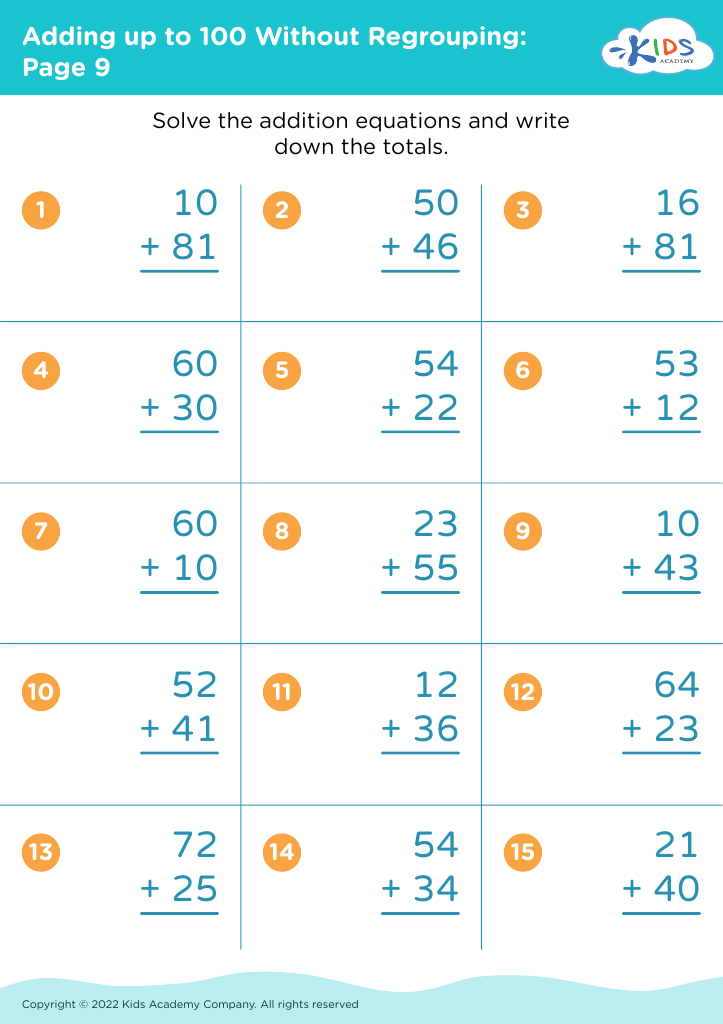
Enhance your child's numerical skills with our "Mathematical Reasoning: Adding up to 100 Worksheets for Ages 4-8." These printable worksheets are expertly designed to engage young learners in solving simple arithmetic problems, fostering their ability to understand, process, and apply mathematical concepts. Covering various techniques for addition, the activities boost critical thinking and problem-solving skills. Ideal for both home and classroom settings, these educational resources provide a fun and interactive way for kids to master the fundamentals of math, build confidence, and achieve their learning milestones with ease. Unlock your child’s potential in math today!






%20(1).jpg)
Mathematical reasoning, such as adding up to 100, is fundamental for children aged 4-8 because it lays the groundwork for future mathematical understanding and problem-solving skills. During these crucial early years, young learners' brains are exceptionally receptive to new information, making it an ideal period to establish strong numerical and cognitive foundations.
First, mastering addition up to 100 enhances basic arithmetic proficiency, necessary for everyday tasks and advanced math subjects like multiplication and division. This knowledge allows kids to build confidence in handling numbers, fostering a positive attitude towards mathematics generally.
Second, engaging in addition sharpens cognitive skills such as logical thinking, pattern recognition, and sequential processing. These skills are not only vital for math but also across other disciplines and real-life situations, where reasoning and problem-solving are required.
Third, early competence in mathematics boosts academic performance and creates a solid platform for future learning. Students who grasp foundational math concepts early are better equipped to tackle more complex topics as they progress in their education.
Lastly, early success in mathematical reasoning promotes perseverance and resilience. Children learn that effort and practice yield results, a mindset that can influence other areas of learning and personal development.
By prioritizing mathematical reasoning at a young age, parents and teachers can ignite curiosity, bolster self-esteem, and ensure children are well-prepared for their academic journey and everyday challenges.








