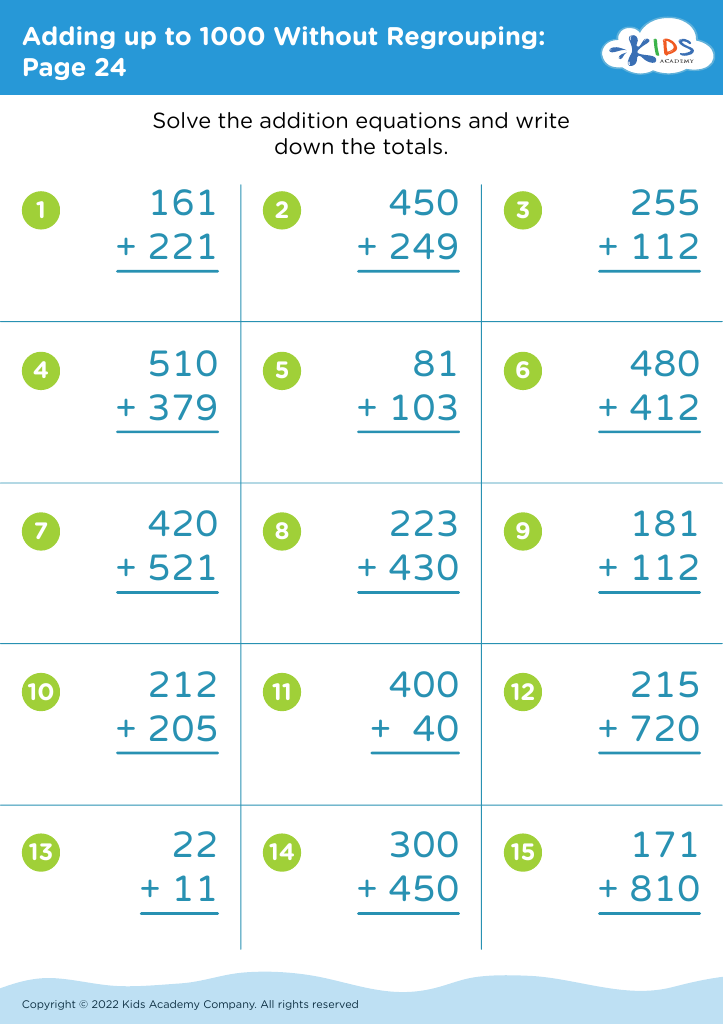
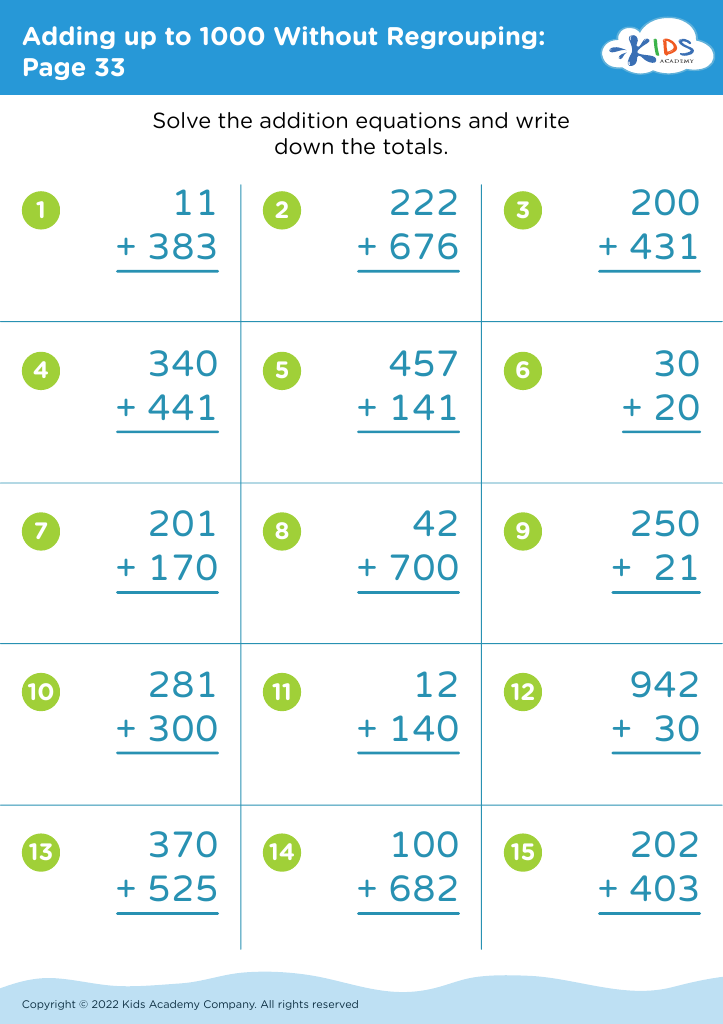
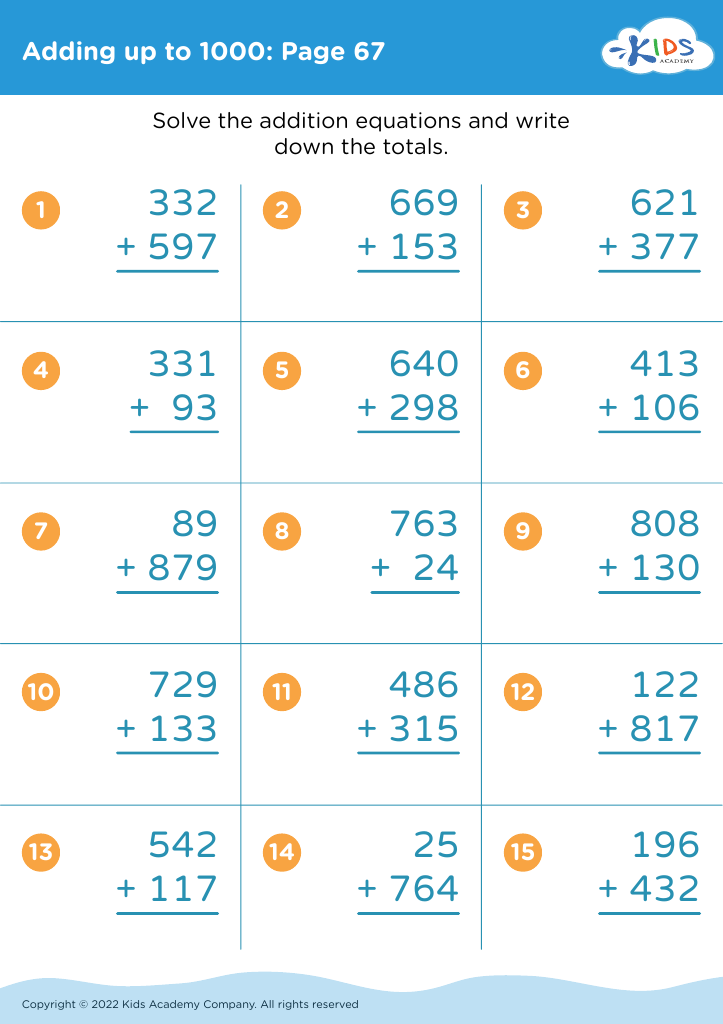




Adding up to 1000 is a crucial skill for children ages 4-8, as it lays the foundation for their mathematical development. At this age, children are naturally curious and eager to explore numbers. Teaching them how to effectively add numbers to reach 1000 helps build their confidence in math, promoting a positive attitude towards future learning.
Understanding addition at this level fosters critical thinking and problem-solving skills. As children practice reaching the target number of 1000, they engage in various strategies, which encourage mental computation and number sense. This groundwork prepares them for more complex mathematical concepts such as subtraction, multiplication, and even basic algebra.
Furthermore, educators and parents who focus on adding up to 1000 cultivate an environment of collaboration and communication. Activities can be framed as games or challenges, making learning enjoyable and interactive. Such engagement often leads to better retention of concepts as children see math as an exciting challenge rather than a chore.
Ultimately, prioritizing this skill helps children become numerically literate, a vital competency in today’s world. By investing time in mastering addition, adults help empower children not only in math but in developing innovative ways to approach everyday problems.








