
Comparison Skills Addition & Subtraction Worksheets for Ages 4-8
5 filtered results
Difficulty Level
Grade
Age
-
From - To
Subject
Activity
Standards
Explore our engaging "Comparison Skills Addition & Subtraction Worksheets" designed specifically for children ages 4-8. These vibrant, interactive worksheets help young learners strengthen their mathematical foundation by focusing on comparing numbers using addition and subtraction concepts. With a variety of activities and problems, students will develop essential skills in identifying greater than, less than, and equal to, all while enhancing their number sense. Tailored for early learners, our worksheets provide a fun and effective way to build confidence in math. Perfect for in-class use or at-home practice, these worksheets make learning an enjoyable adventure for young minds!
Favorites
With answer key
Interactive
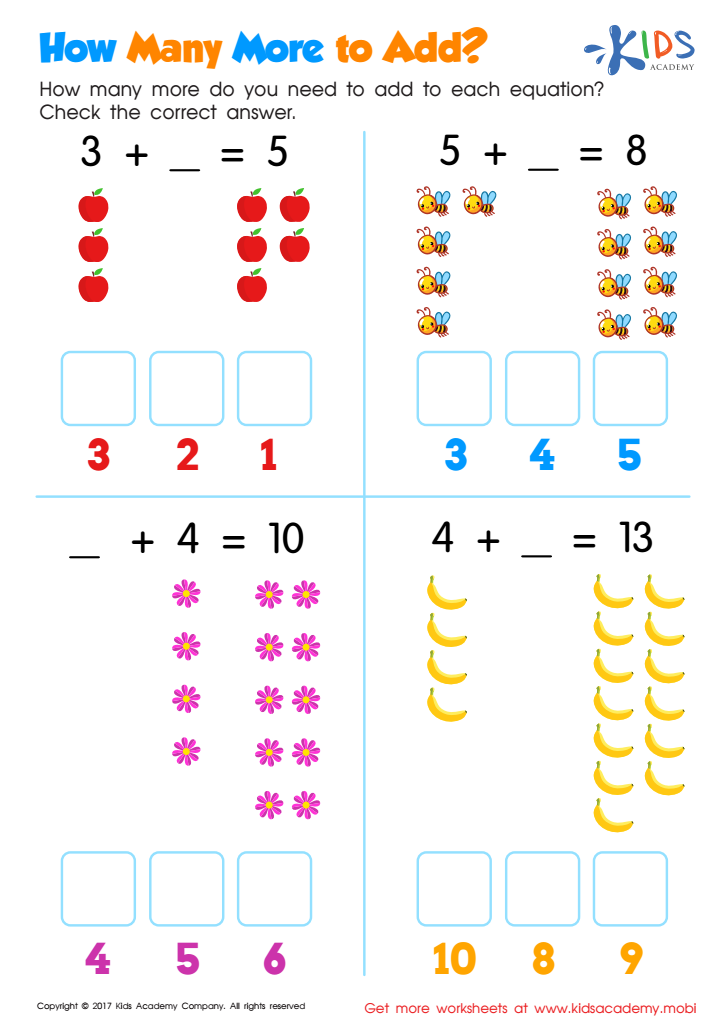
How Many More to Add Worksheet
Sharpen your child's math skills with this pdf worksheet. Help them figure out how many apples, bees, flowers and bananas are needed to reach the answer given. The possible answers are provided at the bottom of the boxes. Have some fun doing some addition and subtraction magic together and get those math skills sharpened!
 Assign to My Students
How Many More to Add Worksheet
Worksheet
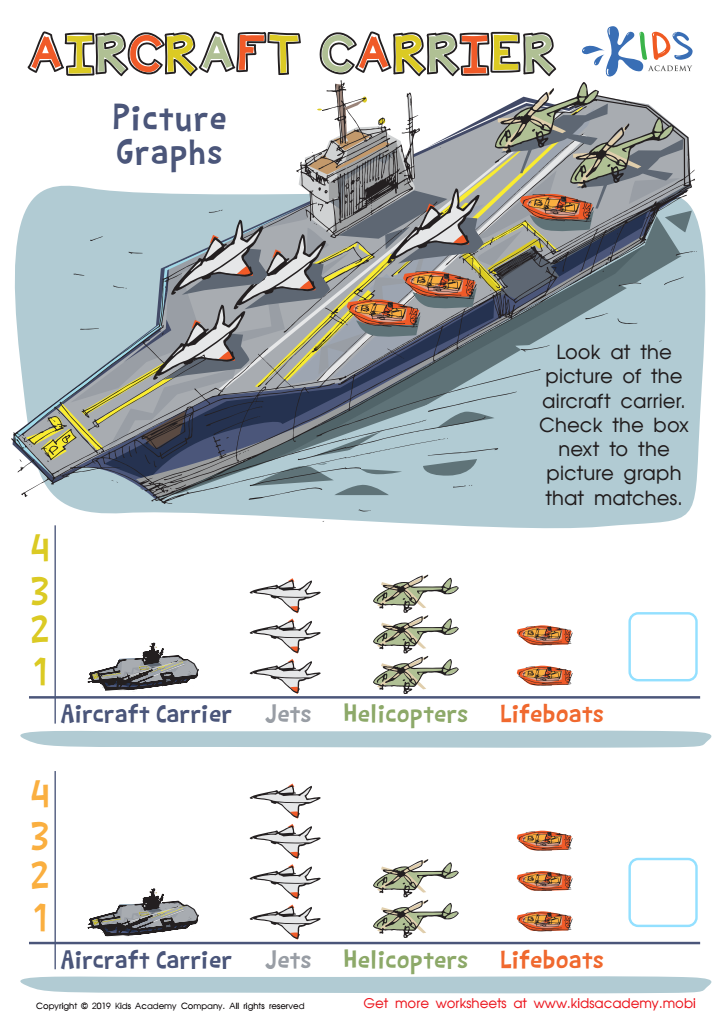
Aircraft Carrier Picture Graphs Worksheet
Kids love learning about jets and boats with this awesome worksheet! It's a great way to engage them as they work on picture graphs. Representing numerical values with pictures, this free PDF requires them to choose which picture graph and representation best match the carrier in the picture. It's also great practice for visual discrimination!
Aircraft Carrier Picture Graphs Worksheet
Worksheet
Join Kids Academy for Free
Who is primarily going to use this learning content?








Comparison skills in addition and subtraction are essential for children aged 4-8, as they lay the foundation for mathematical understanding and critical thinking. During these formative years, children begin to develop numeracy skills that will influence their academic trajectory. Comparison skills enable children to analyze quantities, discern differences and similarities, and make informed decisions based on numerical data.
These skills help children understand concepts such as "more than," "less than," or "equal to," which are fundamental in everyday problem-solving. For instance, when children compare groups of objects or tally scores in games, they practice making comparisons that reinforce their understanding of addition and subtraction. This leads to improved fluency in basic math operations and prepares them for more complex arithmetic tasks in later grades.
Additionally, fostering comparison skills enhances children's ability to approach real-world situations, like budgeting or cooking, where mathematical reasoning is required. Parents and teachers should care about this aspect of learning because it equips children with critical life skills, boosts their confidence in mathematics, and encourages a positive attitude toward learning. Strong comparison skills ultimately contribute to a child's overall cognitive development, setting them on a path to success in both math and beyond.








