
Mental math development Addition & Subtraction Worksheets for Ages 4-8
3 filtered results
Difficulty Level
Grade
Age
-
From - To
Subject
Activity
Standards
Help your child excel in math with our "Mental Math Development: Addition & Subtraction Worksheets for Ages 4-8". Curated by educational experts, these worksheets are designed to boost arithmetic skills and promote fast, accurate mental math. Each engaging activity combines learning with fun challenges, encouraging young minds to develop confidence and speed in addition and subtraction. Ideal for early learners, our resources align with foundational math standards, ensuring that your child builds a solid mathematical base. Perfect for at-home practice or classroom use, watch your child’s numerical abilities flourish with consistent practice. Start their arithmetic journey today!
Favorites
With answer key
Interactive
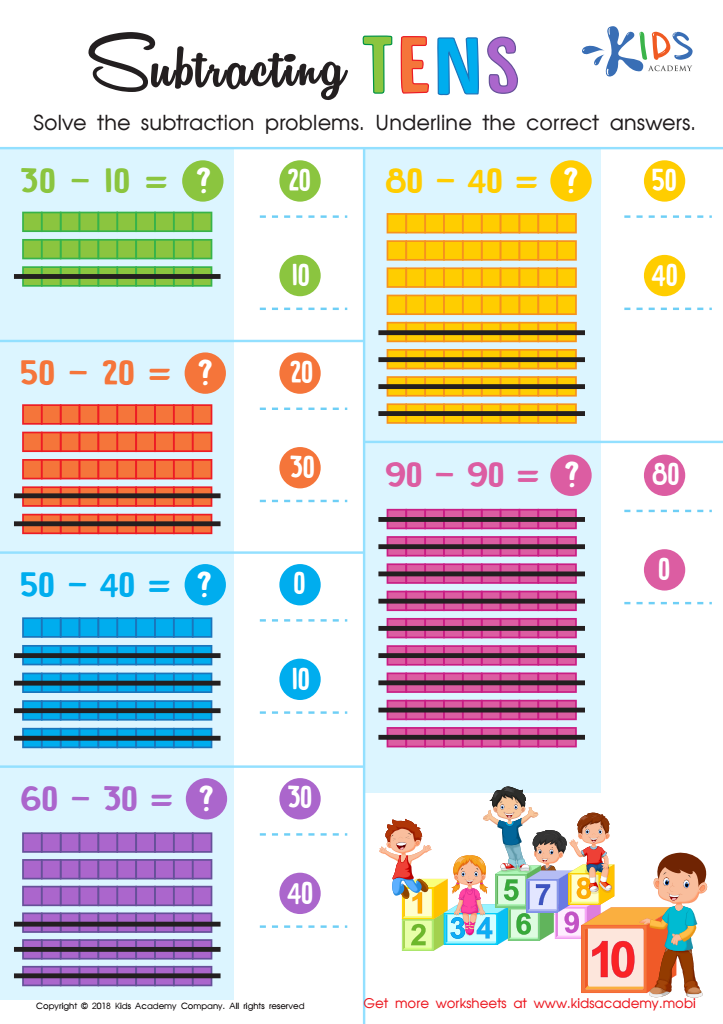
Subtracting Tens Worksheet
Base ten blocks enable kids to make practical math connections and develop number sense. This free worksheet, using bright-colored tens blocks, helps children learn to skip count and subtract. It lays a strong foundation for upcoming higher level math problems.
 Assign to My Students
Subtracting Tens Worksheet
Worksheet
Join Kids Academy for Free
Who is primarily going to use this learning content?








Mental math development in addition and subtraction for children ages 4-8 is crucial because it lays the foundation for their future mathematical skills. When children develop the ability to perform basic operations in their minds, they enhance their number sense, which is understanding numbers and how they relate to each other. This early proficiency fosters stronger cognitive skills, such as memory, attention, and problem-solving, all of which are essential in various aspects of life and learning.
Moreover, mental math encourages children to approach problems flexibly and creatively. It helps them develop strategies and patterns that make learning more understandable and less intimidating. By mastering these skills at a young age, children can build confidence in their mathematical abilities, reducing math anxiety and promoting a positive attitude toward learning.
For parents and teachers, focusing on mental math development is an investment in a child's academic future. It prepares children for more complex mathematical concepts they will encounter in higher grades. Teachers can incorporate fun and engaging activities like games and challenges to make learning enjoyable and effective, while parents can practice with children in everyday situations to reinforce these skills. Overall, cultivating mental math skills early on empowers children to succeed academically and in everyday life.








