
Understanding money Addition & Subtraction Worksheets for Ages 4-8
4 filtered results
Difficulty Level
Grade
Age
-
From - To
Subject
Activity
Standards
Enhance your child's math skills with our "Understanding Money: Addition & Subtraction Worksheets for Ages 4-8". These engaging, colorful worksheets are designed to make learning fun and interactive, helping children understand and practice essential math concepts related to money. Our resources focus on simple addition and subtraction with coins and bills, preparing kids for real-world situations. Perfect for classroom or home use, these printable activities cater to young learners’ needs by developing both their numerical and financial literacy. Boost your child's confidence and knowledge in math by integrating these educational worksheets into their routine today.
Favorites
With answer key
Interactive
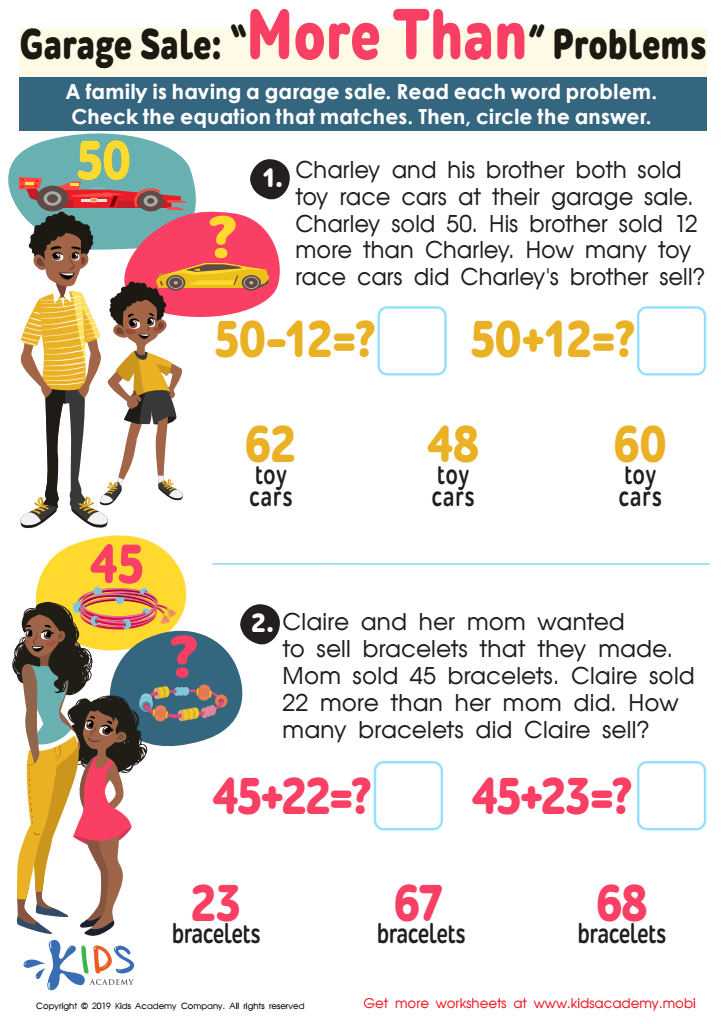
Garage Sale - More yhan Worksheet
The whole family can join in on the fun with this free worksheet! It helps kids practice math word problems while assisting their friends with a garage sale. Kids learn to identify "More Than" key words and pick the right equation, improving their order of operations skills. Download the PDF and get started!
 Assign to My Students
Garage Sale - More yhan Worksheet
Worksheet
Join Kids Academy for Free
Who is primarily going to use this learning content?








Understanding money, along with addition and subtraction, is essential for young children aged 4-8 as it lays the foundation for critical life skills. Early exposure to these concepts helps cultivate financial literacy, preparing children for real-world scenarios involving money. Whether it’s buying groceries, saving pocket money, or planning a simple budget, these skills are critical for responsible financial behavior.
Teaching kids the value of money enhances their numerical skills and boosts cognitive development. Activities that include counting coins or calculating simple change also improve practical math skills. These foundational math skills are crucial, as they make learning more advanced mathematical concepts easier later in life.
For parents and teachers, integrating money lessons with addition and subtraction in fun, hands-on activities can significantly enhance a child's learning experience. Games, role-playing as mini-storekeepers, and using play money can make learning engaging and relevant.
Moreover, grasping these concepts early fosters independence and confidence in children. It encourages them to make informed decisions and understand the importance of money management. For educators and parents alike, emphasizing money addition and subtraction equips children with essential skills needed for puzzle-solving, analytical thinking, and handling everyday tasks efficiently. This prepares them for future academic pursuits and life challenges.








