
Enhance logical thinking Math Worksheets for Ages 4-8
4 filtered results
Difficulty Level
Grade
Age
-
From - To
Subject
Activity
Standards
Unlock your child's potential with our "Enhance Logical Thinking Math Worksheets for Ages 4-8." Designed by education experts, these engaging worksheets help young learners build a solid foundation in math through playful exercises that stimulate critical thinking and problem-solving skills. Perfect for pre-school and early elementary students, our activities feature fun puzzles, games, and challenges tailored to keep children engaged while supporting their logical reasoning development. Encourage growth through vibrant, hands-on activities that make learning enjoyable and effective. Dive into a world where math meets creativity, and watch your child excel with confidence and enthusiasm!
Favorites
With answer key
Interactive
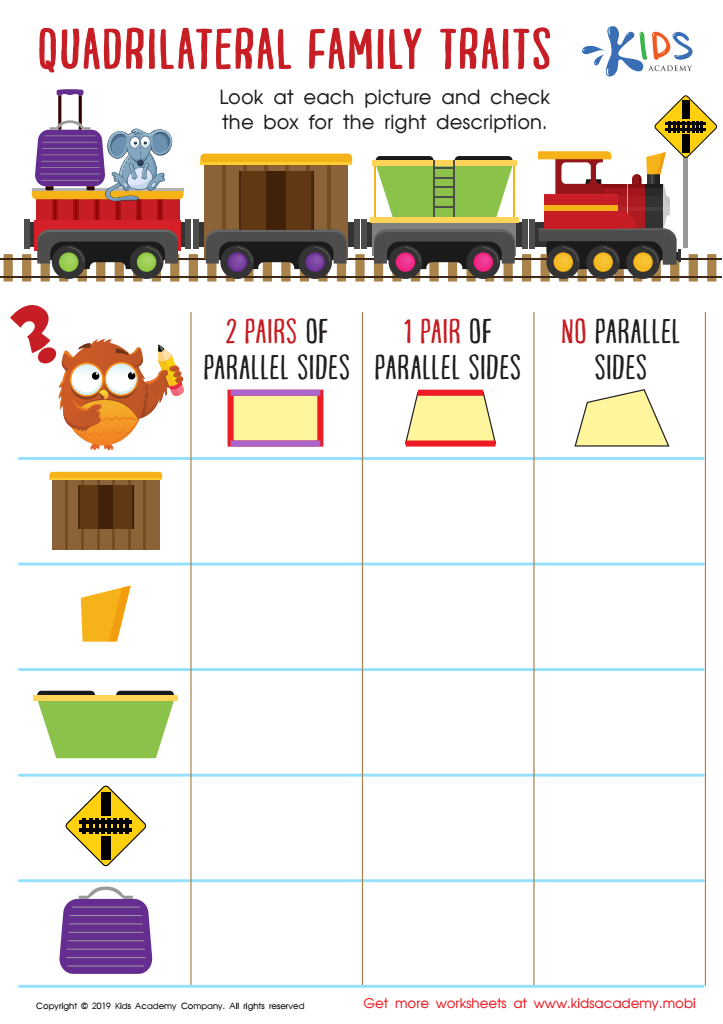
Quadrilateral Family Traits Worksheet
Review with your students what a quadrilateral is: four sides and angles. Now, go through the worksheet with them. Look at the pictures and help them check the boxes to identify the shapes.
 Assign to My Students
Quadrilateral Family Traits Worksheet
Worksheet
Join Kids Academy for Free
Who is primarily going to use this learning content?








Enhancing logical thinking through math for ages 4-8 is crucial for several reasons. At this developmental stage, children's brains are highly receptive to new concepts and ways of thinking. Math is more than just numbers and equations; it fosters logical reasoning, critical thinking, and problem-solving skills that are essential for daily life and future academic success.
Introducing logical thinking through math activities helps build a strong foundation for understanding complex concepts later. It encourages kids to recognize patterns, make connections, and understand cause and effect. These skills are transferable to other subjects like science and reading, thus supporting overall intellectual development.
Moreover, this early math proficiency boosts confidence and fosters a positive attitude toward learning. When children figure out how to solve problems independently, it builds their belief in their capabilities. This self-efficacy is vital for facing challenges not only in academics but in life.
Parents and teachers play a critical role in creating a stimulating environment where mathematical thinking is encouraged through playful, hands-on activities and real-life application rather than rote learning. This engaging approach makes the subject enjoyable while deeply rooting logical thinking skills, ensuring that children are equipped with essential cognitive tools for their future.








