
Improving drawing skills Math Worksheets for Ages 4-8
3 filtered results
Difficulty Level
Grade
Age
-
From - To
Subject
Activity
Standards
Enhance your child's drawing skills with our engaging Math Worksheets designed for ages 4-8. These carefully crafted resources provide a fun and interactive way for young learners to combine creativity with critical thinking. Our worksheets encourage children to practice their fine motor skills while exploring mathematical concepts such as shapes, patterns, and spatial awareness. With a variety of activities, including connect-the-dots, shape tracing, and more, your little artist will build confidence and develop essential drawing skills. Perfect for at-home learning, these worksheets not only foster artistic expression but also reinforce foundational math knowledge. Inspire your child's creativity today!
Favorites
With answer key
Interactive
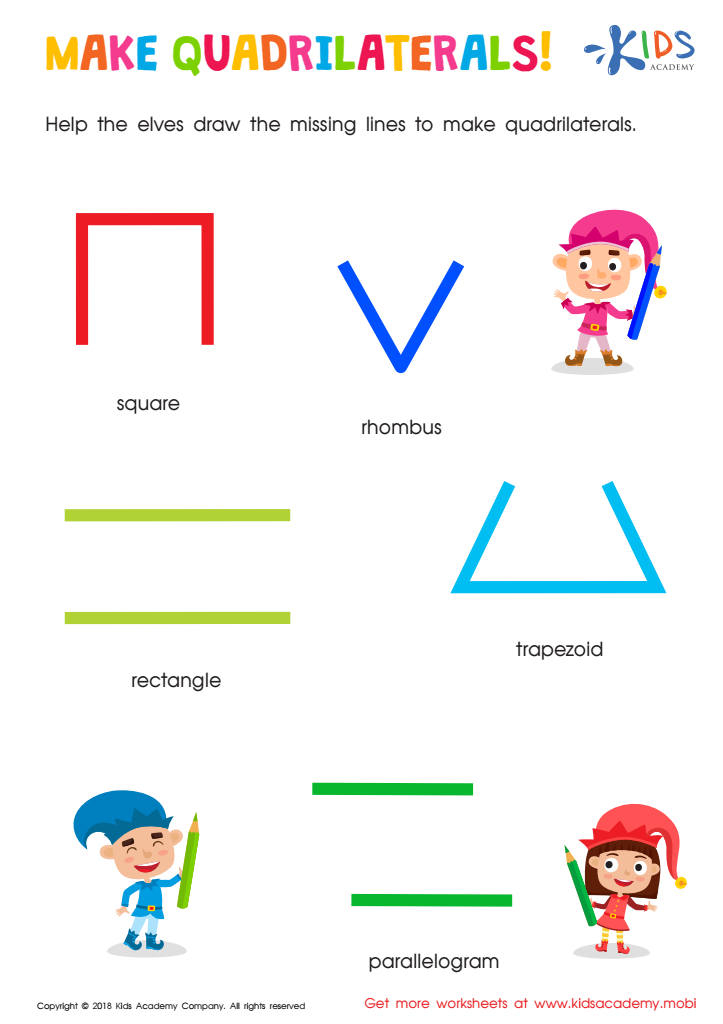
Make Quadrilaterals Worksheet
This fun and colorful worksheet will help your child understand and identify quadrilaterals. It's simple and encourages them to draw lines to create a square, rectangle, rhombus, trapezoid, and parallelogram. Stimulate their minds and watch them learn while they have fun!
 Assign to My Students
Make Quadrilaterals Worksheet
Worksheet
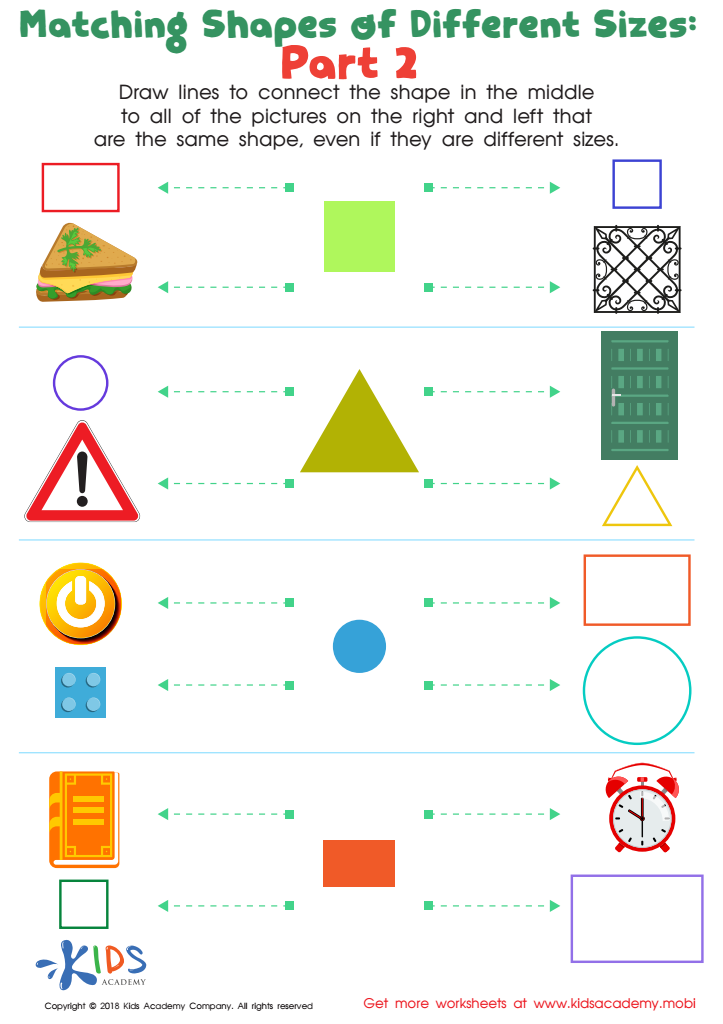
Geometry: Part 2 Worksheet
Third grade geometry gets a challenge with this free worksheet. Kids match shapes to everyday objects like sandwiches, alarm clocks and books for a better understanding of geometry in their lives. Printable pdf is included.
Geometry: Part 2 Worksheet
Worksheet
Join Kids Academy for Free
Who is primarily going to use this learning content?








Improving drawing skills in young children, particularly in the context of mathematics, plays a crucial role in their cognitive and creative development. At ages 4-8, children are developing essential skills that lay the foundation for future learning. Drawing is not just a fun activity; it enhances fine motor skills, hand-eye coordination, and promotes creativity.
When integrated with math, drawing can help children visualize mathematical concepts, making abstract ideas more concrete. For example, drawing shapes, counting objects, or illustrating problems helps solidify understanding and retention of mathematical concepts. Visual representation aids in solving problems, encourages critical thinking, and enables children to communicate their understanding effectively.
Furthermore, encouraging drawing as part of math activities fosters a positive attitude toward learning. Children develop confidence and enthusiasm when they can express mathematical ideas visually. This interdisciplinary approach aligns with diverse learning styles, catering to visual and kinesthetic learners who thrive on hands-on activities.
In summary, parents and teachers should care about enhancing drawing skills within math contexts, as it supports overall cognitive growth, fosters a love for learning, and builds a solid foundation for future academic success while nurturing creativity and problem-solving abilities.








