
Money identification Math Worksheets for Ages 4-8
4 filtered results
Difficulty Level
Grade
Age
-
From - To
Subject
Activity
Standards
Discover our engaging Money Identification Math Worksheets designed for children ages 4-8! These fun and interactive worksheets help young learners recognize and understand the values of different coins and bills. Tailored to enhance their counting proficiency and money management skills, our resources make learning about money an enjoyable experience. With a variety of activities that challenge their knowledge at an age-appropriate level, these worksheets are perfect for classroom use or at-home learning. Encourage your child’s independence and confidence in handling money as they develop essential skills that will benefit them for a lifetime. Start exploring today and watch them thrive!
Favorites
With answer key
Interactive
Money: Coins Dollars Printable
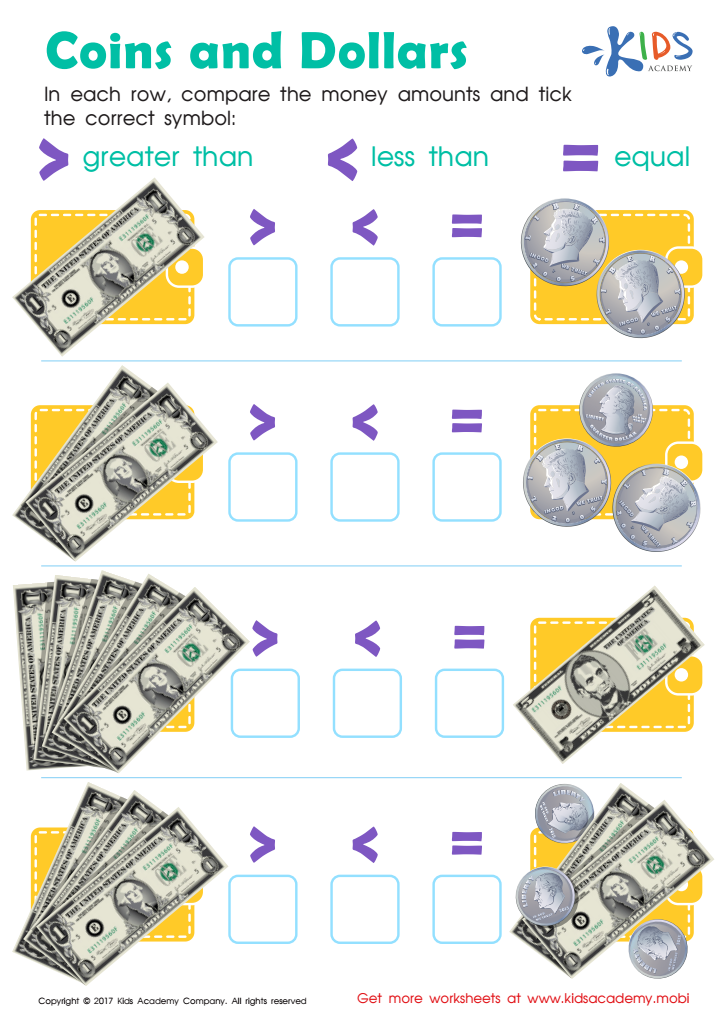
Motivate your kid to learn and practise essential math skills, like 'greater than' and 'less than', by introducing the importance of money! The money worksheet "Coins and Dollars" will give them a hands-on experience of counting coins and dollars, making math symbols more memorable.
 Assign to My Students
Money: Coins Dollars Printable
Worksheet
Picking the Coins You Need Money Worksheet
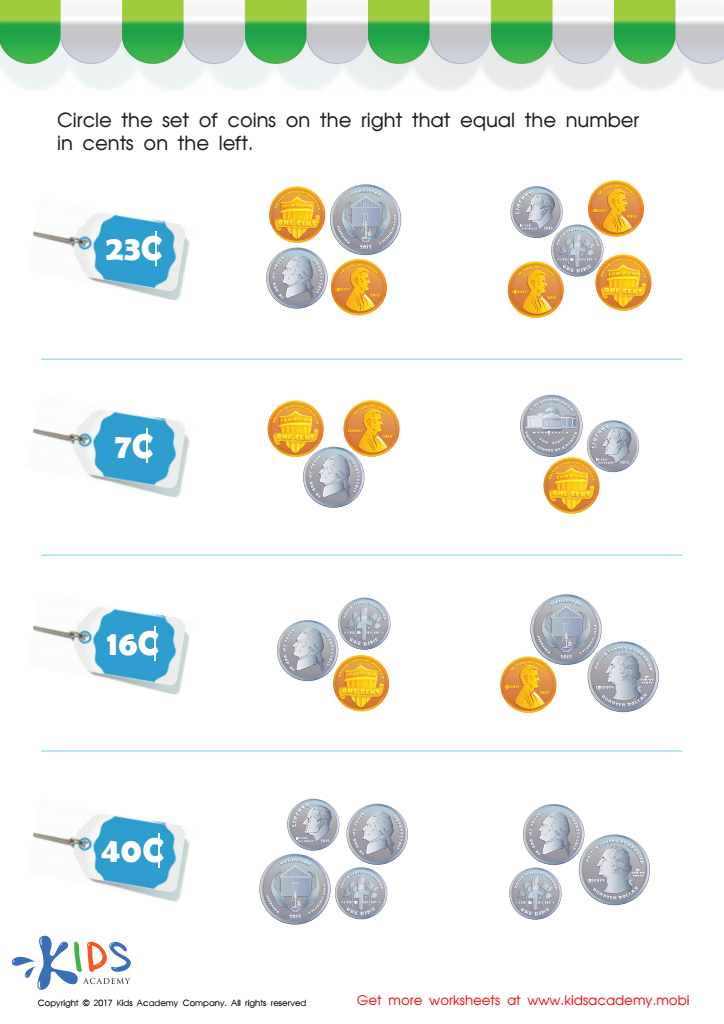
Let's learn to count money with Parents and Kids Academy! Investigate a real shop together: buy a globe, pencils, books, and a school bag using coins. Then, circle the coins you'll need. Visit our website for more free and fun money games for kids!
Picking the Coins You Need Money Worksheet
Worksheet
Join Kids Academy for Free
Who is primarily going to use this learning content?







Money identification math is crucial for children aged 4-8 as it lays the foundation for essential life skills related to financial literacy. At this stage, children are naturally curious and learn best through engaging, hands-on experiences. Teaching them to identify coins and bills fosters not just recognition but also an understanding of worth, value, and basic arithmetic.
Developing money skills enhances math proficiency, introducing concepts such as addition, subtraction, and making change. These are important cognitive skills that contribute to overall mathematical understanding. Furthermore, early exposure to money management concepts nurtures responsibility and independence; children begin to grasp budgeting, saving, and spending wisely.
Parents and teachers play an influential role in shaping children’s perceptions of money. By integrating money identification into everyday activities, they can create opportunities for practical learning. Whether it's setting up a pretend store, using real coins to “buy” items, or involving them in shopping decisions, these interactions deepen children’s understanding.
Ultimately, equipping children with money identification skills fosters confidence and prepares them for future financial challenges. This foundational knowledge not only helps them in academics but also equips them for real-world money management as they mature. Making this a priority enhances their overall development and encourages responsible citizenship.








