
Number Matching Math Worksheets for Ages 4-8
4 filtered results
Difficulty Level
Grade
Age
-
From - To
Subject
Activity
Standards
Boost your child's numerical skills with our engaging Number Matching Math Worksheets for ages 4-8. These meticulously crafted worksheets from Kids Academy help develop essential math foundations by having young learners match numbers to corresponding quantities. Designed to align with early learning standards, these printable activities make math practice fun and interactive. Children will enhance their counting, number recognition, and fine motor skills while gaining confidence in their mathematical abilities. Ideal for preschoolers and elementary students, our worksheets are a perfect resource for both classroom teaching and at-home learning. Make math exciting with Kids Academy today!
Favorites
With answer key
Interactive
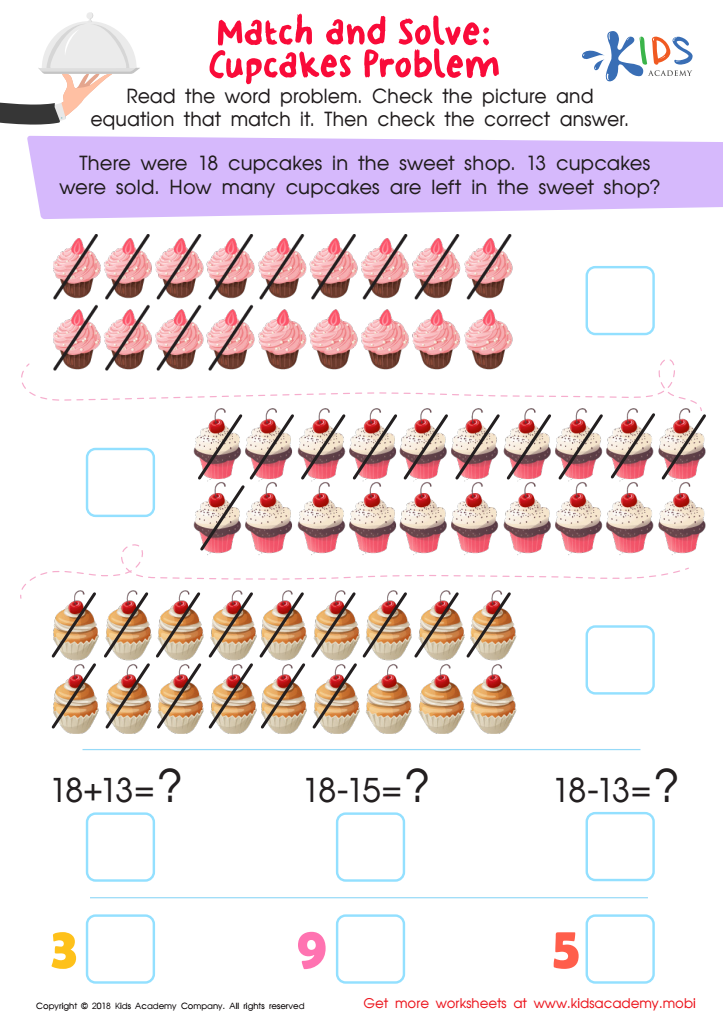
Match and Solve: Cupcakes Problem Worksheet
This math worksheet will excite your kid! Read the word problem and look at the cupcakes; the slashes mean some are being taken away. Select the picture that matches the text, then complete the equation to find the solution!
 Assign to My Students
Match and Solve: Cupcakes Problem Worksheet
Worksheet
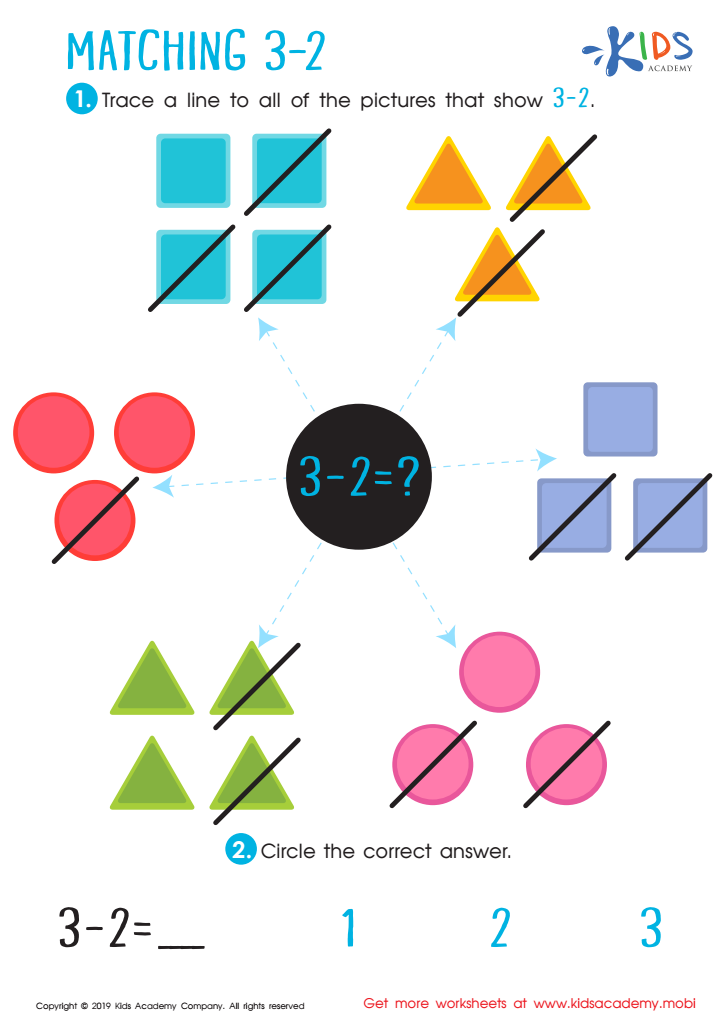
Matching 3-2 Worksheet
Subitizing is the ability to quickly identify sets of items without counting. It's a key skill for young learners to cultivate number sense. This worksheet takes it further, with 3-2=1 number sentences. Look at the sets of counters with slashes to decide which illustrate the sentence. Draw a line from the sentence in the middle to the right images to finish the page!
Matching 3-2 Worksheet
Worksheet
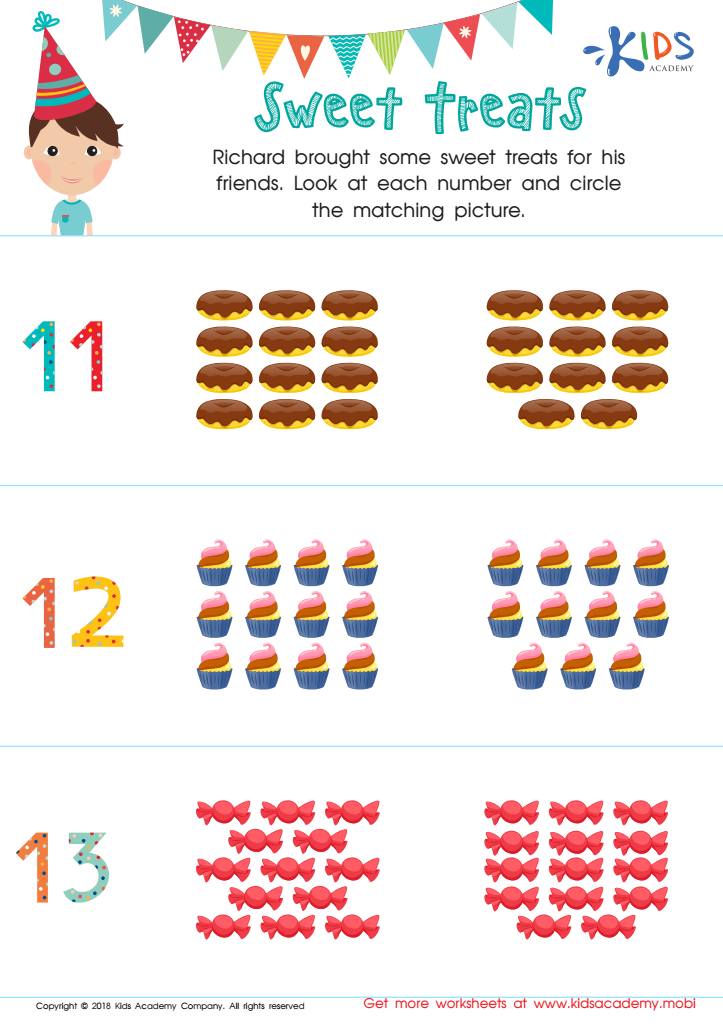
Kindergarten Math Worksheet Matching Numbers
Counting is fun with these kindergarten math worksheets! Richard brought cupcakes and candy - help your child count each treat and circle the picture that matches the number. Let the party begin!
Kindergarten Math Worksheet Matching Numbers
Worksheet
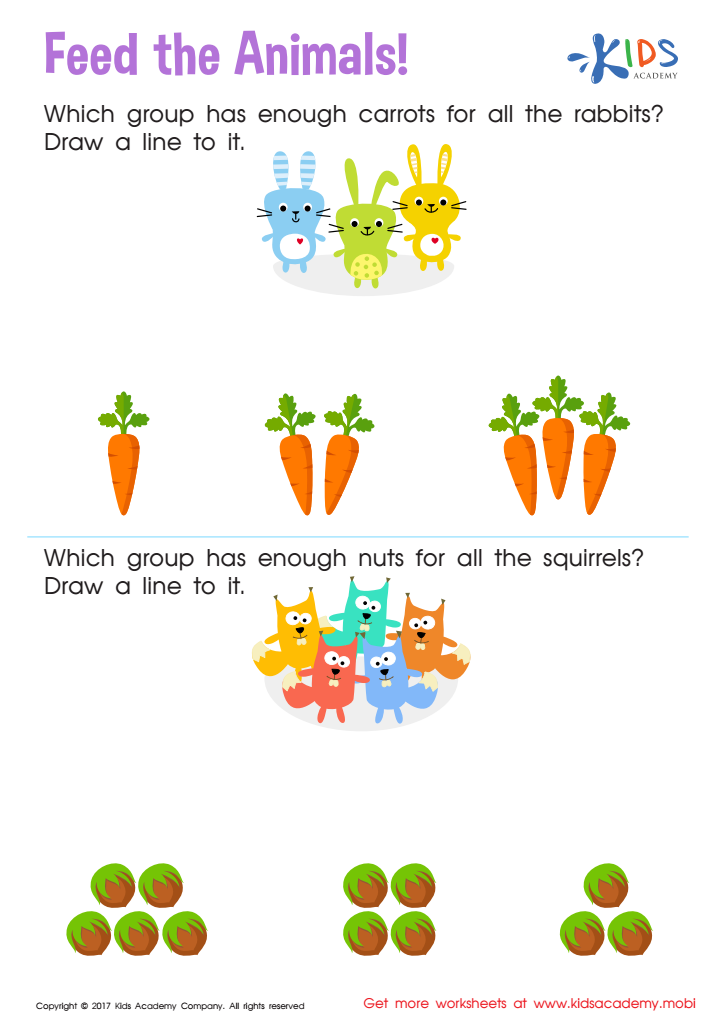
Count and Match: Feed the Animals Worksheet
Learning and growing involves more than just numbers, phonics and comparison. This Feed the Animals worksheet helps kids to exercise their reasoning skills. They must work out how many rabbits and carrots there are, and then repeat the process for the squirrels. This encourages problem solving and counting skills.
Count and Match: Feed the Animals Worksheet
Worksheet
Join Kids Academy for Free
Who is primarily going to use this learning content?








Number matching activities play a crucial role in the early mathematical development of children aged 4-8. At this stage, children are developing key cognitive skills, and number matching helps to solidify these foundational concepts in a fun and engaging way.
First and foremost, number matching fosters essential number recognition and counting skills. By regularly engaging in these activities, children learn to associate symbols with quantities, enhancing their understanding of numerical representation. This basic skill is a building block for more complex mathematical knowledge.
Additionally, number matching promotes problem-solving and critical thinking. When children try to connect numbers that belong together, they inherently engage in logical reasoning. This nurtures their ability to think systematically and enhances their comprehension in other academic areas as well.
Importantly, number matching also helps in developing fine motor skills. As young children handle cards, counters, or other interactive objects, they improve their hand-eye coordination and dexterity — skills that are integral for writing and other activities.
Furthermore, these activities often involve interactive play, which can be beneficial for emotional and social development. Collaborative tasks encourage teamwork, communication, and patience as children work together or with adults to solve tasks.
In conclusion, number matching for ages 4-8 is vital not only for math readiness but also for well-rounded cognitive, motor, and social development, making it an essential tool for parents and teachers alike.








