
Understanding grouping Math Worksheets for Ages 4-8
3 filtered results
Difficulty Level
Grade
Age
-
From - To
Subject
Activity
Standards
Discover comprehensive "Understanding Grouping" math worksheets specifically designed for children ages 4-8. These printable resources from Kids Academy focus on fundamental math skills, helping young learners grasp the concept of grouping and categorizing numbers, objects, and patterns. Each engaging worksheet supports the development of critical thinking and problem-solving abilities, making learning fun and interactive. Perfect for parents and educators, these activities align with educational standards and provide a solid foundation for future math success. Visit Kids Academy to access this essential toolkit that will inspire confidence and proficiency in early counting and organizing skills.
Favorites
With answer key
Interactive
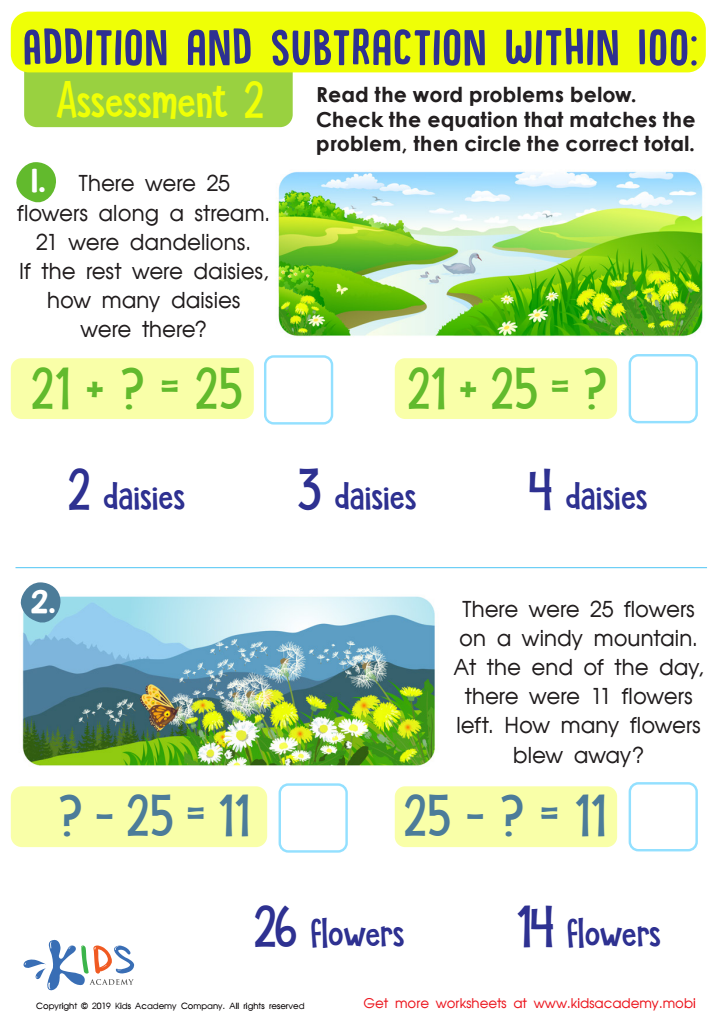
Assessment 2 Math Worksheet
Using fun exercises and pictures, you can get kids excited about math. With practice and reminders of what they've learnt, they'll be solving simple addition and subtraction equations with ease. Read the word problems in the picture to them, then help them check the equation and choose the correct answer.
 Assign to My Students
Assessment 2 Math Worksheet
Worksheet
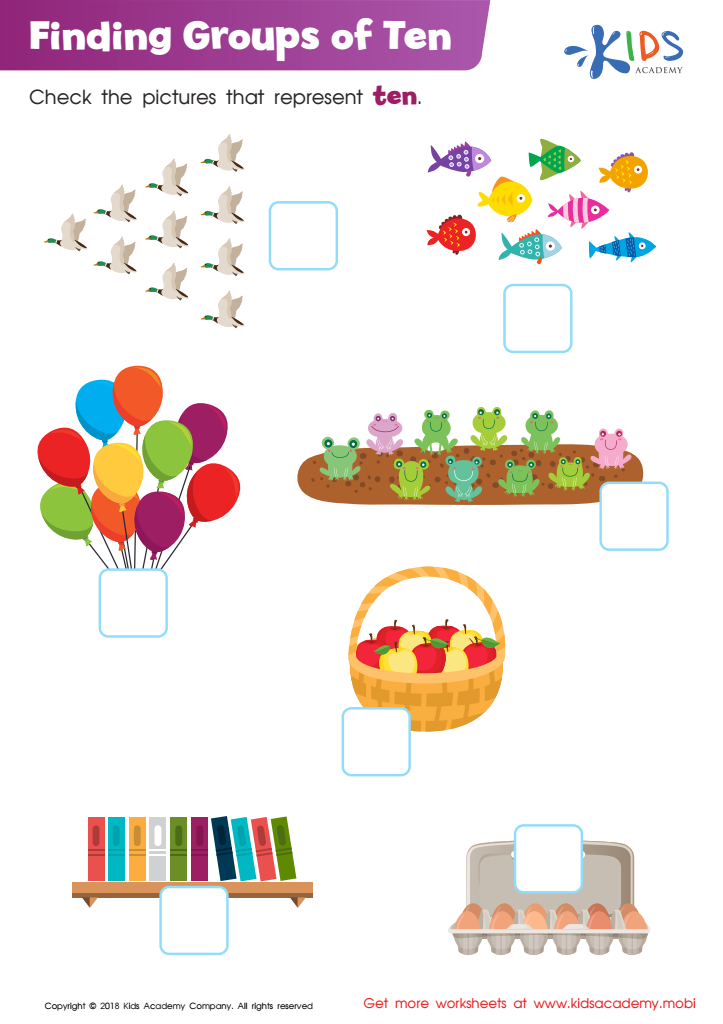
Finding Groups of Ten Worksheet
Can your kids count? If they can't go higher than tens, introduce them to this worksheet. Counting can be fun and easy with this exercise. Ask if they can identify the pictures, then help them count each group. Help them check the pictures that represent ten.
Finding Groups of Ten Worksheet
Worksheet
Join Kids Academy for Free
Who is primarily going to use this learning content?







Understanding grouping in mathematics is fundamental for young children aged 4-8 as it builds the foundational skills necessary for more complex mathematical concepts. Grouping helps children grasp basic arithmetic, like addition and subtraction, by showing them how numbers can be combined or separated into manageable parts.
For parents and teachers, investing time in teaching grouping is crucial because it fosters critical thinking and problem-solving skills. When children see that ten can be grouped as 5+5 or 7+3, they begin to understand the flexibility within numbers and begin to play with these operations more fluidly.
Moreover, competence in grouping supports the development of place value understanding, a key math skill. Recognizing that a number like 24 is made up of 20 (two tens) and 4 (four ones) provides a clearer understanding of math operations and their real-world applications. This comprehension is pivotal for tackling more advanced topics such as multiplication, division, and even fractions.
For children in this age group, math concepts are often abstract, but by teaching grouping through interactive activities and practical examples, parents and teachers can make these ideas more concrete. Emphasizing grouping not only contributes to mathematical fluency but also boosts confidence, transforming potential anxiety towards math into a positive and engaging learning experience.








