Understanding measurements Math Worksheets for Ages 4-8 - Page 2
26 filtered results
-
From - To
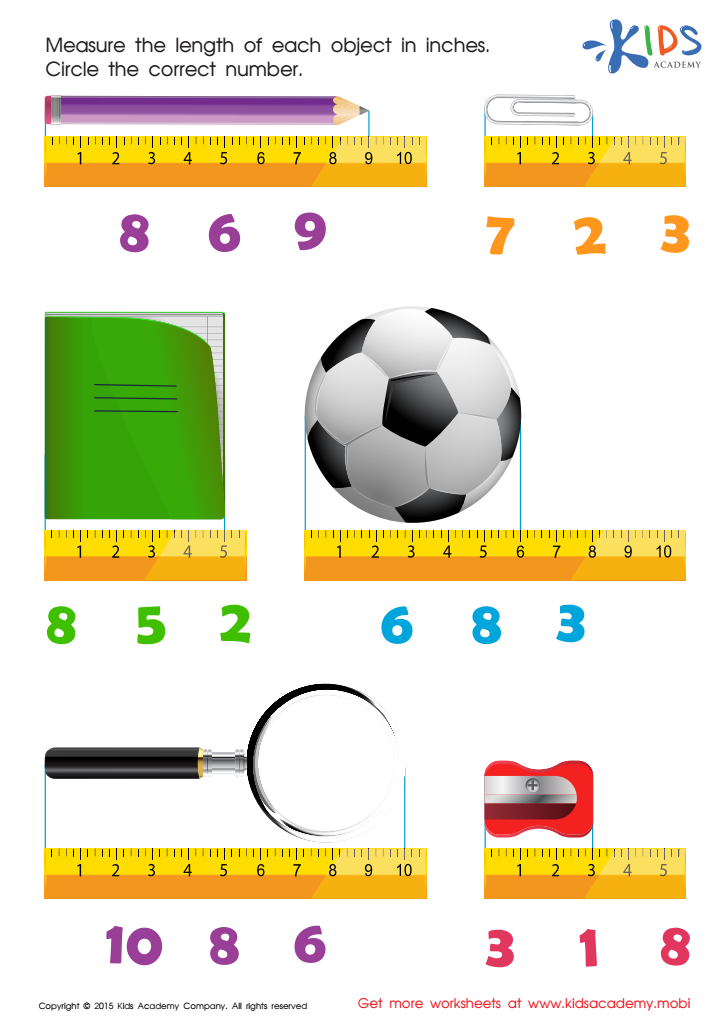
Learning measuring objects in inches Worksheet
 Assign to My Students
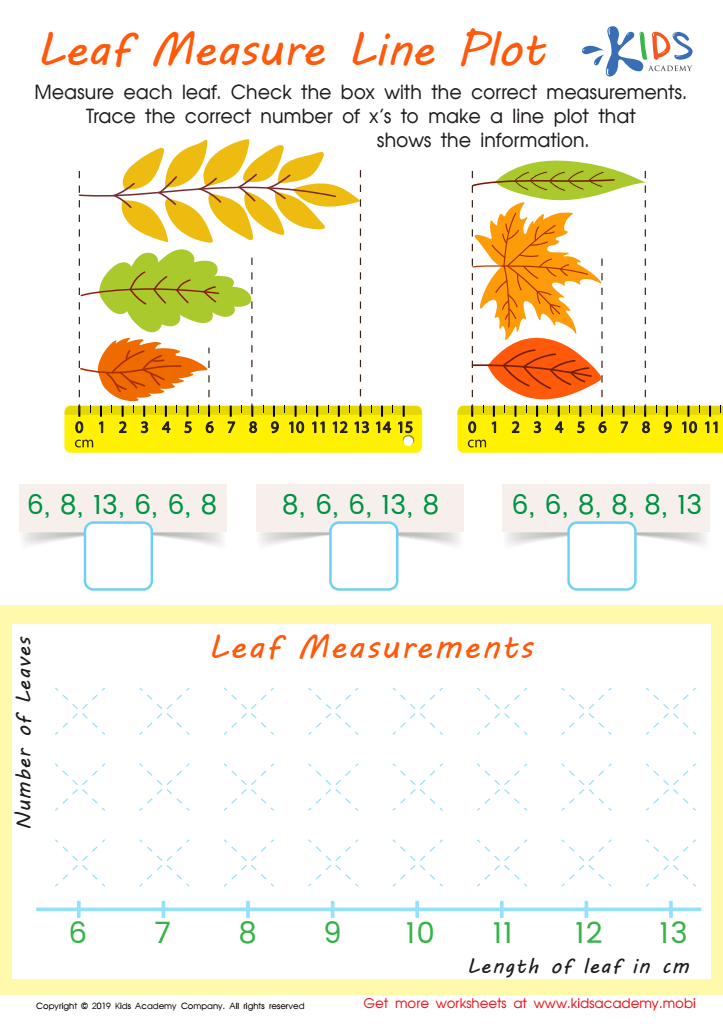
Leaf Measure Line Plot Worksheet







Understanding measurements is a foundational skill crucial for children's cognitive development, particularly for ages 4-8. At this stage, young learners are naturally curious and eager to explore the world around them. Teaching measurement opens doors to critical thinking and problem-solving skills as they assess length, weight, volume, and time practically. This engaging area of mathematics not only supports mathematical reasoning but also lays the groundwork for future academic success in science, technology, engineering, and mathematics (STEM).
Additionally, measurement concepts encourage hands-on activities that cultivate fine motor skills as children use rulers, scales, and measuring cups. These experiences contextually ground math in everyday life, enhancing their understanding and relatability; for instance, when cooking or playing games.
Parents and teachers should care about measurement as these early experiences help children articulate spatial concepts and numerical values, integral for their confidence and competence in mathematics as they progress. Moreover, instilling proficiency in measurement nurtures an analytical mindset, steering children toward becoming adept learners who can navigate the challenges of the increasingly technical world they will face in their futures. Emphasizing measurement now ensures that children develop crucial life skills essential for daily tasks and future learning endeavors.








