
Understanding ordinal numbers Math Worksheets for Ages 4-8
3 filtered results
Difficulty Level
Grade
Age
-
From - To
Subject
Activity
Standards
Explore our comprehensive collection of understanding ordinal numbers math worksheets tailored for children ages 4-8. These engaging resources help young learners grasp the concept of order in mathematics, introducing terms like first, second, and third in a fun and interactive way. With vibrant illustrations and age-appropriate activities, our worksheets aim to reinforce essential math skills while enhancing cognitive development. Perfect for classroom use or at-home practice, these worksheets foster confidence and excitement in learning. Help your child build a strong foundation in ordinal numbers and set them up for success in their mathematical journey! Download your worksheets today!
Favorites
With answer key
Interactive
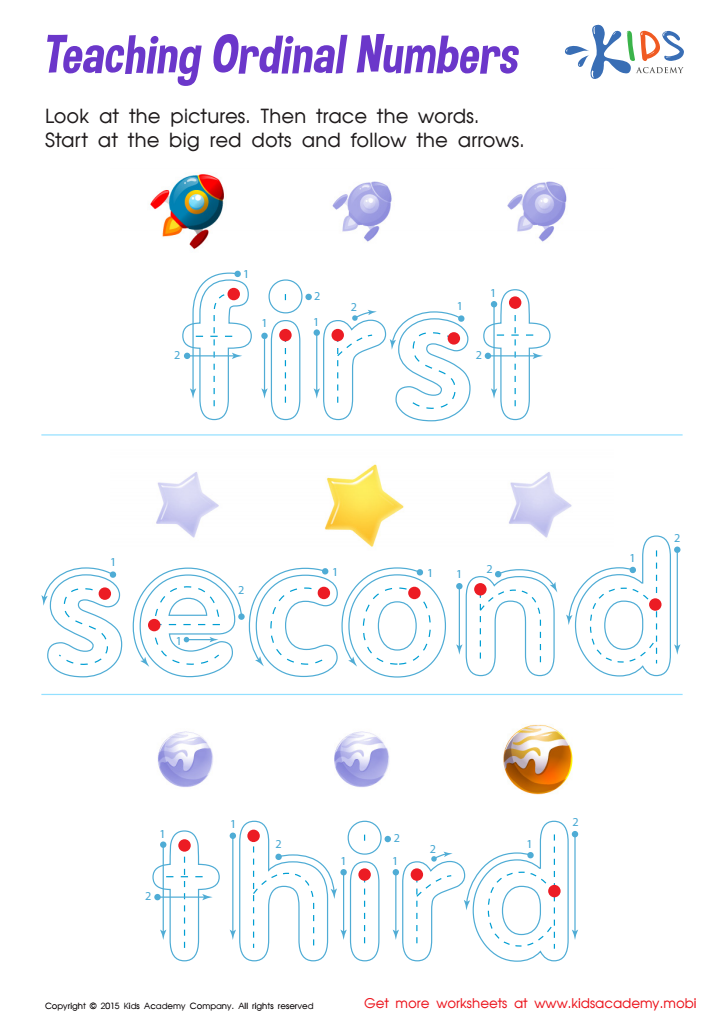
Ordinal Numbers: Teaching Ordinal Numbers Printable
Practice makes perfect!
Kids need to understand ordinal numbers - placement, recognition and spelling. Our worksheet helps kids make connections between the placement and spelling of ordinal numbers. Practice will help your little one perfect this vital number concept.
 Assign to My Students
Ordinal Numbers: Teaching Ordinal Numbers Printable
Worksheet
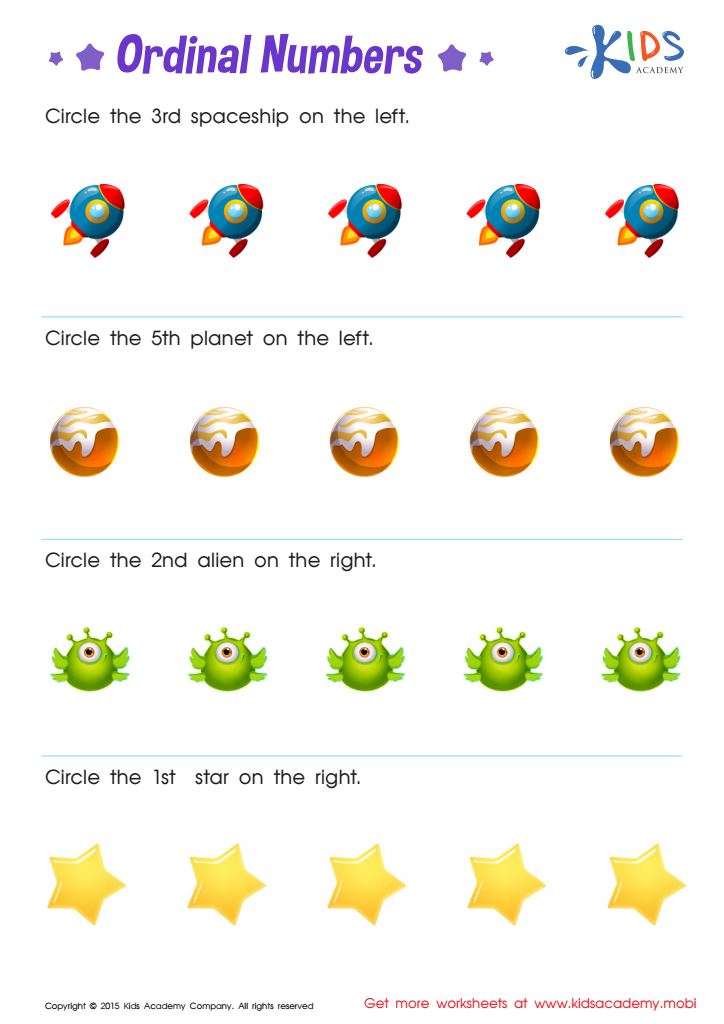
Ordinal Numbers: Space Ordinals Worksheet
Practicing with ordinal numbers worksheet PDFs helps kids master crucial concepts for higher-level math. Plus, when kids have fun learning, the knowledge sticks! So, have your child “blast off” with this space-themed worksheet to read directions, practice relative directions, and learn ordinal numbers.
Ordinal Numbers: Space Ordinals Worksheet
Worksheet
Join Kids Academy for Free
Who is primarily going to use this learning content?







Understanding ordinal numbers is crucial for young learners aged 4-8, as it lays the foundation for various mathematical concepts they will encounter later on. Ordinal numbers—like first, second, and third—help children grasp the idea of positions in a sequence, which is fundamental in both math and everyday life. Parents and teachers should prioritize this understanding because it promotes logical thinking and problem-solving skills.
An early grasp of ordinals enhances children’s ability to understand relationships and comparisons. For instance, it helps them with sorting, ranking, and understanding sequences, which are vital in tasks ranging from organizing their toys to managing schedules. Familiarity with ordinal numbers also supports the development of reading skills in math contexts, where children must interpret problems and data that involve positioning.
Additionally, mastering ordinal numbers encourages participation in interactive learning activities, such as games or cooperative sorting tasks, reinforcing social skills while promoting cognitive development. Parents and teachers can integrate ordinal number usage into daily routines, further embedding these concepts without added pressure. By fostering a strong understanding of ordinal numbers, caregivers set their young learners on a path toward greater confidence and competence in math, paving the way for future academic success.








