Understanding patterns Math Worksheets for Ages 4-8 - Page 3
52 filtered results
-
From - To
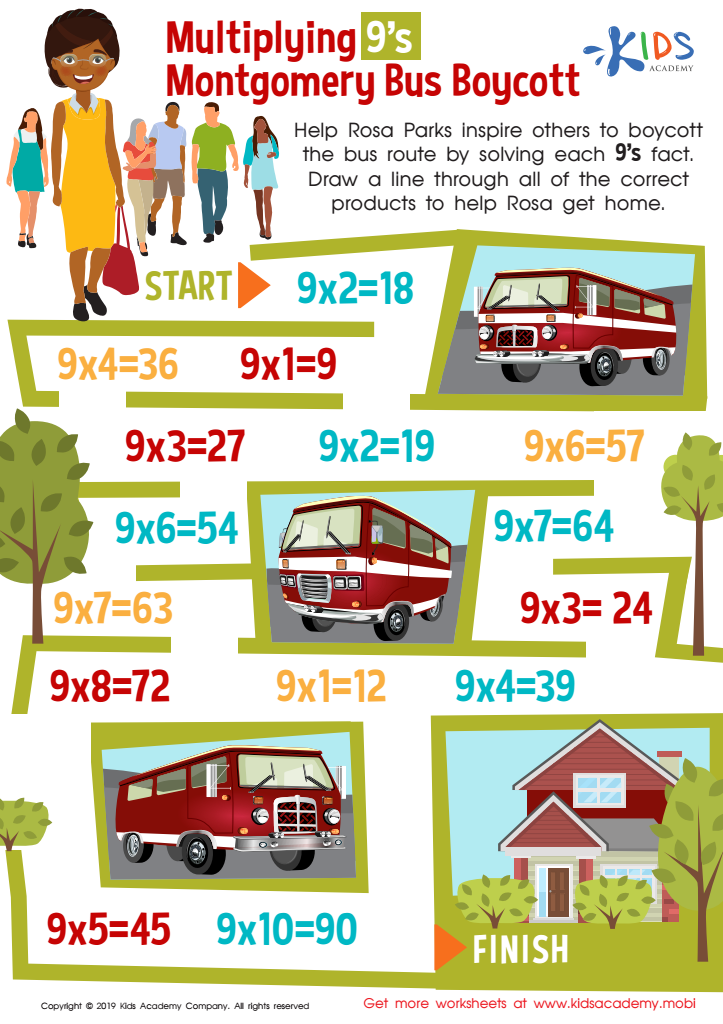
Multiplying 9’s Montgomery Bus Boycott Worksheet
 Assign to My Students








Understanding patterns is a foundational skill in mathematics that is crucial for children aged 4-8. Parents and teachers should care about this concept because it serves as a building block for more complex mathematical ideas. Recognizing, creating, and extending patterns helps children develop critical thinking and problem-solving skills. These abilities are essential not just in math, but across all areas of learning.
Moreover, engaging with patterns enhances cognitive development, as kids learn to see relationships and make predictions based on observed sequences. This forms the basis for understanding variables and functions in later math studies. By teaching children about patterns, we also prepare them for future concepts such as algebra, as much of algebra revolves around recognizing patterns and relationships between numbers.
Additionally, the exploration of patterns is inherently fun and interactive, making it a motivating learning experience for young children. Through games, songs, and activities that highlight patterns, parents and teachers can create a rich learning environment that fosters curiosity and engagement. Ultimately, understanding patterns not only empowers children in their current academic journey but also lays the groundwork for their success in future mathematical concepts and everyday problem-solving.








