
Boost critical thinking Worksheets for Ages 4-9
5 filtered results
Difficulty Level
Grade
Age
-
From - To
Subject
Activity
Standards
Enhance your child's cognitive development with our "Boost Critical Thinking Worksheets for Ages 4-9." Designed to foster analytical and problem-solving skills, these engaging worksheets are perfect for young learners eager to explore creativity and logic. Each activity encourages kids to think outside the box through puzzles, pattern recognition, and thoughtful questions. Tailored for home and classroom use, our worksheets help children grasp essential reasoning skills in an enjoyable way. By integrating play with learning, we aim to build a strong foundation for lifelong critical thinking abilities. Empower your child today and witness their confidence and skills soar!
Favorites
With answer key
Interactive

 Assign to My Students
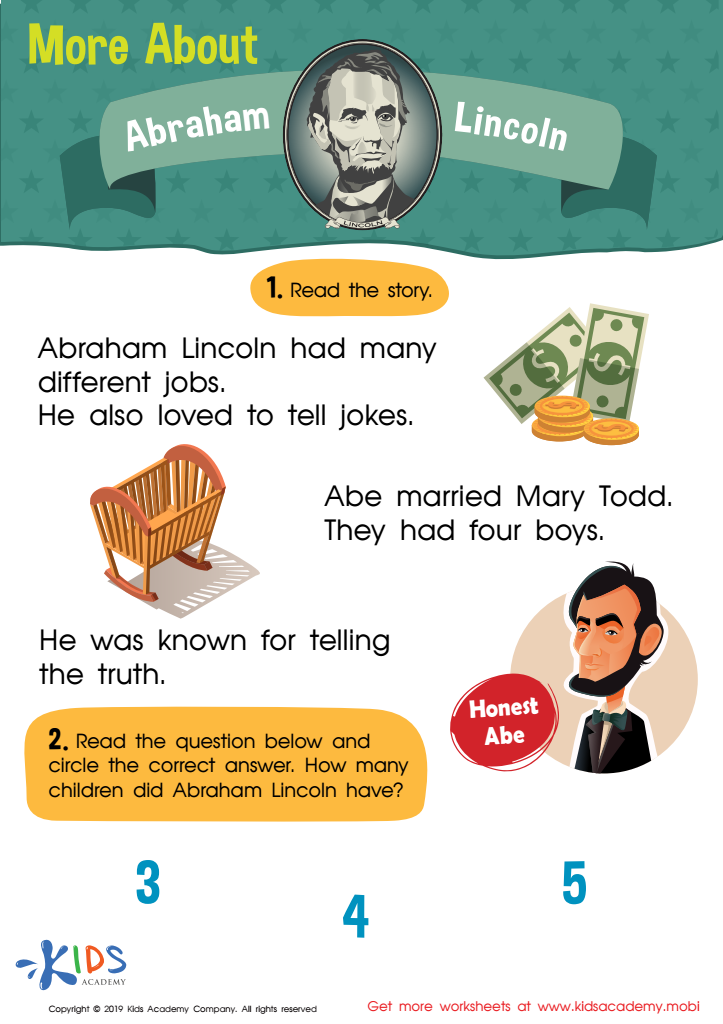
More About Abraham Lincoln Worksheet
Read the short story in the worksheet with your kids. Show them the pictures representing the sentences, then ask the questions and help them circle the correct answer. Make sure they are actually paying attention and learning from the stories.
More About Abraham Lincoln Worksheet
Worksheet
Join Kids Academy for Free
Who is primarily going to use this learning content?






.jpg)

Boosting critical thinking skills in children aged 4-9 is essential for their overall development and future success. During these formative years, children are naturally curious, eager to explore, and develop cognitive abilities. Teaching critical thinking fosters these traits, encouraging kids to analyze situations, ask questions, and solve problems effectively. This skill set not only enhances academic performance across subjects but also equips children with the tools to navigate daily challenges.
Critical thinking in early education helps differentiate and connect concepts, illustrating to young learners that knowledge is interconnected. When parents and teachers prioritize this skill, they empower children to think independently, make informed decisions, and approach problems methodically. This builds confidence and resilience, as students learn to evaluate evidence and draw conclusions rather than accepting information at face value.
Moreover, fostering critical thinkers supports social development and collaboration. It encourages children to listen to diverse perspectives, enhancing communication and teamwork—skills increasingly vital in a complex, interconnected world. Ultimately, nurturing critical thinking lays a solid foundation for lifelong learning, adaptability, and informed citizenship, essential qualities in today’s rapidly changing society. Thus, parents and teachers play a pivotal role in cultivating these invaluable skills in young learners, setting them up for future achievements.








