
Number sequence recognition Worksheets for Ages 4-9
3 filtered results
Difficulty Level
Grade
Age
-
From - To
Subject
Activity
Standards
Unlock your child's numerical potential with our engaging Number Sequence Recognition Worksheets, designed specifically for ages 4-9. These interactive activities help young learners master the essential skill of identifying and completing number sequences, laying a strong foundation for future math success. Featuring colorful designs and age-appropriate challenges, our worksheets make learning fun and effective. As children practice recognizing patterns and continuing sequences, they'll enhance their critical thinking and problem-solving abilities. Perfect for parents or educators, these resources support classroom learning and at-home practice. Start your child's journey to math mastery today with our expertly crafted worksheets!
Favorites
With answer key
Interactive
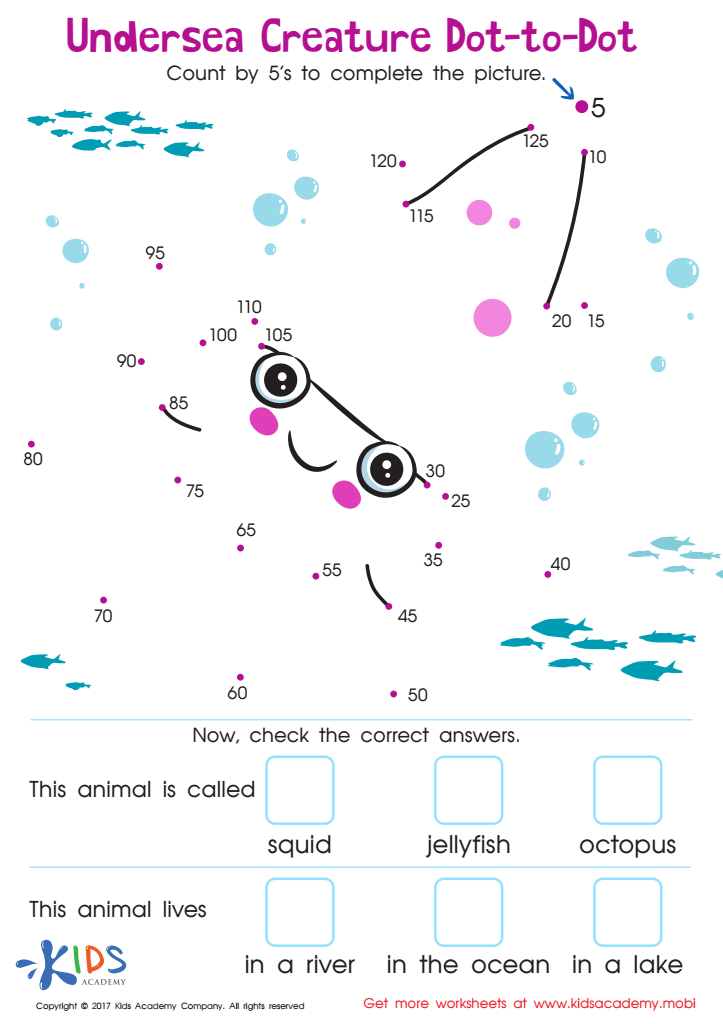
Undersea: Dot To Dot Worksheet
This dot-to-dot worksheet is a great way to teach kids about the undersea world while having fun. Kids will love connecting the dots and counting in 5s. Then they can check their answers.
 Assign to My Students
Undersea: Dot To Dot Worksheet
Worksheet
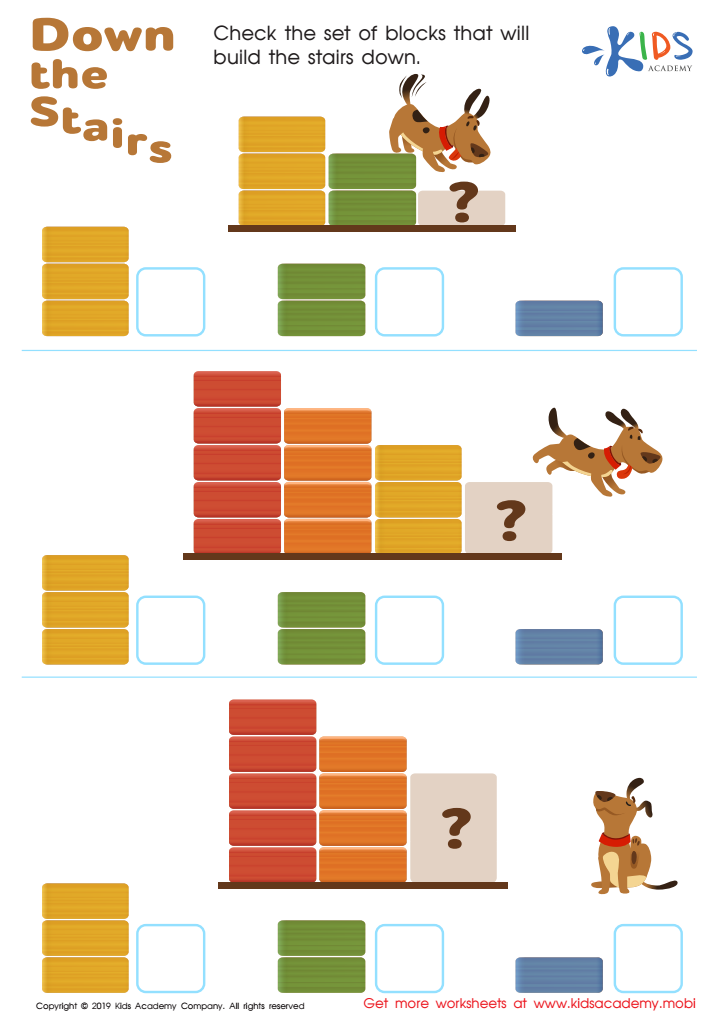
Down the Stairs Worksheet
Let your kids' imaginations run wild with this worksheet featuring a cute and friendly dog! Ask them to point out the dog in the printout, then help count the blocks in each set. Aim to stack them in descending order and build stairs for the pup to get down. Count each block and check the set - it's that easy!
Down the Stairs Worksheet
Worksheet
Join Kids Academy for Free
Who is primarily going to use this learning content?







Number sequence recognition is a fundamental skill for children ages 4-9 that lays the groundwork for later mathematical learning. This skill, which involves understanding and identifying patterns in numbers, is crucial for building a strong numerical foundation. Parents and teachers should care about this skill because it enhances children's problem-solving abilities and cognitive development.
First, recognizing sequences helps children understand basic operations such as addition and subtraction, as they learn how numbers relate to one another. For example, recognizing that counting up is a pattern helps foster mental math skills. Furthermore, number sequences are foundational concepts for more advanced mathematics, including multiplication and division, reinforcing why early mastery is essential.
Additionally, engaging in number sequence activities promotes critical thinking and logical reasoning. When children can identify patterns, they become more adept at predicting outcomes and solving problems creatively.
By nurturing number sequence recognition, educators and parents can help children develop confidence in their mathematical abilities, setting the stage for future academic success. Ultimately, this skill supports overall cognitive development and is linked to performance in various subjects, making it an essential area of focus in early education.








