
Practicing division Worksheets for Ages 4-9
3 filtered results
Difficulty Level
Grade
Age
-
From - To
Subject
Activity
Standards
Discover engaging Practicing Division Worksheets tailored for ages 4-9 at Kids Academy! These tailored worksheets, designed with young learners in mind, make mastering division concepts fun and interactive. Perfect for children in preschool through early elementary grades, these exercises support the development of essential math skills while keeping kids motivated. Each worksheet is creatively crafted to build a solid foundation in division, boost confidence, and enhance problem-solving abilities. Parents and educators will love how these resources bring learning to life. Explore our collection today to give your child a head start in math! Visit Kids Academy to download now.
Favorites
With answer key
Interactive
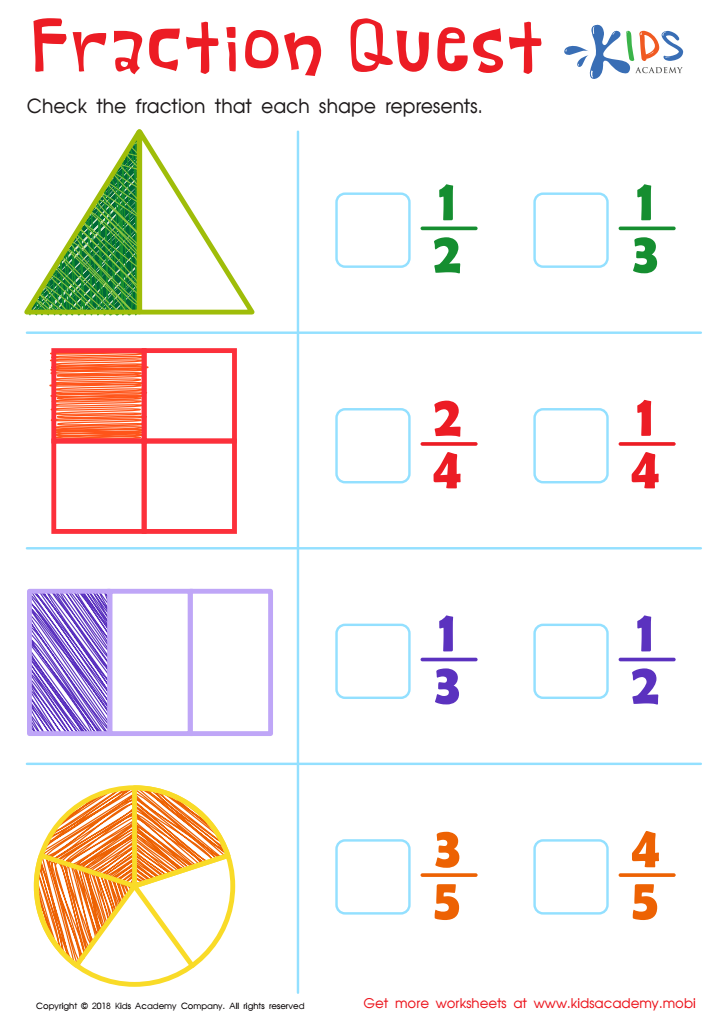
Fraction Quest Worksheet
This colorful and educative worksheet can help kids conquer their fractions struggles. Ask them to identify the four shapes, then the fractions they represent. They can then check the correct answers from the options given.
 Assign to My Students
Fraction Quest Worksheet
Worksheet
Join Kids Academy for Free
Who is primarily going to use this learning content?





Practicing division for children aged 4-9 is crucial for building a strong mathematical foundation and fostering critical thinking skills. Division, being one of the basic arithmetic operations, teaches children about equal sharing, partitioning, and problem-solving, which are essential skills that apply to many real-life situations. Understanding division at an early age aids in the comprehension of more complex mathematical concepts later on, such as fractions, ratios, and algebra.
When children engage in division exercises, they enhance their ability to think logically and sequentially. For instance, dividing objects into equal groups helps kids develop a clear sense of fairness and equality. This not only strengthens their mathematical reasoning but also promotes a more equitable mindset.
Integration of division in early education makes math enjoyable, using tangible and relatable objects like toys or snacks, which keeps children engaged. For parents and teachers, seeing a child’s confidence grow as they solve division problems boosts their self-esteem and encourages a positive attitude toward learning.
Moreover, by learning division early on, children develop perseverance and patience, cultivating a will to face challenges. Thus, investing time in teaching children division supports their overall cognitive development, ensuring they are well-prepared for future academic pursuits.








