
Understanding base ten Worksheets for Ages 4-9
3 filtered results
Difficulty Level
Grade
Age
-
From - To
Subject
Activity
Standards
Welcome to our Understanding Base Ten Worksheets for Ages 4-9! These engaging and interactive worksheets are designed to help young learners grasp the fundamental concepts of the base ten number system. With fun activities, kids will learn to recognize place values, understand addition and subtraction using tens and ones, and build their counting skills in an enjoyable way. Perfect for teachers and parents, our printable resources cater to various learning styles, ensuring a solid mathematical foundation. Explore our collection today and watch your child develop confidence and proficiency in math as they play and learn through these expertly crafted worksheets!
Favorites
With answer key
Interactive
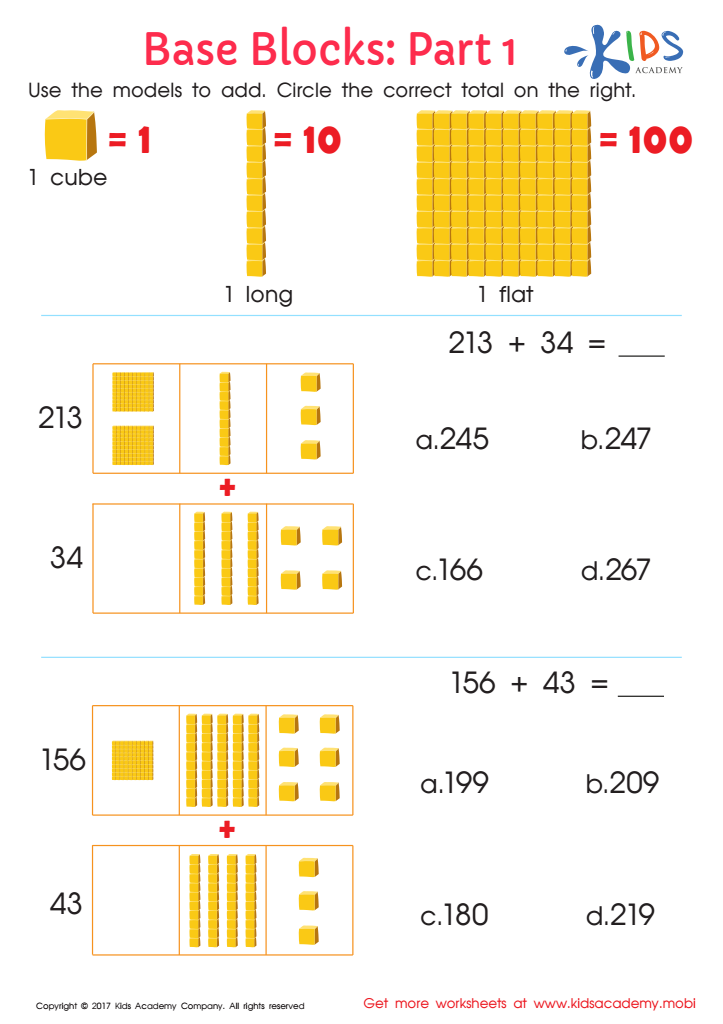
Base Ten Blocks Worksheet: Part 1
They promote numeracy and are a great substitute when kids don't have access to physical blocks.
 Assign to My Students
Base Ten Blocks Worksheet: Part 1
Worksheet
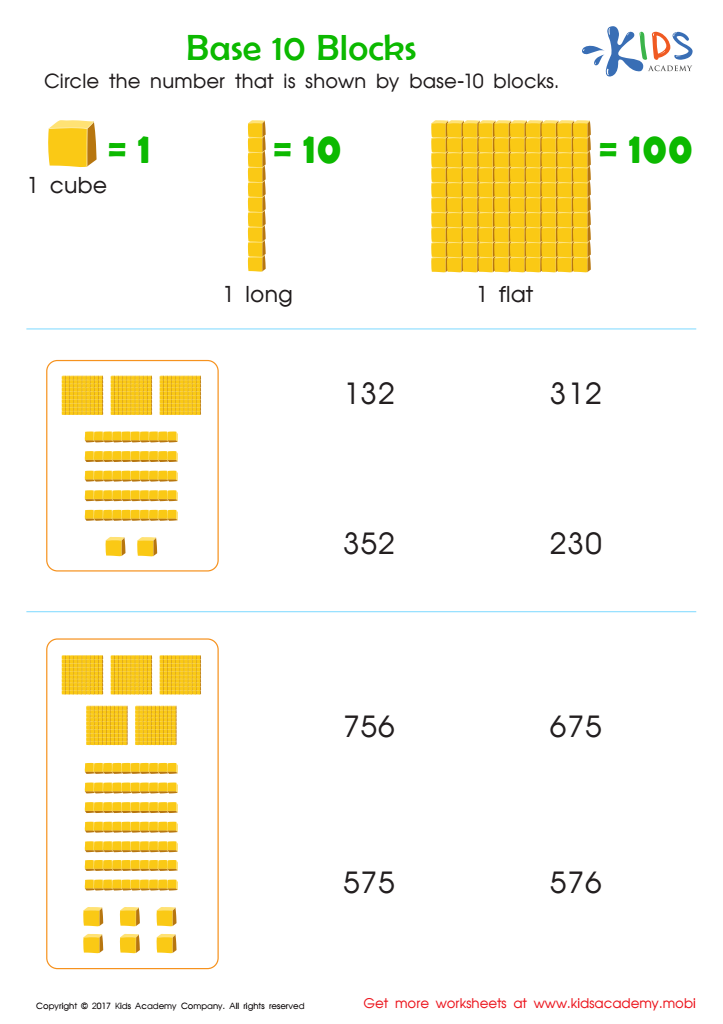
Base Ten Blocks Worksheet
When school ends, your child can still practice place value at home with this base ten blocks worksheet. They'll count and circle the right number, gaining mastery of the concept. It's a fun, easy way to hone their skills!
Base Ten Blocks Worksheet
Worksheet
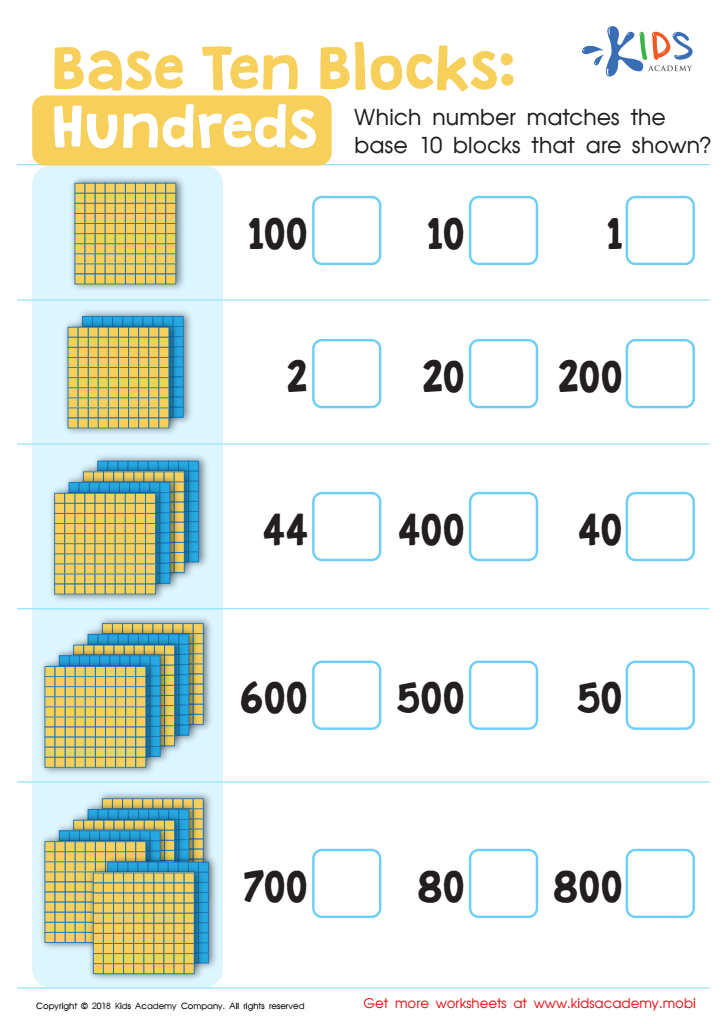
Base Ten Blocks: Hundreds Worksheet
Help your child overcome their dislike of math by guiding them with this base ten blocks worksheet. Count the blocks and answer the questions together. Ask them which number matches the base ten blocks shown. This will help them solve math problems more easily.
Base Ten Blocks: Hundreds Worksheet
Worksheet
Join Kids Academy for Free
Who is primarily going to use this learning content?







Understanding base ten is crucial for children aged 4-9, as it forms the foundation of their mathematical development. This system, which involves grouping numbers into tens and ones, helps children make sense of quantities and enables them to perform arithmetic operations more easily. By grasping base ten concepts, children learn to decompose numbers, making addition and subtraction intuitive and manageable. For instance, instead of trying to add 27 and 15 directly, they can break the numbers down into tens and ones, significantly simplifying the process.
Moreover, understanding base ten fosters strong number sense, which is essential for advanced mathematical skills in later years, such as multiplication, division, and fractions. It also promotes critical thinking and problem-solving skills, as children learn to manipulate numbers in various ways.
Parents and teachers play a vital role in building this foundational skill by providing engaging, hands-on learning experiences that can include games, manipulatives, and real-life scenarios. Encouraging children to explore and discover these concepts will not only boost their confidence in mathematics but also set them up for future success, ensuring they can navigate more complex mathematical concepts with ease.








