
Understanding greater/less than Worksheets for Ages 4-9
4 filtered results
Difficulty Level
Grade
Age
-
From - To
Subject
Activity
Standards
Discover the perfect resource for teaching young learners the concepts of greater and less than with our engaging worksheets designed for ages 4-9. These printable activities encourage children to compare numbers, enhancing their critical thinking and mathematical skills in a fun, interactive way. Through colorful visuals and relatable examples, students will gain confidence in recognizing numerical values, fostering a solid foundation for future math concepts. Ideal for both classroom and home use, our greater/less than worksheets make learning enjoyable and effective, allowing educators and parents to support children’s developmental growth. Start exploring and boost your child's math proficiency today!
Favorites
With answer key
Interactive
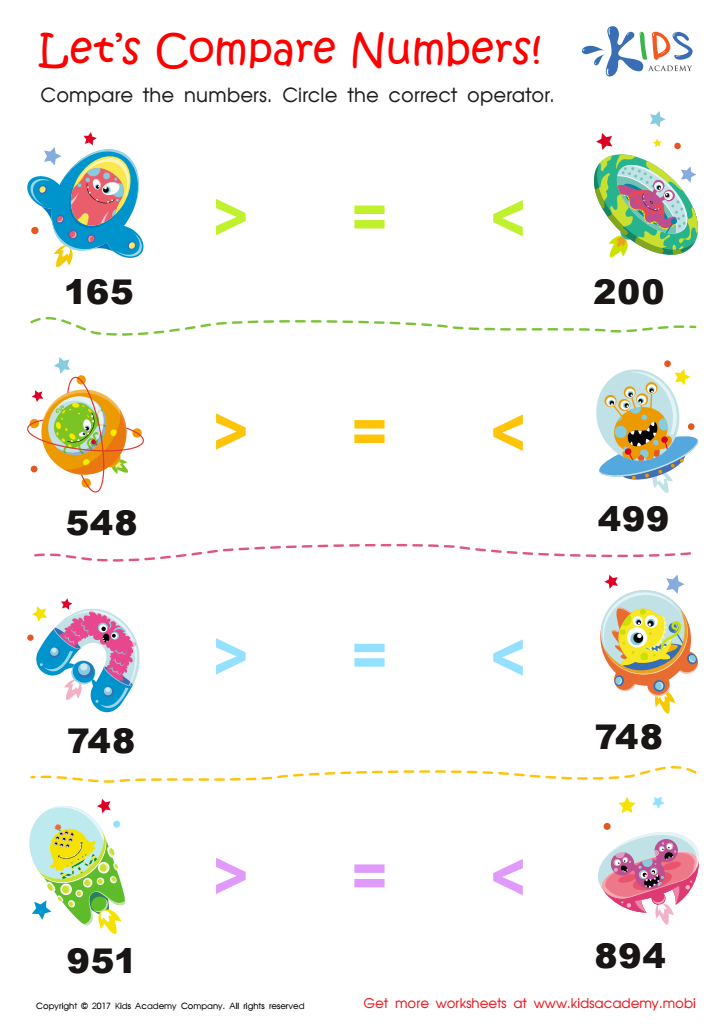
Comparing Numbers Worksheet for 2nd Grade
Alien friends are back to help your child learn to compare numbers using >, < and = symbols. This 2nd grade worksheet will challenge them with larger numbers!
 Assign to My Students
Comparing Numbers Worksheet for 2nd Grade
Worksheet
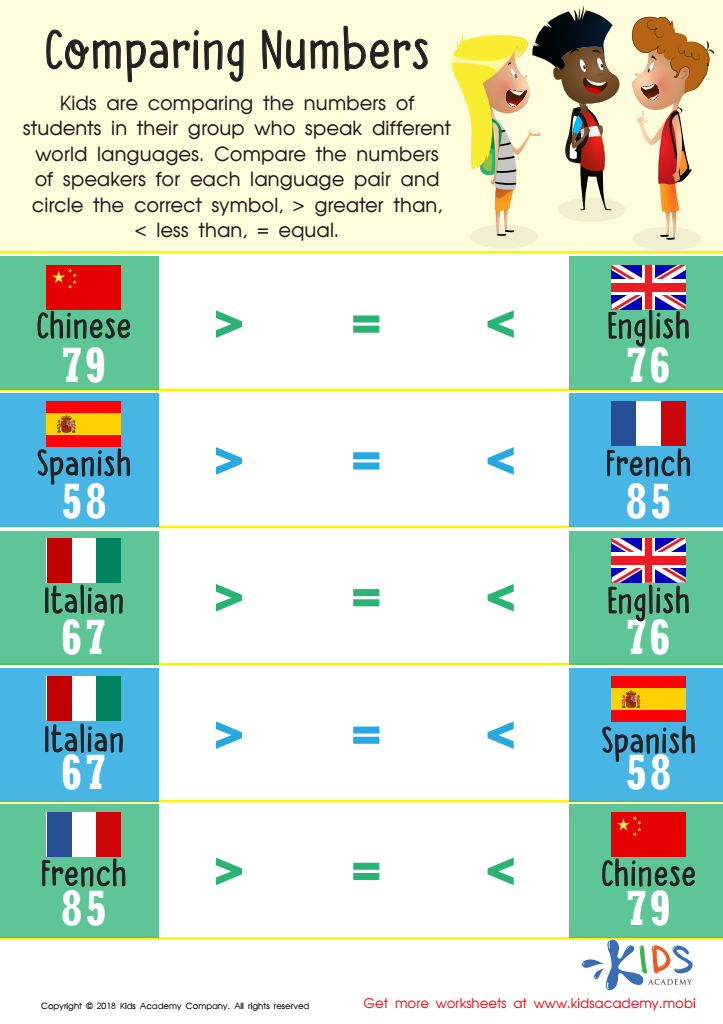
Comparing Numbers Worksheet for 1st Grade
Children can build number sense by exploring the relationship between numbers. This worksheet uses bright international flags to compare numerical groups. Kids will love the cheerful colors and flags from different countries. It encourages them to compare numbers and reinforces their number sense with tens and ones place values.
Comparing Numbers Worksheet for 1st Grade
Worksheet
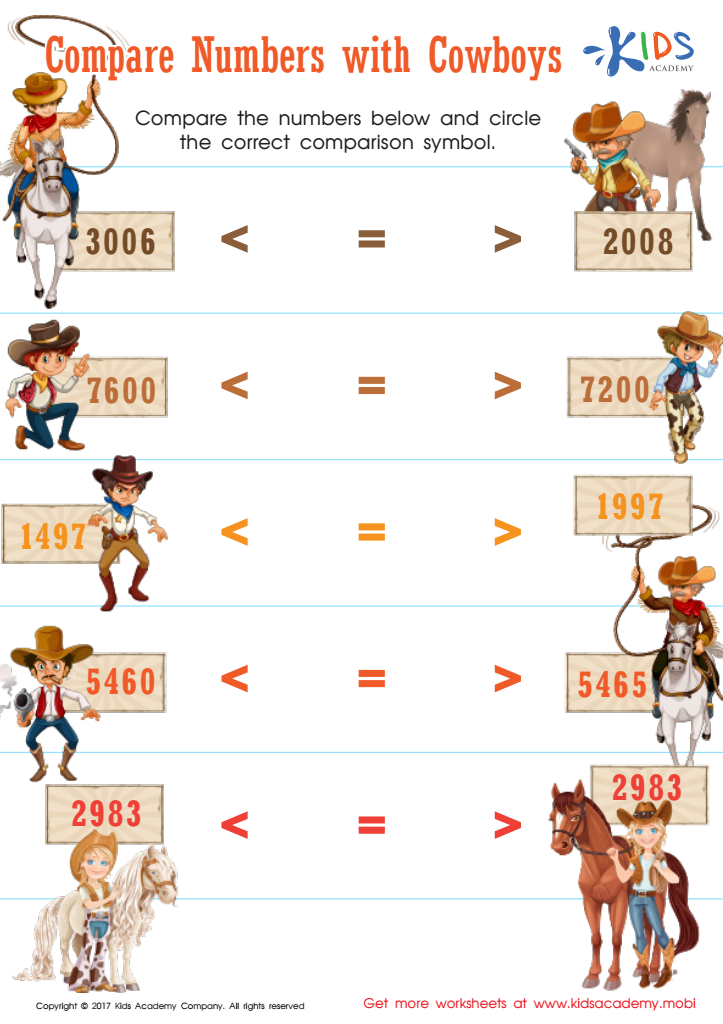
Compare Numbers Worksheet for 3rd Grade
Time to get a roundup on big numbers! Help your 3rd grader practice comparing thousands with this compare numbers worksheet. They'll use >, <, and = symbols for tricky numbers. Jump in and join the cowboys!
Compare Numbers Worksheet for 3rd Grade
Worksheet
Join Kids Academy for Free
Who is primarily going to use this learning content?








Understanding greater than (>) and less than (<) is crucial for children aged 4-9 because it lays the foundational skills for mathematics and critical thinking. Early mastery of these concepts fosters number sense, enabling children to compare quantities, understand order, and make informed decisions in various scenarios. Recognizing which numbers are greater or lesser enhances problem-solving abilities, encouraging logical reasoning and mathematical fluency.
Furthermore, this understanding supports daily life skills. For example, children use these concepts when sorting objects, sharing equally, or even managing money—skills that are essential as they grow. Engaging with comparisons also boosts vocabulary and cognitive development, as children learn mathematical language, enriching their communication skills.
Additionally, fostering a solid grasp of greater than and less than prepares children for future learning. As they advance in their education, these foundational concepts become critical for understanding equations, inequalities, and data interpretation later in math. For parents and teachers, promoting an awareness of these ideas not only enriches children’s academic experiences but also builds confidence in their abilities, paving the way for a lifelong appreciation of mathematics and critical thinking. Involving children in fun activities—such as games or real-life comparisons—makes learning these concepts enjoyable and memorable.








