Developing critical thinking Addition & Subtraction Worksheets for Ages 4-9
3 filtered results
-
From - To
Enhance your child's mathematical skills with our carefully designed Addition & Subtraction Worksheets for ages 4-9. These engaging printables aim not just to teach basic arithmetic, but also to develop critical thinking and problem-solving abilities. Tailored to make learning fun, each worksheet offers a variety of challenges that encourage young minds to think logically and creatively. Perfect for both classroom and home use, these resources cater to different learning styles and paces, ensuring every child can succeed. Equip your young learners with the tools they need to explore and understand the fundamental concepts of addition and subtraction while boosting their cognitive development.
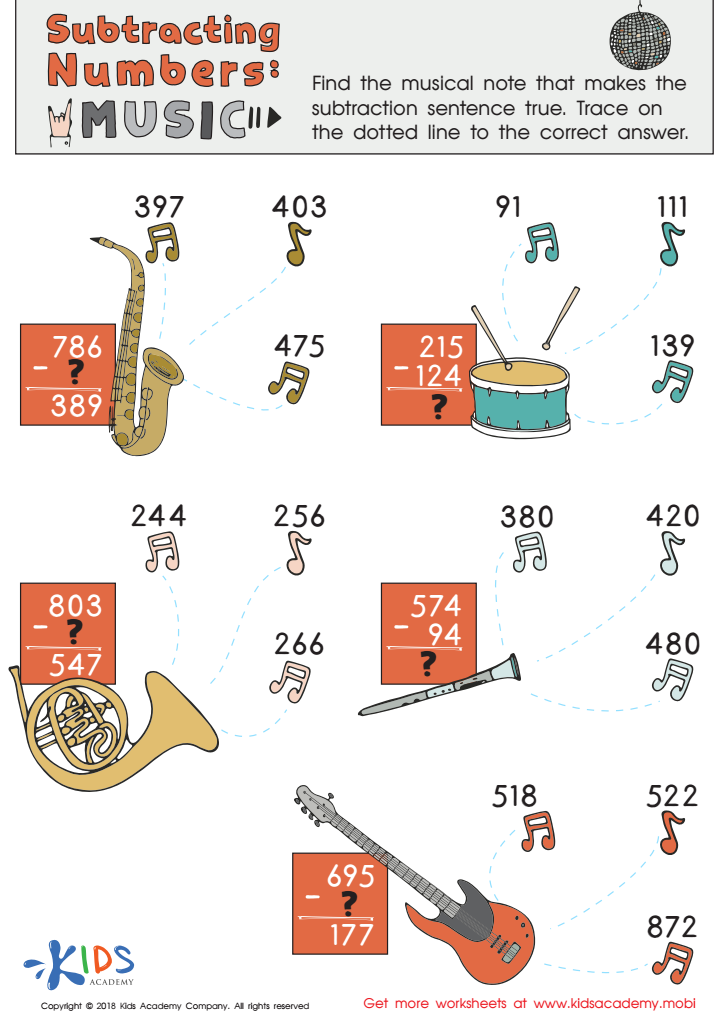
Subtracting Numbers: Music Worksheet
 Assign to My Students








Developing critical thinking in addition and subtraction for children aged 4-9 is crucial for their cognitive and academic growth. During these formative years, children's brains are highly receptive to learning and developing new skills. By fostering critical thinking through arithmetic skills, parents and teachers prepare children for more advanced problem-solving scenarios.
First, mastering addition and subtraction enhances numeracy, a fundamental component of everyday life. It provides a foundation for understanding more complex mathematical concepts. When children learn to approach these problems with critical thinking, they develop skills such as reasoning, analyzing, and applying logical steps to reach solutions. These abilities are transferrable to other academic subjects and life situations.
Additionally, learning these basic arithmetic operations through critical thinking encourages a growth mindset. Children learn to see challenges as opportunities for improvement rather than obstacles. This mindset helps build resilience, perseverance, and confidence—key attributes for lifelong learning.
Moreover, bilingual problem-solving and teamwork skills bloom as children work together to solve math problems, promoting social interaction and communication skills. Parents and teachers who cultivate this environment support a holistic educational approach, blending cognitive, emotional, and social development smoothly. Thus, emphasizing critical thinking in addition and subtraction equips children with essential skills that benefit their entire educational journey and beyond.








