
Understanding money Addition & Subtraction Worksheets for Ages 4-9
4 filtered results
Difficulty Level
Grade
Age
-
From - To
Subject
Activity
Standards
Our "Understanding Money: Addition & Subtraction Worksheets" for ages 4-9 are designed to make learning math engaging and practical. These printable worksheets help children develop essential skills by combining basic arithmetic with real-world money concepts. Kids will gain confidence in addition and subtraction through fun and interactive exercises featuring coins and bills. Perfect for young learners, these worksheets encourage problem-solving and critical thinking, while making math relatable. Ideal for use at home or in the classroom, our worksheets are a valuable resource for building a solid foundation in both math and financial literacy. Download now for enjoyable, effective learning!
Favorites
With answer key
Interactive
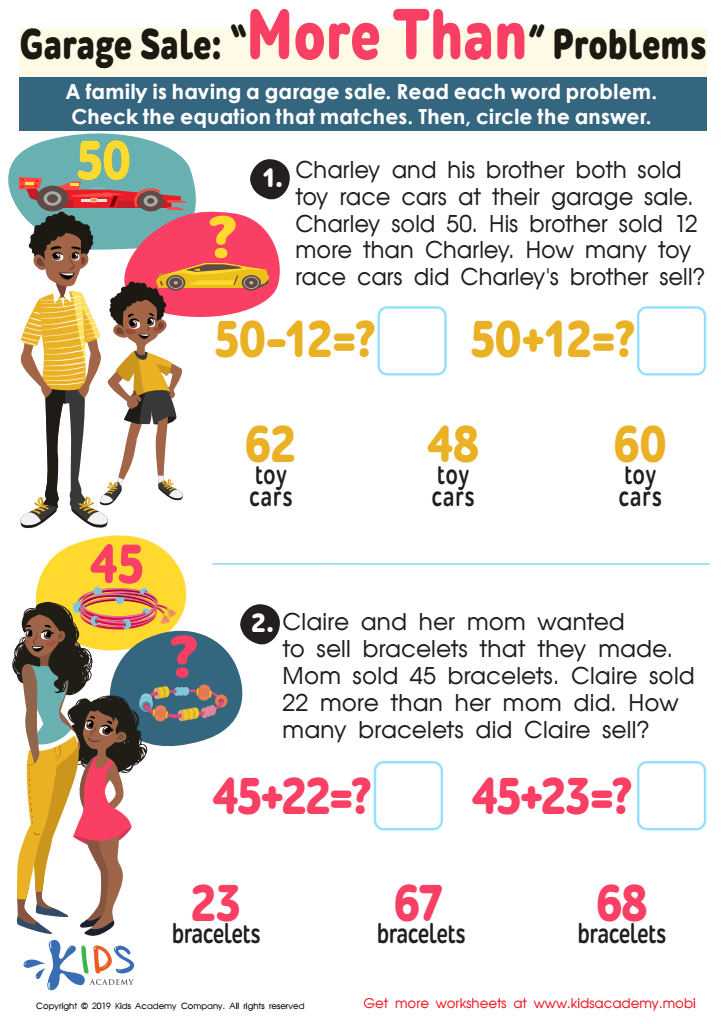
Garage Sale - More yhan Worksheet
The whole family can join in on the fun with this free worksheet! It helps kids practice math word problems while assisting their friends with a garage sale. Kids learn to identify "More Than" key words and pick the right equation, improving their order of operations skills. Download the PDF and get started!
 Assign to My Students
Garage Sale - More yhan Worksheet
Worksheet
Join Kids Academy for Free
Who is primarily going to use this learning content?








Understanding money, addition, and subtraction is crucial for children aged 4-9 for several reasons. Firstly, these skills are fundamental for basic financial literacy. Learning to recognize coins and bills, and understanding their values helps children grasp the concept of money, which is essential for daily life. As they grow, managing money will become a critical part of their independence and responsibility.
Secondly, addition and subtraction are foundational math skills that support overall cognitive development, problem-solving abilities, and logical thinking. When children engage in activities involving money, they naturally practice these math concepts in an engaging, practical context. This not only reinforces their mathematical understanding but also demonstrates how these skills apply in real-world situations.
Moreover, early proficiency in money-related math fosters confidence. Whether purchasing an item on their own or saving up money, children feel empowered when they successfully manage these tasks. This self-assurance promotes a positive attitude towards learning and handling new challenges.
Lastly, integrating money management and math in early education aligns with many educational standards and curricula. It ensures children are on the right track for future academic success. By focusing on these areas, parents, and teachers lay a strong foundation for children's lifelong learning and healthy attitudes about money.








