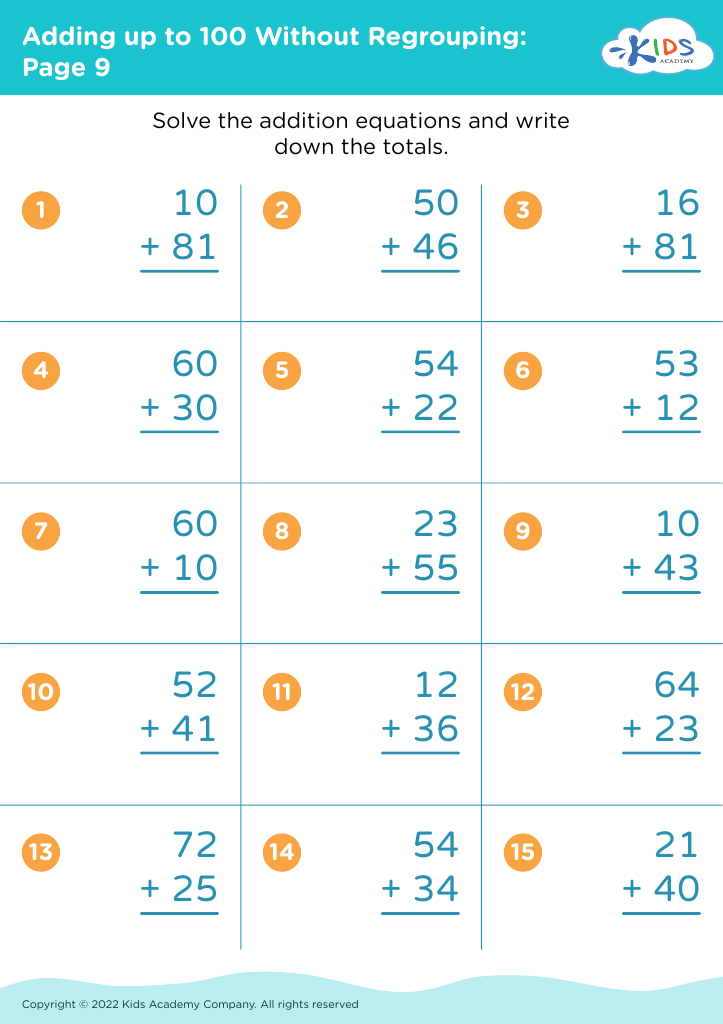








Mathematical reasoning, particularly in addition, is crucial for children aged 4-9, as it lays the foundation for their overall cognitive development and academic success. Developing strong reasoning skills early on helps students make connections between numbers and concepts, fostering a deeper understanding of mathematics beyond rote memorization. This age group is an essential period for learning through play and exploration, where children can use manipulatives, visual aids, and real-life scenarios to grasp addition conceptually.
Parents and teachers should care about mathematical reasoning because it cultivates critical thinking and problem-solving abilities. When children understand the "why" behind addition, they gain confidence in tackling more complex mathematical challenges as they progress in their education. Moreover, these skills are not limited to math; they translate to other subjects such as science, geography, and even language arts.
Investing time in developing mathematical reasoning also promotes a positive attitude towards mathematics, which is vital for success in an increasingly quantitative world. By engaging with children through fun exercises and discussions, parents and teachers can instill a love for learning and encourage lifelong skills that will serve students well throughout their academic careers and beyond.








