Filters

6 filtered results

Clear all filters
Favorites
With answer key
Interactive

6 filtered results

Difficulty Level

Grade


Enhance your child's understanding of geometry with our engaging categorization skills worksheets designed for ages 4-9! These printable resources offer fun, age-appropriate activities that help young learners identify, sort, and categorize shapes and sizes. By practicing categorization in geometry, children develop critical thinking skills, spatial awareness, and a strong foundation in math. Our worksheets are perfect for both classroom settings and at-home learning, making it easy to create enjoyable educational moments. Foster creativity and cognitive growth while reinforcing essential geometry concepts with these comprehensive worksheets that make learning interactive and exciting. Download your worksheets today and watch your child thrive!

Check out this FREE Trial Lesson on Geometry for age 4-9!

Sorting Objects into 3 Categories

Favorites
With answer key
Interactive
  • 4-9
  • Categorization skills
  • Geometry
Sorting Jewels Worksheet

Sorting Jewels Worksheet

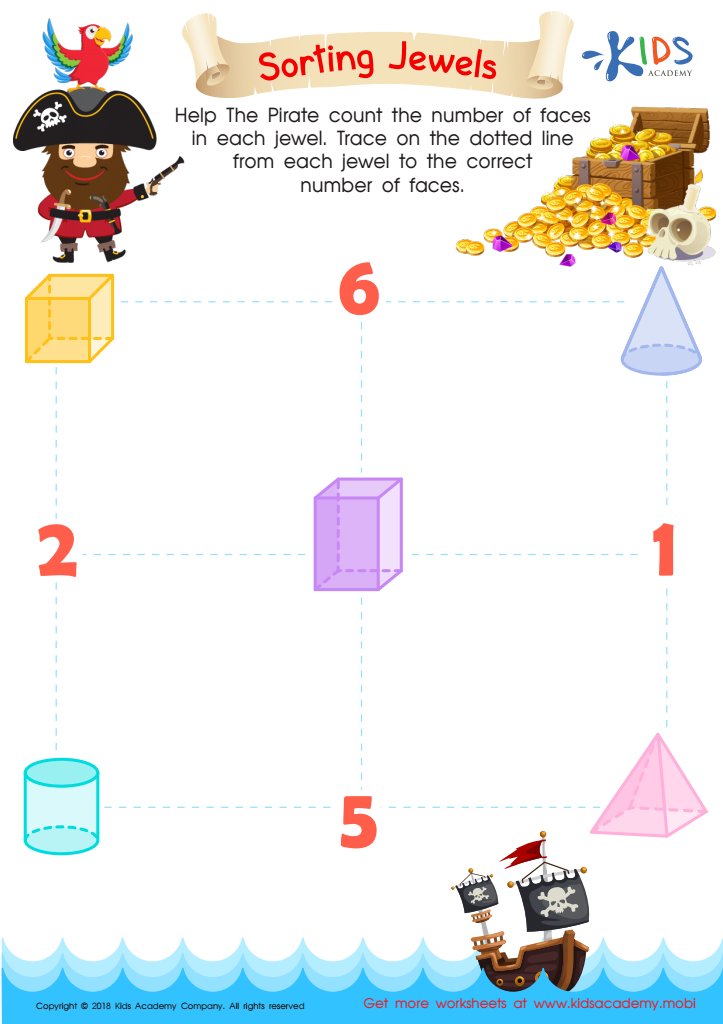
Help your kids explore their pirate fantasies with this tracing sheet. Ask them to count the number of faces in each jewel and then trace the dotted line to the correct number. How many faces does a rectangle have? What about a triangle and a cone? This fun worksheet is a great way to teach your kids the basics of identifying the number of faces on shapes.
Sorting Jewels Worksheet
Worksheet
Sorting Shapes - Part 3 Worksheet

Sorting Shapes - Part 3 Worksheet

Download this fun PDF to help your kiddos recognize basic shapes like circles, squares, and triangles. It'll sharpen their fine motor skills as they trace and sort shapes by color, size, and sides. Your kids won't even realize they're learning with these cheery shapes!
Sorting Shapes - Part 3 Worksheet
Worksheet
Dinner Shapes: Making a Whole Worksheet

Dinner Shapes: Making a Whole Worksheet

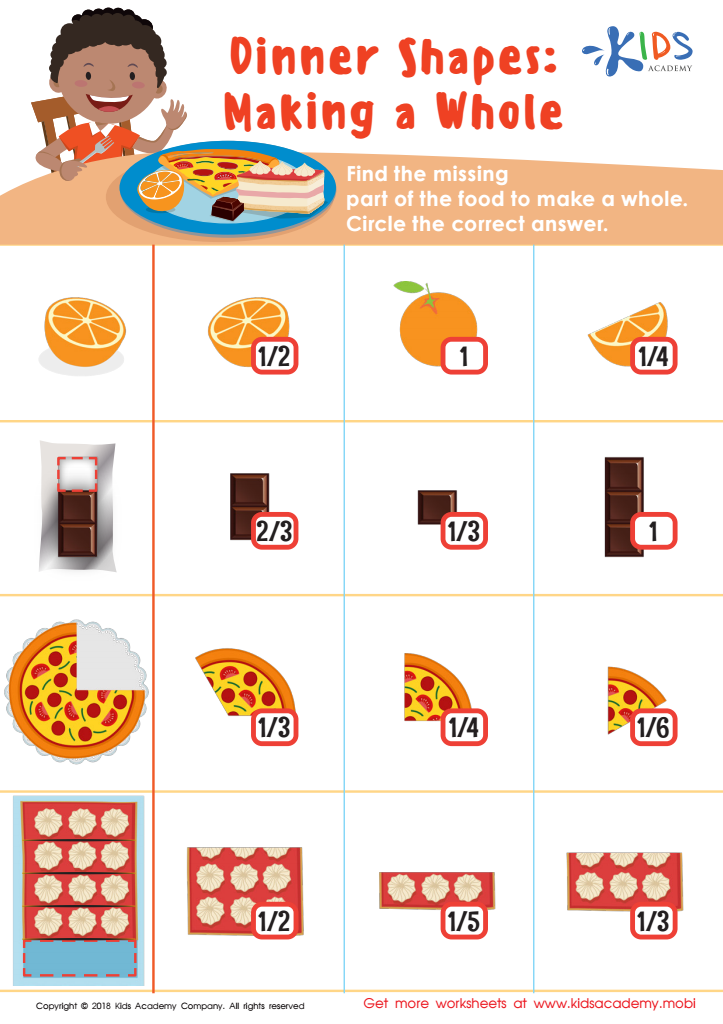
Using food and snacks to stimulate learning and interest in topics is a great strategy. Fractions can prove tricky, but this worksheet can help your child become an expert. Have them look for the missing parts of the food to make a whole, then circle the answer.
Dinner Shapes: Making a Whole Worksheet
Worksheet
Sorting Shapes Worksheet

Sorting Shapes Worksheet

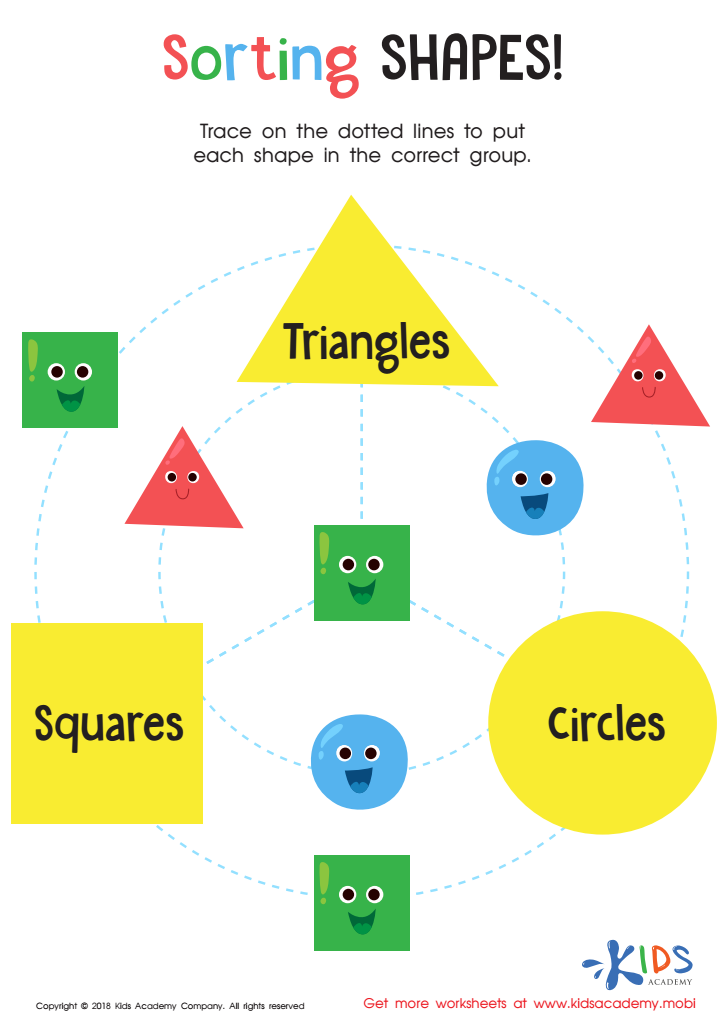
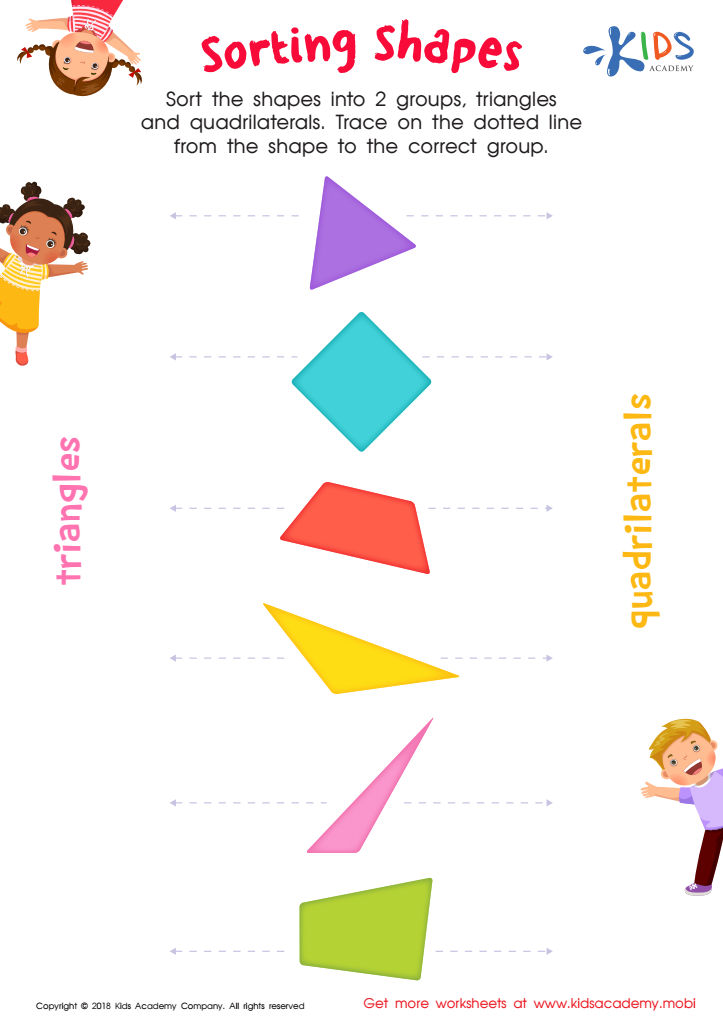
Before beginning, ensure your child is familiar with quadrilaterals (4 sides) and triangles (3 sides). This tracing exercise is easy: sort the shapes into the two groups and trace the dotted lines to the correct group.
Sorting Shapes Worksheet
Worksheet
Shape Sorter Worksheet

Shape Sorter Worksheet

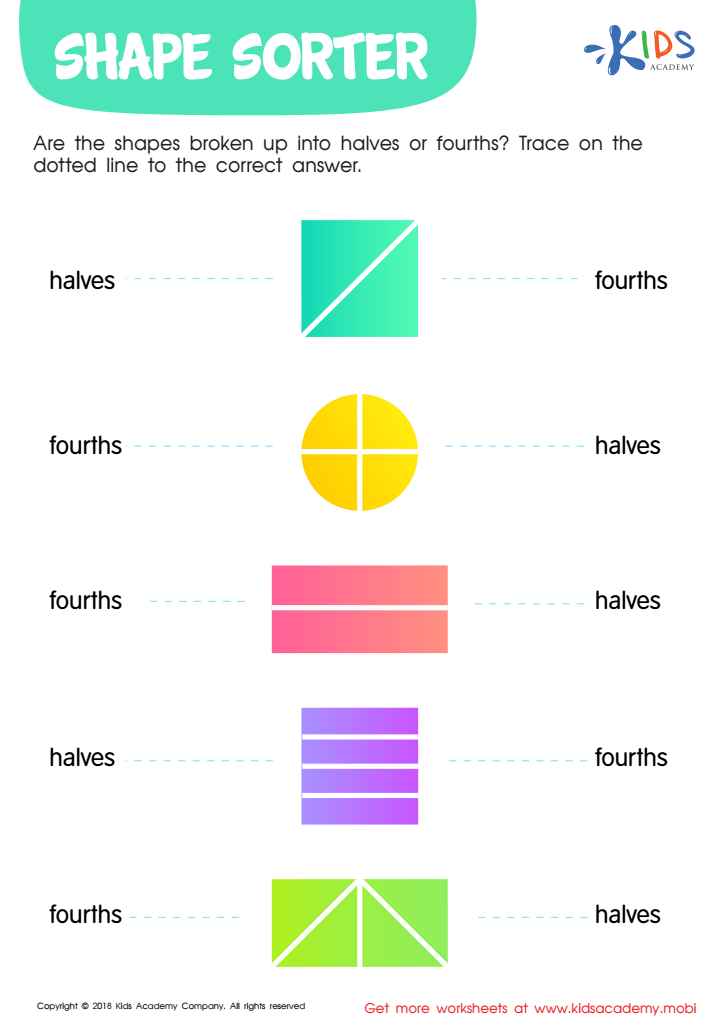
Ask your child if they know halves and fourths. If not, explain that halves are when a shape is divided into two equal parts and fourths is when a shape is divided into four equal parts. Look through this worksheet with your child and let them trace the dotted lines to the correct answer to show whether the shapes are cut into halves or fourths.
Shape Sorter Worksheet
Worksheet
Let's Look! Part 1 Worksheet


Let's Look! Part 1 Worksheet

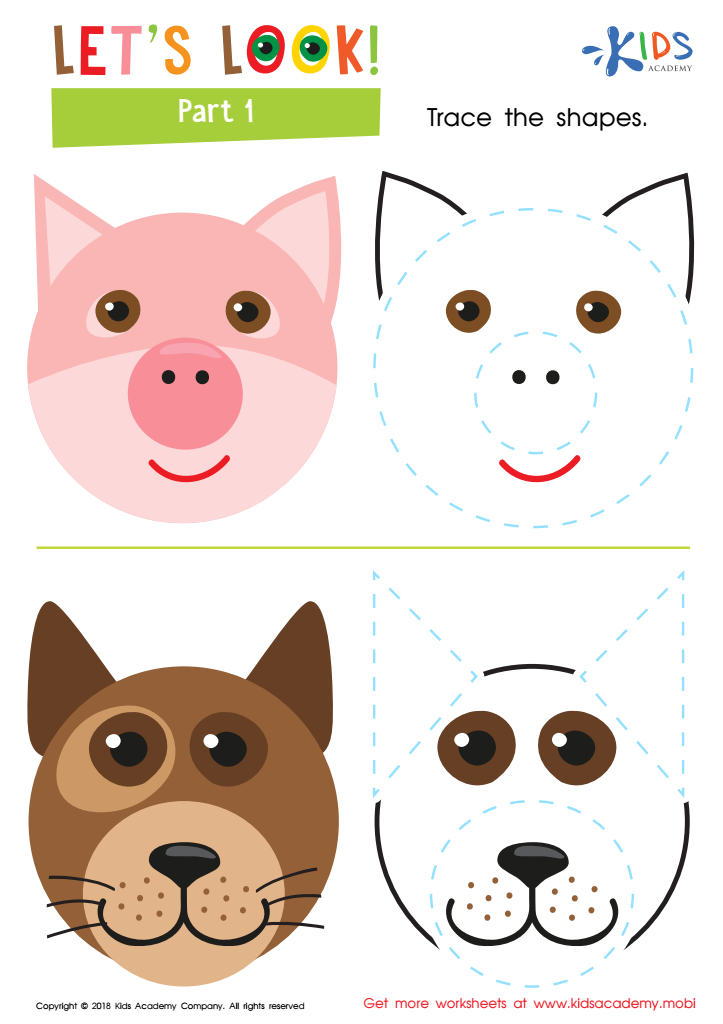
If your kids love animals or have a pet at home, they'll get a kick out of this tracing worksheet. It tests their ability to imitate shapes, starting with a pig and followed by a dog. Beside each of these pictures is a space for tracing the shapes. Unleash your child's creativity and see what they come up with!
Let's Look! Part 1 Worksheet
Worksheet


Categorization skills in geometry are crucial for children aged 4-9 as they form the foundation for spatial awareness and mathematical reasoning. At this developmental stage, children begin to explore the world around them, identifying shapes, sizes, and patterns. This understanding is not just academic; it enhances critical thinking and problem-solving abilities, which are vital across all subjects.

When parents and teachers focus on these skills, they support children’s cognitive development. Categorization encourages them to group objects based on attributes such as shape, color, or size, fostering logical thinking. For example, categorizing shapes helps children comprehend their properties and relationships, forming the basis for further studies in geometry and mathematics.

Moreover, these skills are linked to everyday experiences. When kids categorize items like toys, blocks, or even foods, they learn to recognize similarities and differences, which enhances their observational skills and decision-making.

Encouraging categorization in geometry also allows for learning through play, making education engaging and interactive. Ultimately, a solid grasp of categorization will not only aid in subsequent academic achievements but ensures children develop a well-rounded understanding of the world. Thus, investing in these skills at a young age has far-reaching benefits.