
Counting proficiency Numbers Worksheets for Ages 4-9
3 filtered results
Difficulty Level
Grade
Age
-
From - To
Subject
Activity
Standards
Boost your child’s counting skills with our Counting Proficiency Numbers Worksheets designed for ages 4-9! These engaging and interactive worksheets help young learners master counting through fun activities, including number recognition, sequential counting, and simple addition. Each worksheet is tailored to suit varying skill levels, ensuring that whether your child is a beginner or looking to advance their knowledge, they’ll find the right support. Our printable resources encourage independent learning in a fun and stress-free environment, setting the foundation for future mathematical success. Start your child on their counting journey today, and watch their confidence and skills blossom!
Favorites
With answer key
Interactive
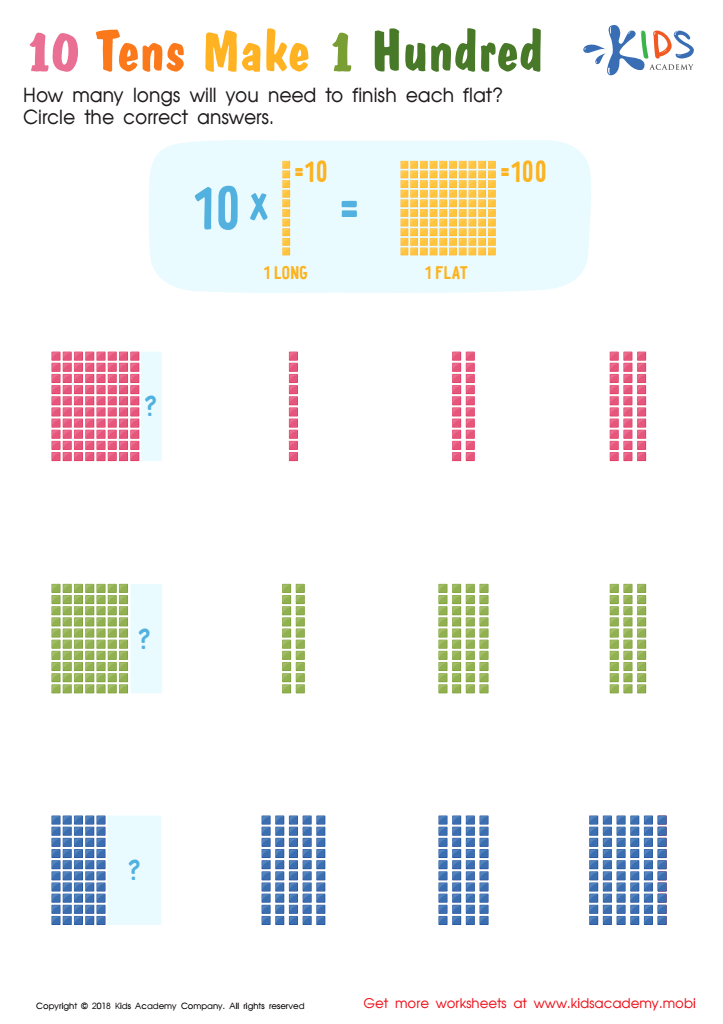
10 Tens Make 1 Hundred Worksheet
Help your child understand multiplication with this worksheet. Ask them how many 'longs' will be needed to complete each flat, then have them circle the correct answer from the options. With this exercise, your child will learn that 10 'tens' make 1 'hundred'!
 Assign to My Students
10 Tens Make 1 Hundred Worksheet
Worksheet
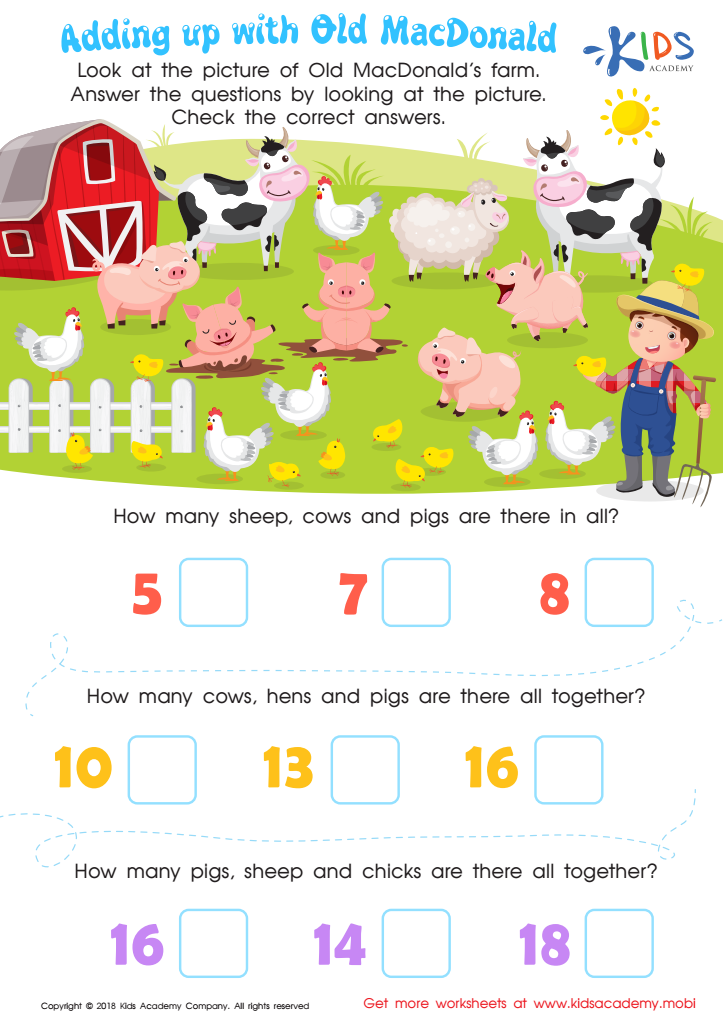
Adding Up with Old MacDonald Worksheet
Old MacDonald needs help counting his animals! Give your little math whiz a fun challenge with a free PDF worksheet. They'll love counting the animals and doing basic addition with two or three addends. Who knew math could be so much fun on the farm?
Adding Up with Old MacDonald Worksheet
Worksheet
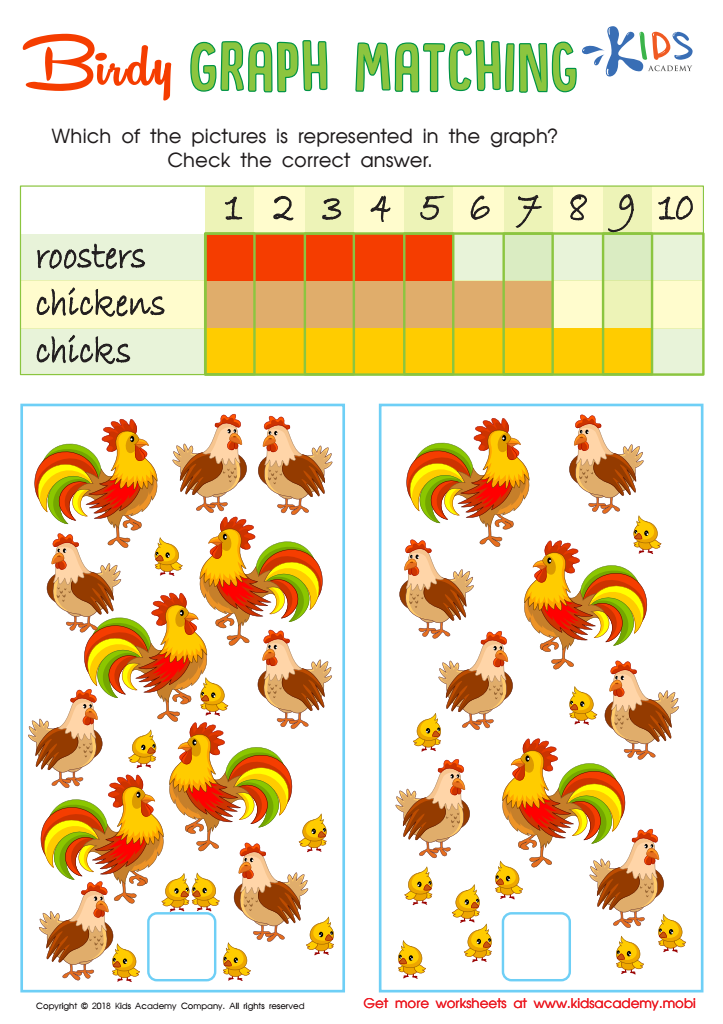
Birdy Graph Matching Worksheet
Treat your little one to a fun worksheet to practice visual discrimination, counting, graphing and tallying! They will sort the birds, count and assign values and use graph reading to answer the questions. They'll be so busy enjoying the counting that they won't even realize they are honing their skills!
Birdy Graph Matching Worksheet
Worksheet
Join Kids Academy for Free
Who is primarily going to use this learning content?








Counting proficiency in children aged 4 to 9 is crucial for their mathematical foundation and overall cognitive development. During these formative years, children develop essential skills that will impact their future learning experiences. Parents and teachers should prioritize counting proficiency because it lays the groundwork for various mathematical concepts such as addition, subtraction, and understanding number relationships.
Additionally, mastering counting enhances children's confidence and fosters a positive attitude toward math. When children can comfortably count, they are better prepared to tackle more complex problems as they progress in their education. This skill also promotes critical thinking and problem-solving abilities, which are invaluable across all subjects.
Moreover, counting helps develop fine motor skills, as children engage with numbers through manipulation of objects or drawing. Encouraging counting can also lead to vibrant discussions about patterns, sequencing, and grouping, which enriches their language and cognitive skills.
By investing time and resources into developing counting proficiency, parents and teachers create a learning environment that nurtures curiosity and a love for math. Additionally, early proficiency can bridge educational gaps, ensuring that all children have equitable access to mathematical knowledge as they continue their academic journeys.








