Fraction identification Math Worksheets for Ages 4-9
6 filtered results
-
From - To
Discover our engaging Fraction Identification Math Worksheets designed specifically for children ages 4-9! These hands-on activities introduce young learners to the fundamental concept of fractions in a fun and interactive way. Each worksheet is filled with colorful visuals and easy-to-understand examples that help kids identify and understand different fractions. Perfect for classroom use or at-home learning, our worksheets cater to various skill levels, ensuring every child can build a strong foundation in mathematical concepts. Foster your child’s confidence and love for math with these exciting fraction identification resources. Start their math journey today and watch them excel!
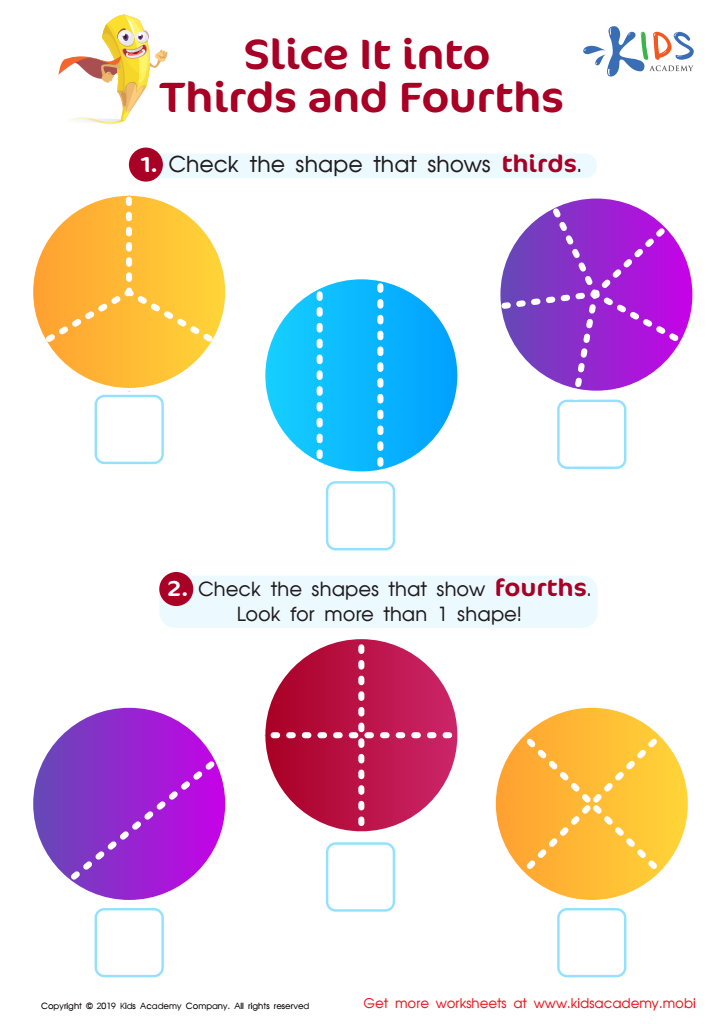
Slice in Thirds Fourths Worksheet
 Assign to My Students







Fractions are foundational mathematical concepts that play a crucial role in a child’s cognitive development. For children aged 4-9, learning about fractions enhances their understanding of numbers, measurement, and relationships between parts and wholes. This early grasp of fractions supports critical thinking and problem-solving skills, ultimately paving the way for more complex mathematical concepts in later grades.
Identifying fractions helps children develop a sense of proportionality and equips them with the tools to analyze their surroundings. For instance, sharing food or dividing toys introduces practical applications of fractions in everyday life. As children learn to identify and represent fractions, they gain confidence in their mathematical abilities, fostering a positive attitude toward learning.
Moreover, early exposure to fraction concepts aids in literacy and language development. Children learn vocabulary related to portions, equality, and comparisons, linking math strategies to real-world scenarios. As family members and educators support fraction identification, they play an integral part in laying the groundwork for effective mathematical skills, critical for future academic success. Recognizing fractions from the start allows children to build a strong mathematical foundation, ensuring they are well-prepared for more advanced topics as they advance through their education.








