Improve counting skills Math Worksheets for Ages 4-9 - Page 3
53 filtered results
-
From - To
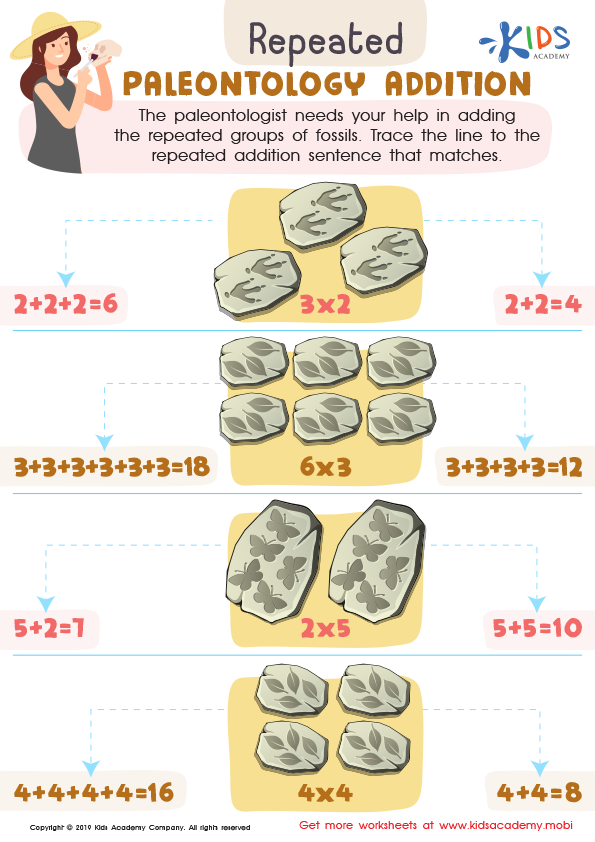
Repeated Archaeology Addition Worksheet
 Assign to My Students






Improving counting skills in children aged 4-9 is crucial for their overall mathematical development and future academic success. Counting is the foundational building block of mathematics, and proficiency in this area benefits a child's cognitive abilities, problem-solving skills, and confidence in tackling various subjects. During early childhood, students absorb information like sponges, making it the ideal time to introduce and solidify core math concepts.
When parents and teachers prioritize the development of counting skills, they help children sharpen their number sense—a critical aspect of understanding values, quantities, and numerical relationships. These abilities pave the way for grasping more advanced math topics, such as addition, subtraction, multiplication, and division, as students progress in their education.
Furthermore, counting activities encourage logical thinking, pattern recognition, and memory enhancement, contributing to better performance in other academic areas and daily life tasks. For instance, children learn to measure ingredients in recipes, estimate time, and manage money, which are practical skills that foster independence.
Ultimately, fostering strong counting skills sets the stage for lifelong learning, cultivating an inquisitive and confident mindset in children. Parents and teachers who nourish this essential skill are investing in their children’s overall intellectual development and success.








