Improve vocabulary Math Worksheets for Ages 4-9
3 filtered results
-
From - To
Unlock your child's potential with our "Improve Vocabulary Math Worksheets for Ages 4-9." Designed to blend core math skills with essential vocabulary building, these worksheets make learning fun and engaging. Each activity encourages young learners to grasp mathematical concepts while expanding their word knowledge, applicable both in academics and daily conversations. With colorful designs and interactive tasks, children stay motivated, fostering a love for learning and boosting their confidence. Ideal for both classroom and home use, these worksheets ensure a well-rounded approach to early education, setting a strong foundation for your child's future academic success.
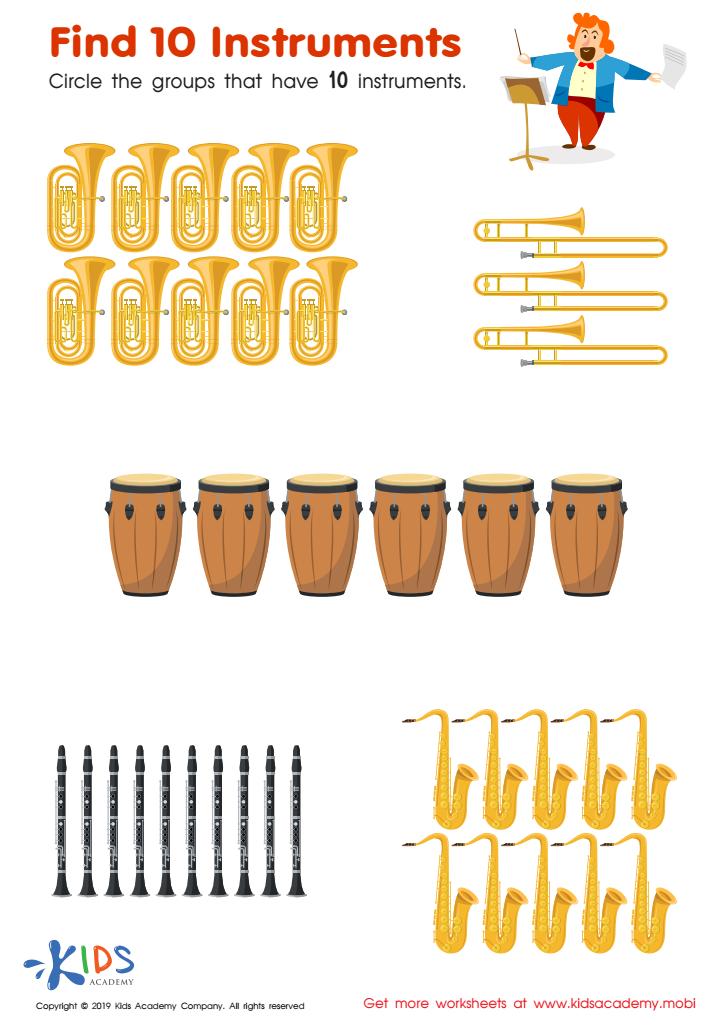
Find 10 Instruments Worksheet
 Assign to My Students








Fostering a strong mathematical vocabulary in children aged 4-9 is crucial for several reasons. First, it lays the foundation for more advanced mathematical understanding. When children grasp the correct terms and concepts, like "addition," "subtraction," "doubles," or "halves," they’re better equipped to tackle complex problems later on. Clarity in vocabulary reduces confusion and frustration, making math more accessible and enjoyable.
Second, strong math skills are essential for success in many areas of life. Early comprehension of mathematical vocabulary ensures that children develop numeracy skills vital for everyday tasks—whether it’s telling time, measuring ingredients for a recipe, or managing money.
Third, early proficiency in mathematical language improves overall cognitive development. Math trains the brain to think logically and critically, fostering problem-solving skills that are transferable to other subjects and real-life situations. Additionally, being proficient in the language of math boosts a child's confidence, encouraging them to participate actively in class and approach new challenges positively.
Finally, socio-economic research consistently shows that early math proficiency can predict academic success and future job prospects. In a rapidly evolving world driven by technology and data, a solid foundation in math, starting with a strong vocabulary, is indispensable. Therefore, parents and teachers should prioritize building a strong mathematical vocabulary to ensure holistic growth and lifelong success for children.








