
Practice problem-solving Math Worksheets for Ages 4-9
5 filtered results
Difficulty Level
Grade
Age
-
From - To
Subject
Activity
Standards
Unlock your child’s mathematical potential with our engaging practice problem-solving math worksheets designed for ages 4-9. These worksheets encourage critical thinking and help develop essential problem-solving skills through a variety of fun activities. Each worksheet is crafted to challenge young minds while aligning with educational standards, making learning both enjoyable and effective. Parents and teachers can easily print these resources for classroom use or at-home practice. Our collection covers key concepts, ensuring kids gain confidence and foundational knowledge in math. Explore our vast selection today and give your child the tools they need for mathematical success!
Favorites
With answer key
Interactive
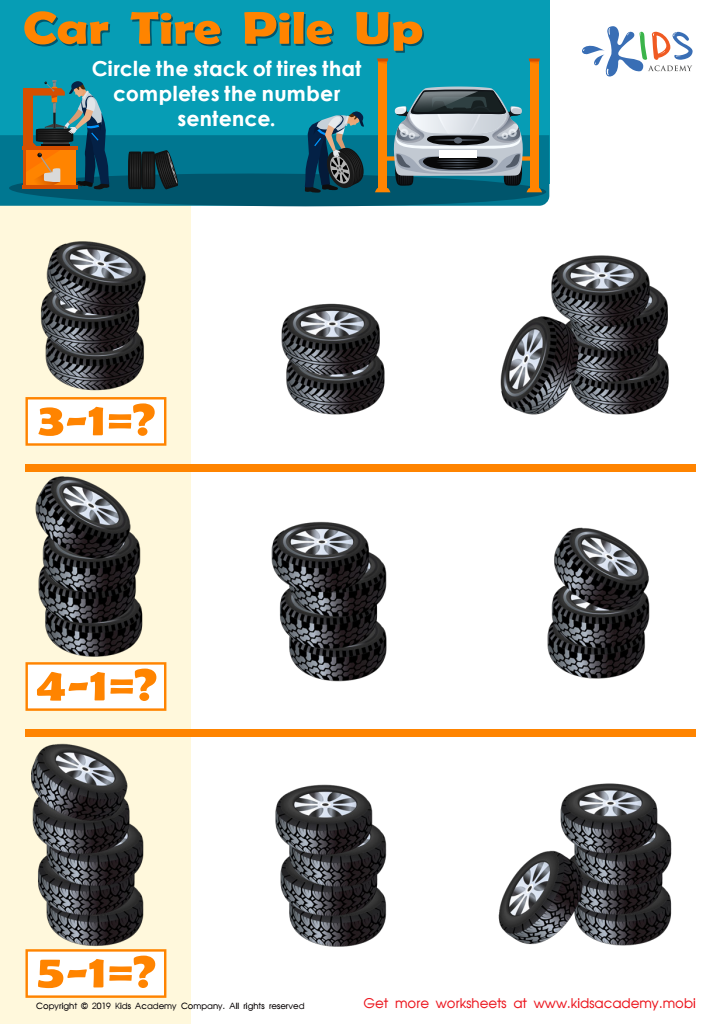
Car Tire Pile Up Worksheet
Examine the pic with your kids. Can they recognize the items piled up? The tires are organized in different quantities. Equations are on the left. Have your children work out the equations, counting the tire stacks to identify the correct answer.
 Assign to My Students
Car Tire Pile Up Worksheet
Worksheet
Join Kids Academy for Free
Who is primarily going to use this learning content?








Parents and teachers should prioritize practice problem-solving math for children aged 4-9 because it lays the critical foundation for cognitive development and lifelong learning. At this young age, children's brains are highly adaptable and capable of growing through engaging activities that challenge their thinking processes.
Problem-solving encourages children to develop logical reasoning, critical thinking skills, and the ability to approach challenges methodically. When children engage in math problem-solving, they learn to identify patterns, make predictions, and evaluate solutions which fosters resilience—an essential quality for academic success and personal growth.
Moreover, math is not just about numbers; it encompasses understanding spatial awareness, measurements, and relationships among objects, which all aid in broader analytical skills. Integrating these practices in early education builds children's confidence with math concepts, transforming what is often seen as a daunting subject into an enjoyable and relatable experience.
Furthermore, collaborative problem-solving activities enhance social skills and teamwork, essential life competencies. By involving themselves in their children's math learning, parents and teachers help cultivate curiosity and a warm attitude toward lifelong learning, ensuring that children are not only prepared for future academic challenges but also equipped to face the complexities of real-world situations.








