
Reading analog clocks Math Worksheets for Ages 4-9
8 filtered results
Difficulty Level
Grade
Age
-
From - To
Subject
Activity
Standards
Discover our engaging "Reading Analog Clocks Math Worksheets" designed specifically for children aged 4-9. These fun and interactive worksheets help young learners master the essential skill of telling time on analog clocks. With colorful visuals and age-appropriate exercises, children will enjoy practicing how to read clocks, understand time notation, and develop their number recognition. Our resources encourage hands-on learning, ensuring that kids not only grasp the concept but also build confidence in their math skills. Perfect for home or classroom use, these worksheets will make mastering time-telling an exciting adventure for your little ones! Explore now and start the time-telling journey!
Favorites
With answer key
Interactive
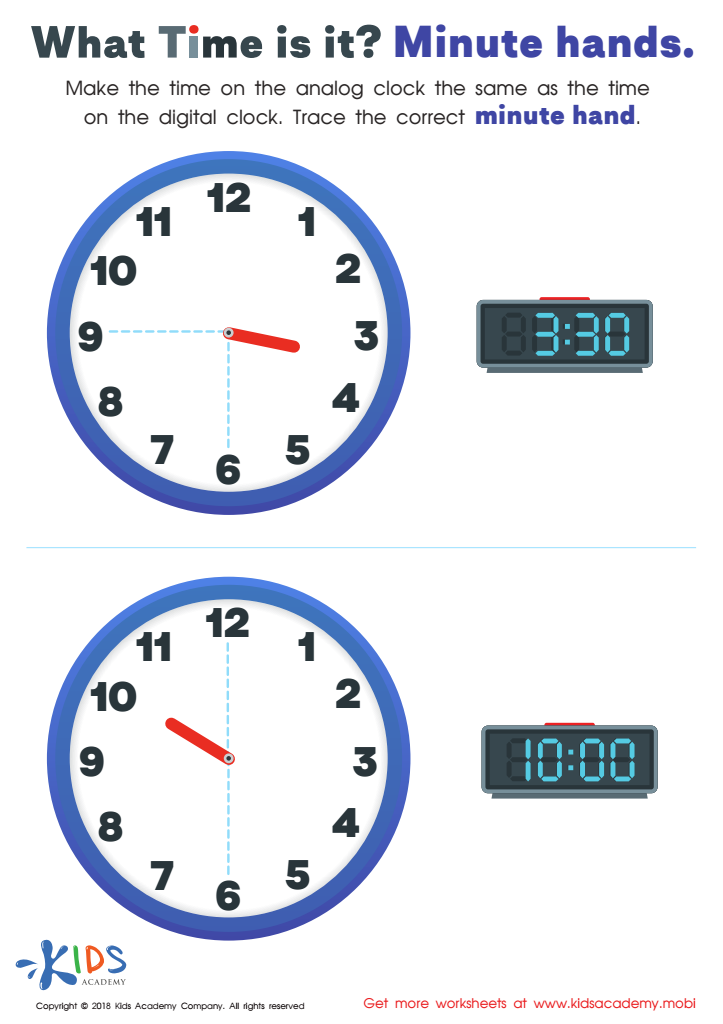
What Time Is it? Minute Hands Worksheet
Help your kids telling time with the minute hand correctly with this tracing sheet. Trace the correct minute hand to make the time on the analog clock the same as the time on the digital clock. Give them a pictured demonstration of how to do it and you'll be all set!
 Assign to My Students
What Time Is it? Minute Hands Worksheet
Worksheet
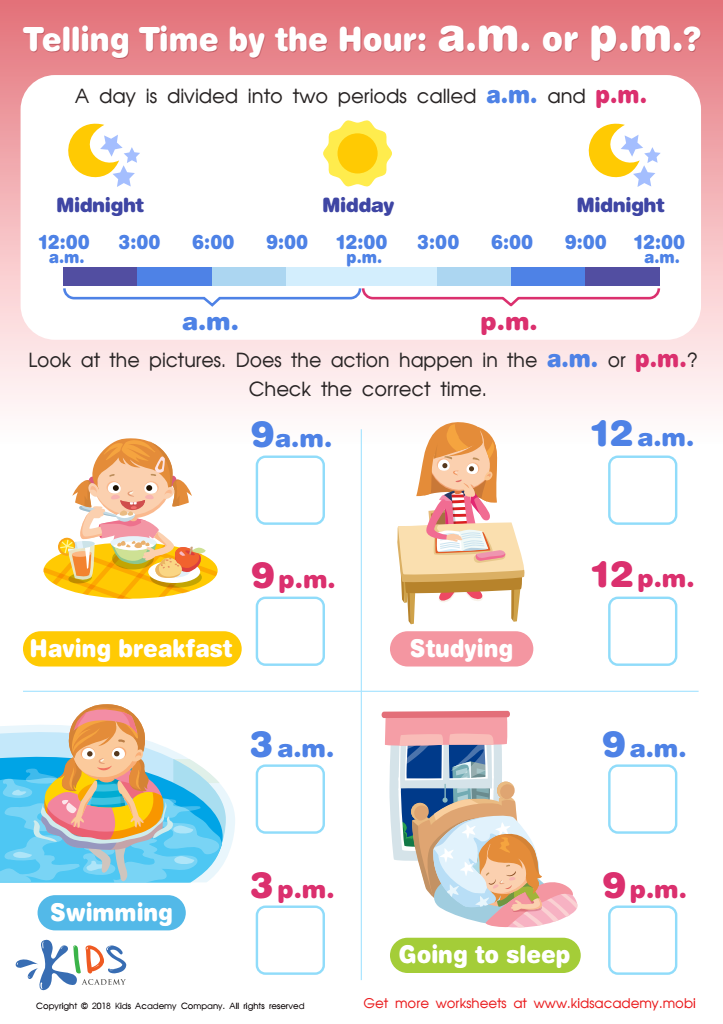
Tilling Time by the Hour: a.m. or p.m.? Worksheet
Can your child tell the time? This worksheet will help them learn. Explain a.m and p.m. and look at the pictures together. Ask your child if the activities happen in the a.m or p.m and help them check the correct time.
Tilling Time by the Hour: a.m. or p.m.? Worksheet
Worksheet
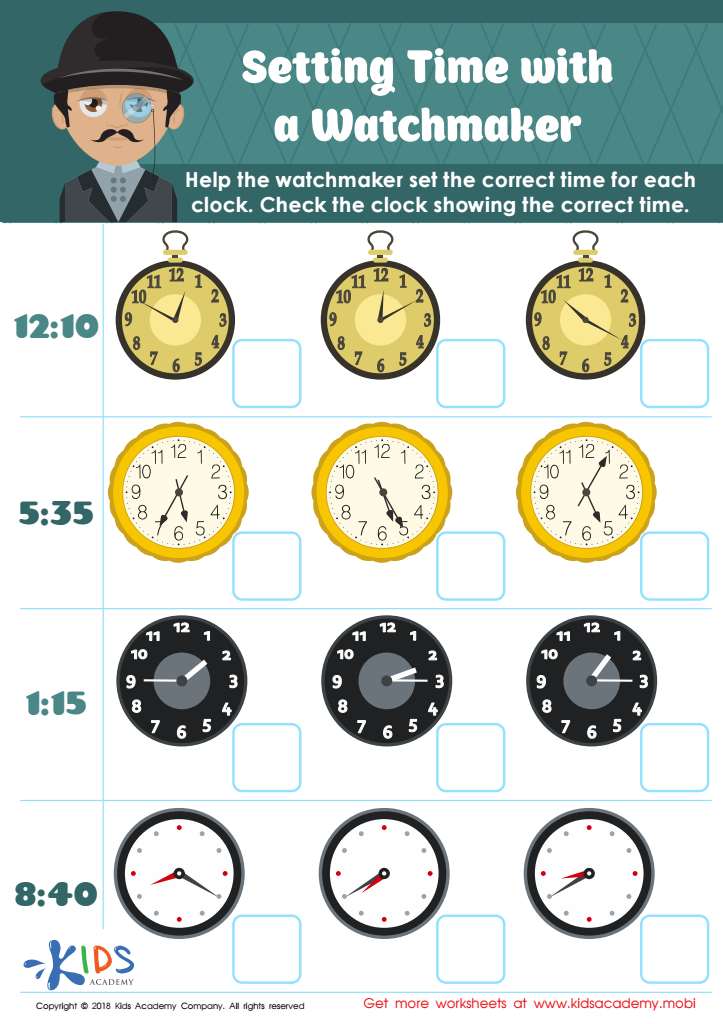
Setting Time with Watchmaker Worksheet
Can your kids tell the time? If so, this worksheet should be easy. Help them set the time for each clock: look at the time written on the left side and find the clock on the right side that matches.
Setting Time with Watchmaker Worksheet
Worksheet
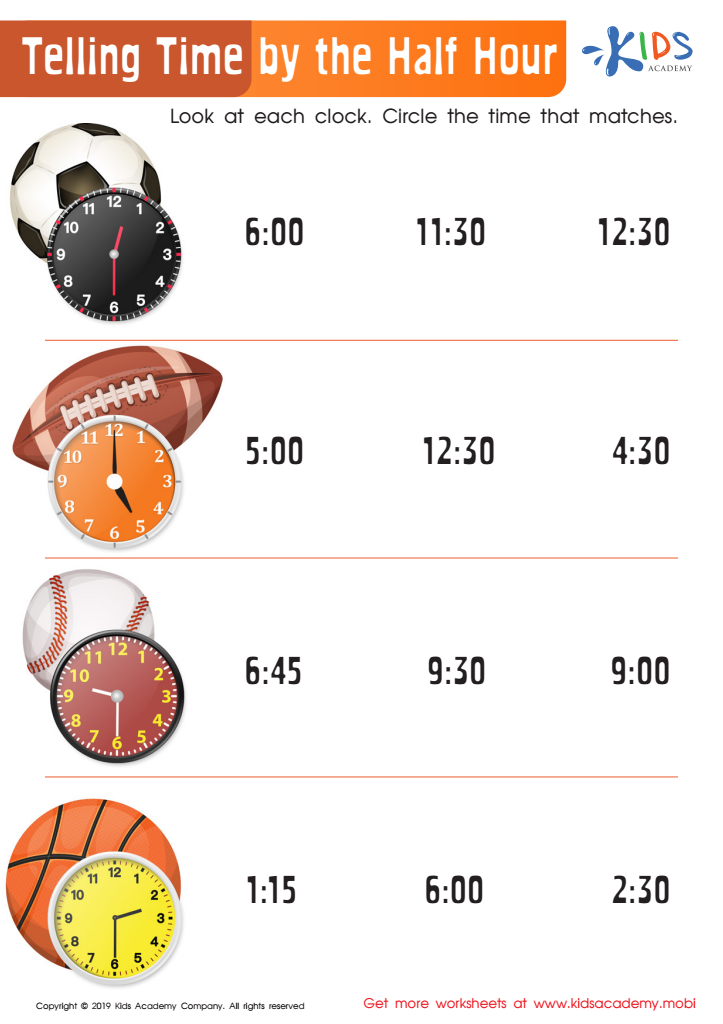
Telling Time by the Half Hour Worksheet
Teach kids to tell time with this worksheet! Four clocks are labeled with different times; help your child circle the right one. It's a great way to teach them to read analog and digital clocks, watches, and written times. Easy and fun learning!
Telling Time by the Half Hour Worksheet
Worksheet
Join Kids Academy for Free
Who is primarily going to use this learning content?







Teaching children to read analog clocks is an essential foundational skill that goes beyond merely telling time. For parents and teachers, caring about this subject holds immense significance for several reasons. Firstly, reading an analog clock helps develop critical thinking and spatial awareness, as children learn to interpret the position of hourly and minute hands. This skill reinforces their understanding of fractions and the concept of division—30 minutes being half an hour, for example.
In a world increasingly dominated by digital technology, analog clocks often remain prevalent in various settings, such as schools, public transportation, and traditional settings. Ensuring that children are proficient in reading analog clocks equips them with practical life skills they will continue to use into adolescence and adulthood.
Additionally, learning to tell time can enhance a child's sense of responsibility and independence—assigning them the ability to manage their time effectively for activities, school, and social events. It also fosters discussions about routines, enhancing numeracy skills in a context children find relatable. Ultimately, introducing this skill in early education not only enriches a child's academic journey but also prepares them for everyday experiences that require time management.








