
Comparing object weights Worksheets for Ages 5-6
3 filtered results
Difficulty Level
Grade
Age
-
From - To
Subject
Activity
Standards
Explore our engaging "Comparing Object Weights Worksheets" designed specifically for children aged 5-6. These fun and interactive worksheets help young learners develop essential skills in weight comparison through colorful illustrations and relatable scenarios. Kids will practice identifying heavier and lighter objects while honing their reasoning and critical thinking abilities. Our carefully crafted activities encourage hands-on learning that makes foundational concepts accessible and enjoyable. Perfect for classroom or home use, these worksheets not only build mathematical understanding but also inspire a love for learning. Download today and start your child’s journey in comparing weights with confidence and excitement!
Favorites
With answer key
Interactive
 Assign to My Students
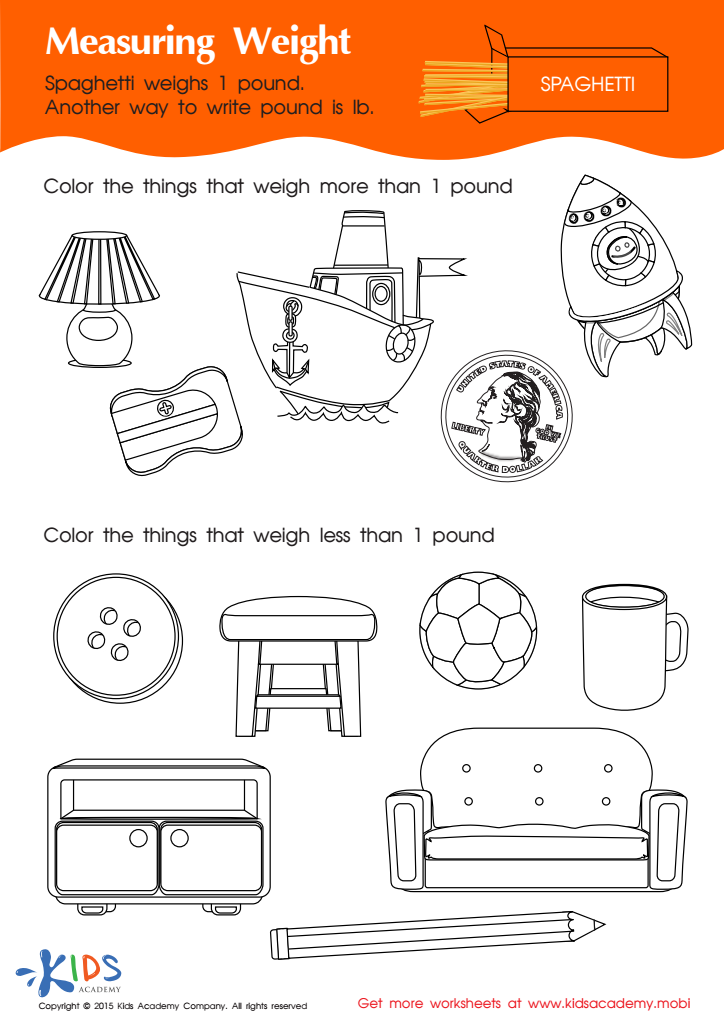
Measurement: Measuring Weight in Pounds 1 Worksheet
Worksheet
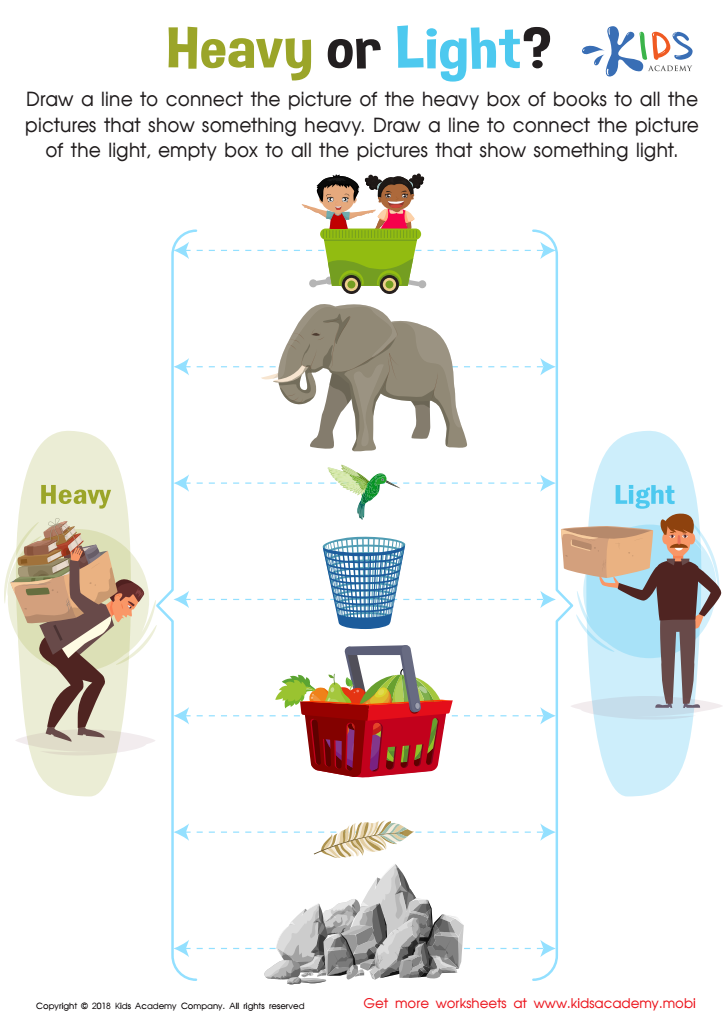
Heavy or Light? Worksheet
Kids can struggle to understand weight comparison, as size and mass matter. This free PDF helps develop fine-motor and hand-eye skills as kids trace lines to match pictures. The familiar pictures create concrete representations, ideal for learning more complex concepts.
Heavy or Light? Worksheet
Worksheet
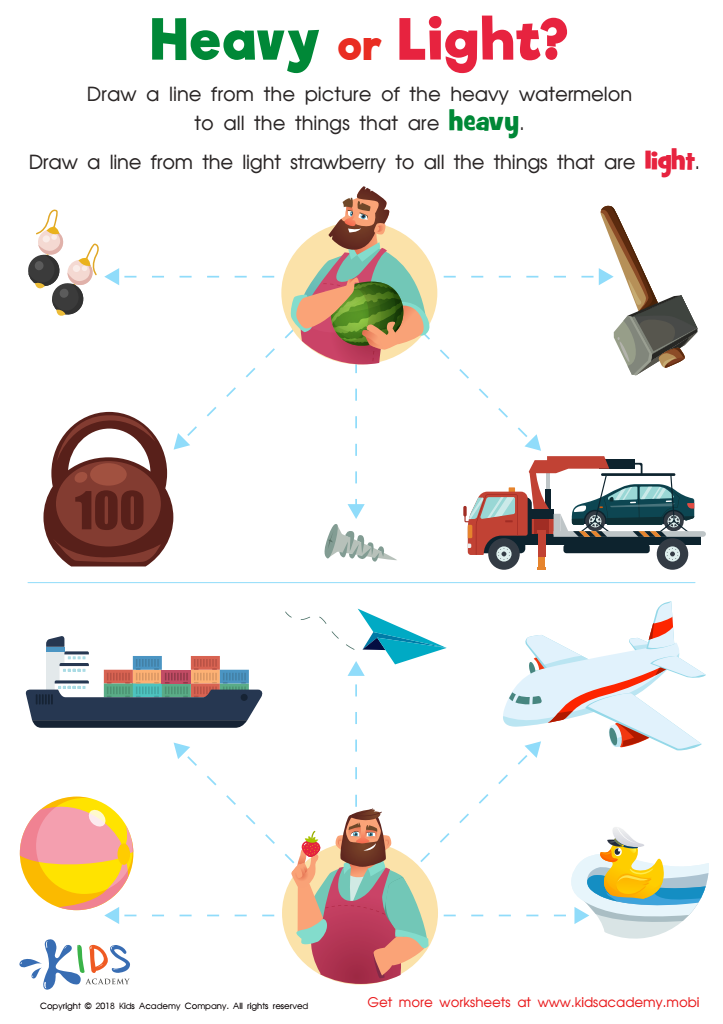
Heavy or Light? Worksheet
This fun, free worksheet helps kids build measurement skills and reinforce concepts of 'heavy' and 'light', while also improving their fine motor skills. Kids use traceable lines to connect the gentleman to objects they know, giving them a strong foundation for understanding weight.
Heavy or Light? Worksheet
Worksheet
Join Kids Academy for Free
Who is primarily going to use this learning content?



.jpg)


Comparing object weights is an essential mathematical and scientific concept, particularly for children aged 5-6. At this developmental stage, children are naturally curious and eager to explore their environment, and engaging them in weight comparison activities fosters their inherent curiosity. Parents and teachers should care about this skill because it lays the foundation for critical thinking and problem-solving abilities.
Understanding weight helps children develop measurement skills, which are foundational for later math education. By comparing lighter and heavier objects, children enhance their vocabulary with terms like "heavier," "lighter," and "equal," aiding in their language development as well. Additionally, these activities promote fine motor skills through hands-on experiences, such as using scales and balancing objects, which are crucial at this age.
Furthermore, comparing weights encourages collaborative play and communication when children work in pairs or groups. This social interaction helps cultivate teamwork and interpersonal skills. Lastly, it introduces basic scientific principles like gravity and density in a tangible way. In summary, focusing on comparing object weights at this early age not only supports a child's cognitive and social development but also makes learning fun and engaging.








