
Grammar skills Worksheets for Ages 5-6
3 filtered results
Difficulty Level
Grade
Age
-
From - To
Subject
Activity
Standards
Discover our engaging Grammar Skills Worksheets for Ages 5-6, designed to build a strong foundation in language fundamentals. Our printable activities are crafted to enhance vocabulary, improve sentence structure, and develop punctuation knowledge through fun and interactive exercises. Each worksheet encourages creativity and critical thinking, allowing young learners to explore language in an enjoyable way. With colorful illustrations and age-appropriate challenges, these resources are perfect for both classroom and home learning. Help your child gain confidence in their grammar skills and prepare them for future academic success. Explore our wide range of worksheets and watch your child's language abilities flourish!
Favorites
With answer key
Interactive
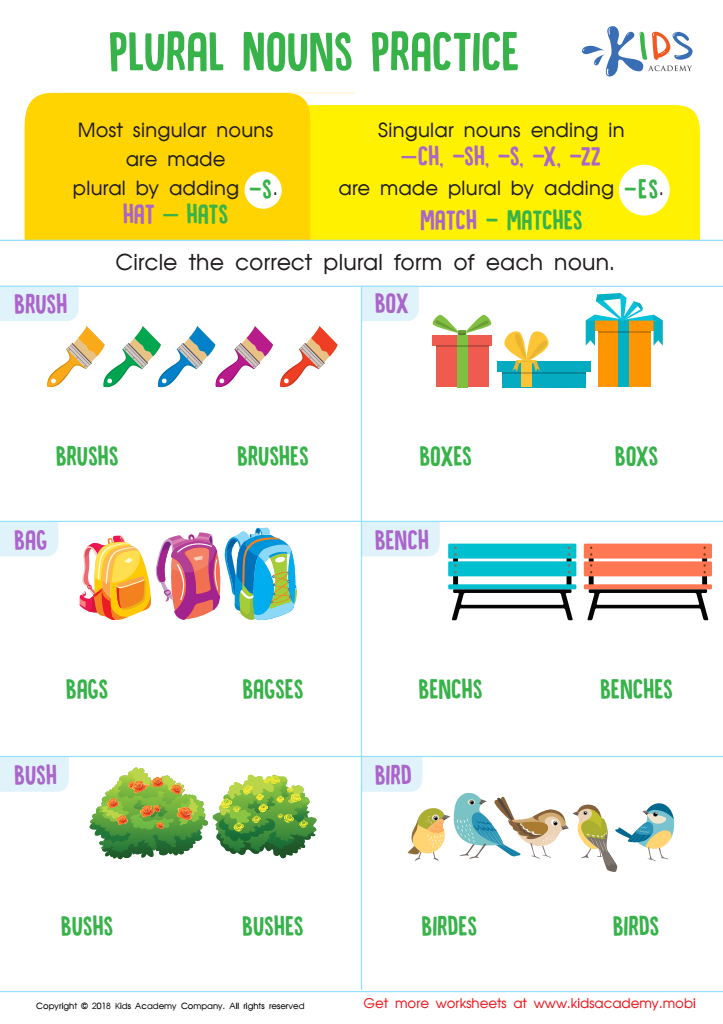
Plural Nouns Practice Worksheet
Explain to your child that most singular nouns become plural by adding "-s". E.g. "cat"->"cats". For words ending in "-ch", "-sh", "-s", "-x", or "-zz", add "-es". E.g. "buzz"->"buzzes". Then, get them to circle the right plural form of each noun on the worksheet.
 Assign to My Students
Plural Nouns Practice Worksheet
Worksheet
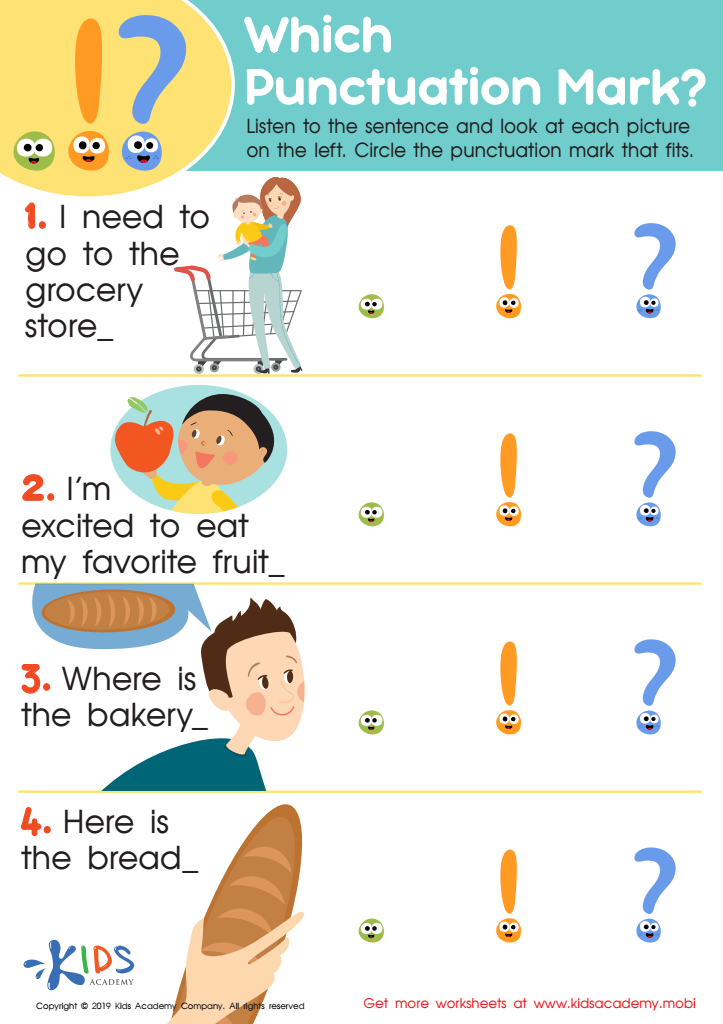
Which Punctuation Mark Worksheet
Punctuation marks are essential for expressing what we say. This worksheet asks your kindergarten student to circle the correct punctuation mark for each sentence. Read each sentence aloud and help them identify the expression needed. A picture accompanies each sentence. Enjoy! (79 words)
Which Punctuation Mark Worksheet
Worksheet
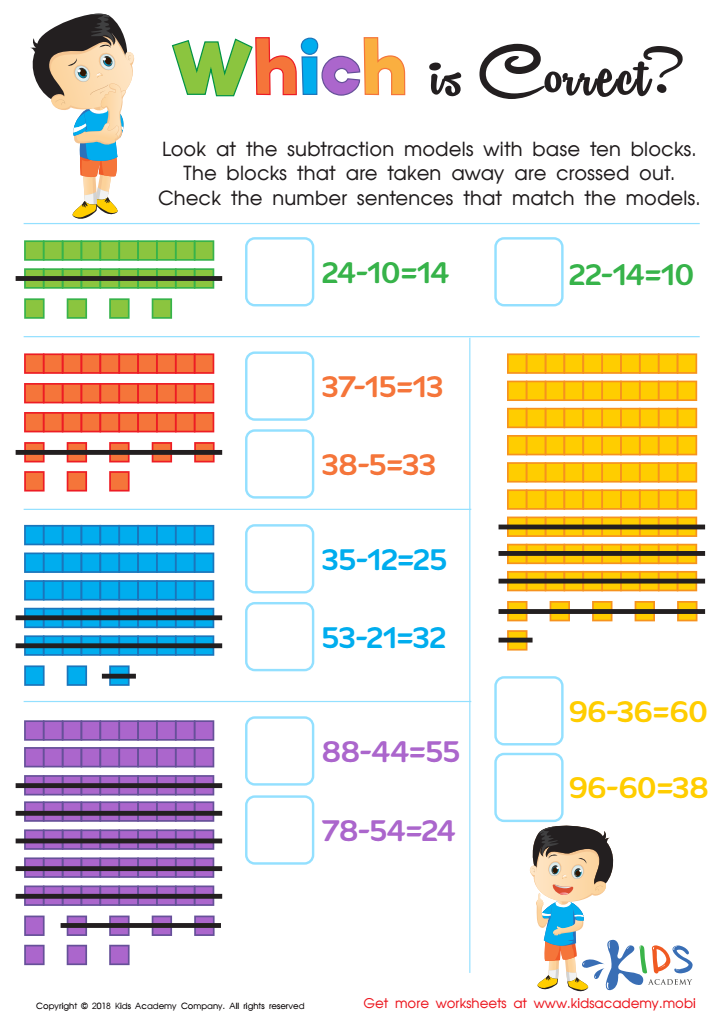
Which Is Correct? Math Worksheet
Young mathematicians will gain confidence solving subtraction problems with this bright, colorful worksheet. They'll use base ten blocks representations, then pick the right number sentence to match. It's great practice for developing number sense, helping them excel in higher-level math.
Which Is Correct? Math Worksheet
Worksheet
Join Kids Academy for Free
Who is primarily going to use this learning content?








Parents and teachers should prioritize grammar skills for children aged 5-6 because these foundational abilities are crucial for effective communication and literacy development. At this age, children are beginning to construct sentences and express their thoughts more clearly. By introducing them to basic grammar concepts, such as nouns, verbs, and simple sentence structure, we lay the groundwork for their understanding of language.
Strong grammar skills improve a child’s reading comprehension and writing abilities. As they learn to recognize how sentences are formed, they become more confident readers and writers. This early exposure enhances their ability to convey ideas clearly, crucial in a world where effective communication plays a significant role both academically and socially.
Furthermore, mastering grammar helps children develop critical thinking, as they learn to analyze and construct their own sentences, strengthening their cognitive skills. Encouraging children to use proper grammar also builds their self-esteem; they feel proud of their language skills and are more willing to participate in discussions and storytelling.
In essence, instilling grammar skills in young children fosters literacy, communication proficiency, and cognitive development, setting them up for future academic success in an increasingly complex world.








