Practical math application Measurement Worksheets for Ages 5-6
3 filtered results
-
From - To
Enhance your child's practical math skills with our engaging Measurement Worksheets for Ages 5-6. Carefully designed to make learning fun and effective, these worksheets focus on real-world applications of measurements. Kids Academy offers a variety of exercises that help young learners understand concepts like length, weight, and volume. Through hands-on activities and playful tasks, children will develop critical thinking and problem-solving skills. Suitable for classroom use or at-home practice, our age-appropriate worksheets are perfect for early grade students. Visit Kids Academy to explore our collection and support your child’s journey to math proficiency.
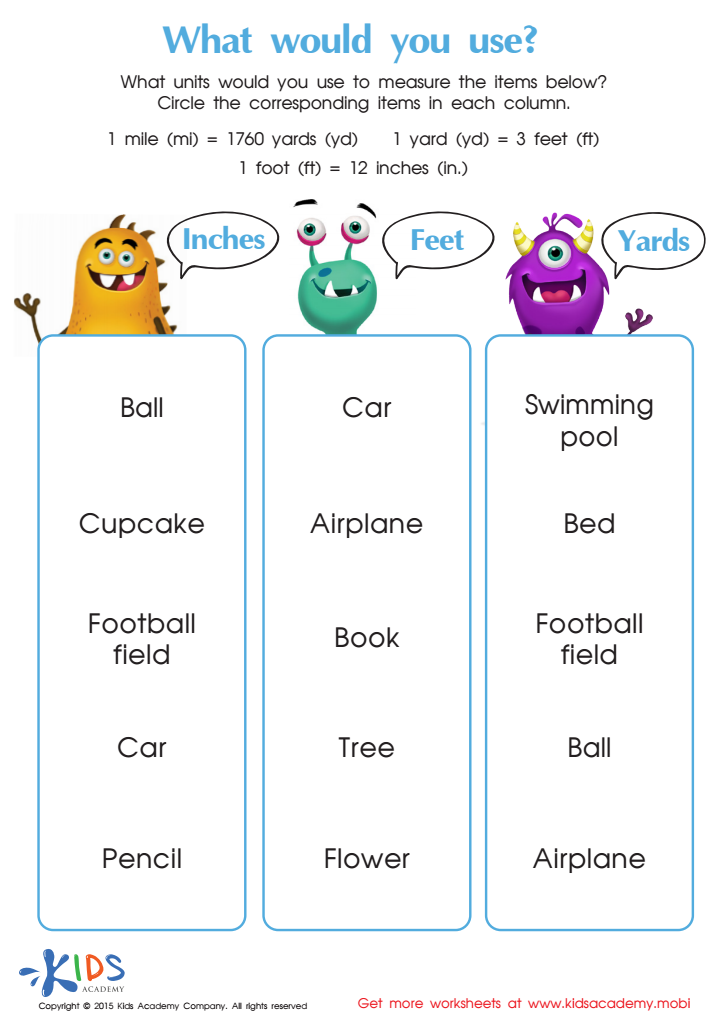
Learning about measuring objects in inches, feet and yards Worksheet
 Assign to My Students
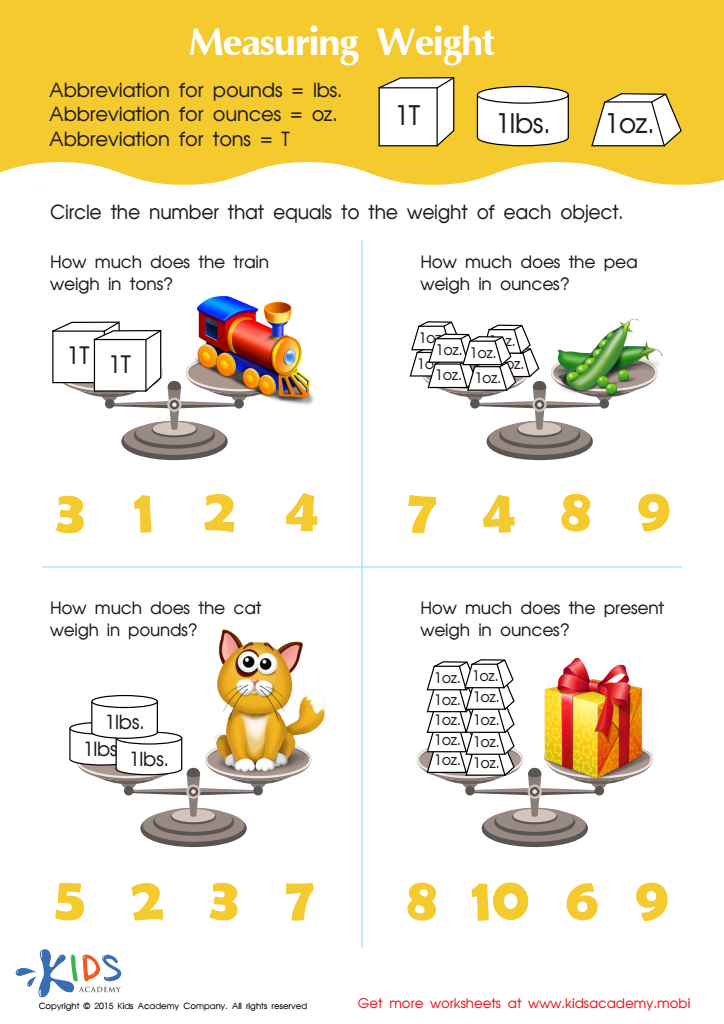
Measuring Weight in Ounces, Pounds and Tons Worksheet
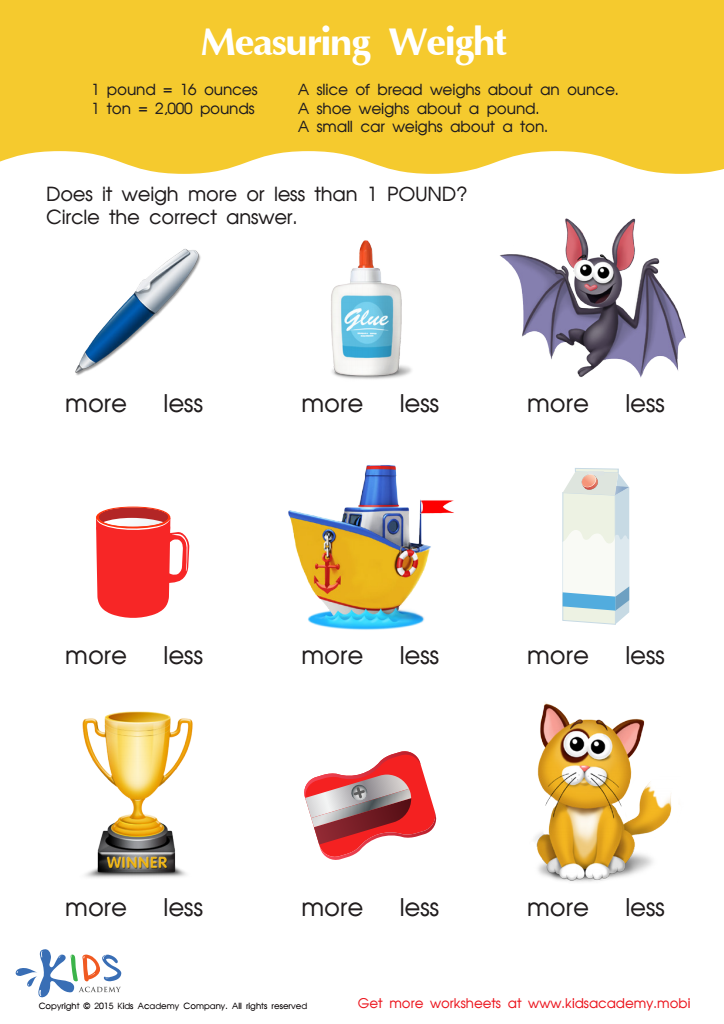
Measuring weight in pounds Worksheet








Parents and teachers should care about practical math applications, particularly measurement, for ages 5-6 because it lays the foundation for essential life skills and cognitive development. At this formative age, children are beginning to make sense of the world around them. By engaging in hands-on measurement activities, young kids learn to compare, estimate, and understand quantities and dimensions, which are foundational concepts in math and everyday problem-solving.
When children measure objects, whether using blocks, rulers, or even their own feet, they develop critical thinking and spatial awareness. These activities are not just about math; they also support language development by encouraging children to use descriptive words such as "longer," "shorter," "heavier," and "lighter," thus enhancing their vocabulary and communication skills.
Measurement activities provide interactive and practical learning experiences that encourage curiosity and experimentation. For instance, cooking offers lessons in volume and weight, while building projects can teach lengths and heights. These real-world applications make learning engaging and meaningful, promoting a positive attitude towards math.
Additionally, early exposure to measurement helps to build confidence and proficiency in math. This solid mathematical foundation will not only prepare children for more advanced math concepts in the future but also equip them with everyday skills vital for their academic and personal lives.








