
Reading analog clocks Time Worksheets for Ages 5-6
3 filtered results
Difficulty Level
Grade
Age
-
From - To
Subject
Activity
Standards
Introduce your child to the world of time-telling with our engaging "Reading Analog Clocks Time Worksheets" designed for ages 5-6. These worksheets provide young learners with fun and interactive activities to help them master reading analog clocks. From identifying hour and minute hands to understanding full and half hours, our carefully crafted exercises ensure that kids grasp time concepts with ease. Boost their confidence and watch their time-reading skills flourish. Ideal for both classroom and home practice, these worksheets cater to your child's learning pace, making the learning experience enjoyable and effective. Start your time-telling journey today!
Favorites
With answer key
Interactive
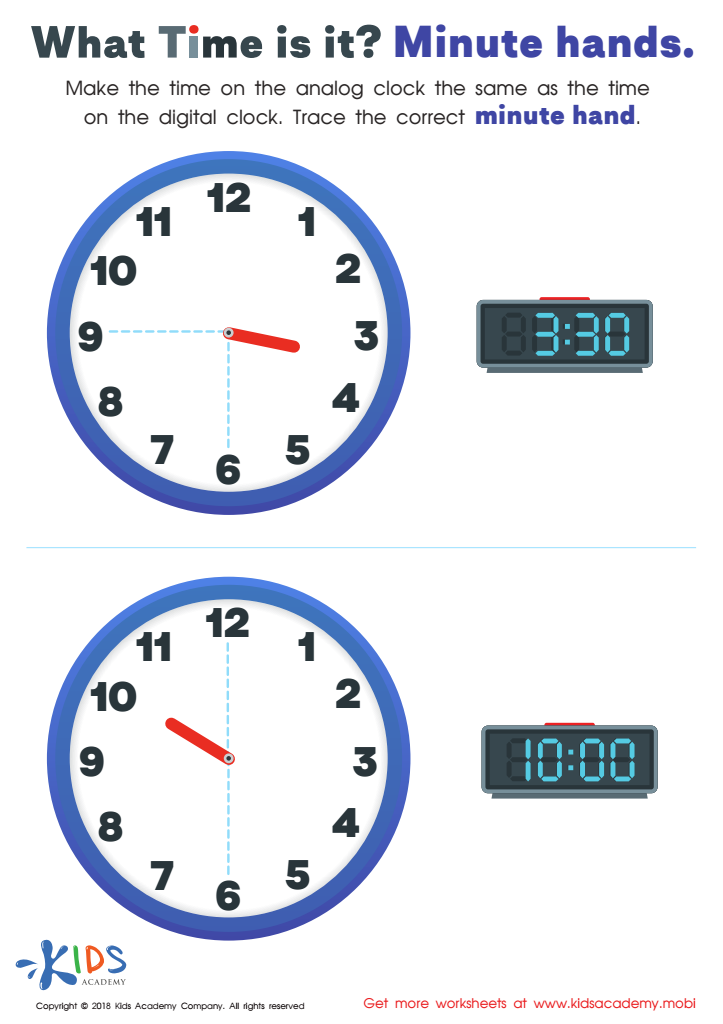
What Time Is it? Minute Hands Worksheet
Help your kids telling time with the minute hand correctly with this tracing sheet. Trace the correct minute hand to make the time on the analog clock the same as the time on the digital clock. Give them a pictured demonstration of how to do it and you'll be all set!
 Assign to My Students
What Time Is it? Minute Hands Worksheet
Worksheet
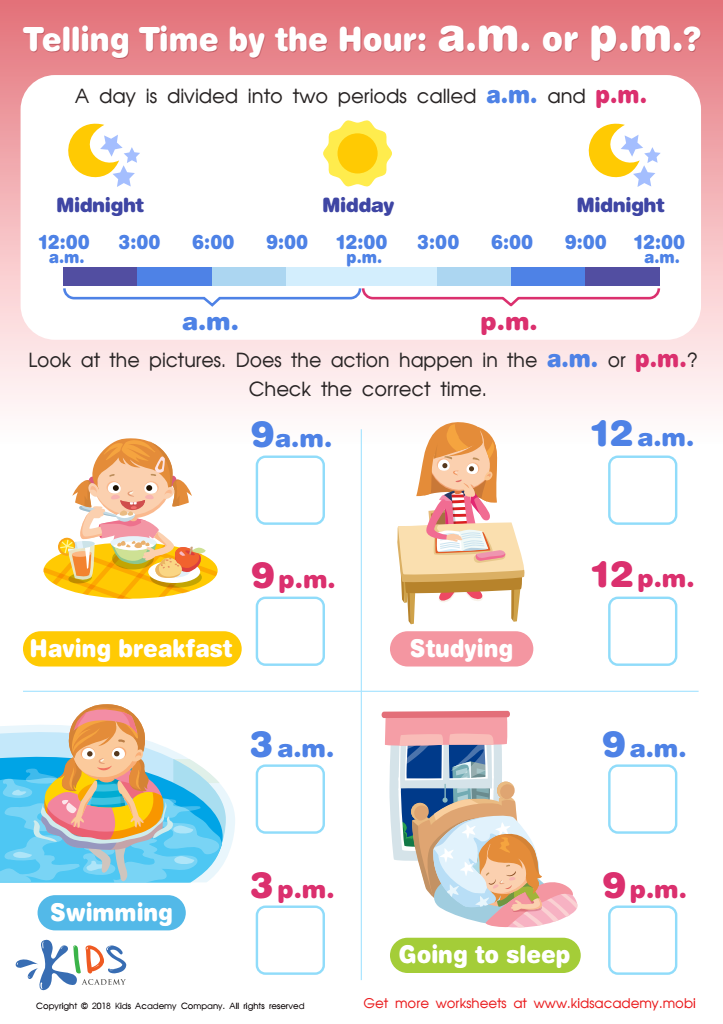
Tilling Time by the Hour: a.m. or p.m.? Worksheet
Can your child tell the time? This worksheet will help them learn. Explain a.m and p.m. and look at the pictures together. Ask your child if the activities happen in the a.m or p.m and help them check the correct time.
Tilling Time by the Hour: a.m. or p.m.? Worksheet
Worksheet
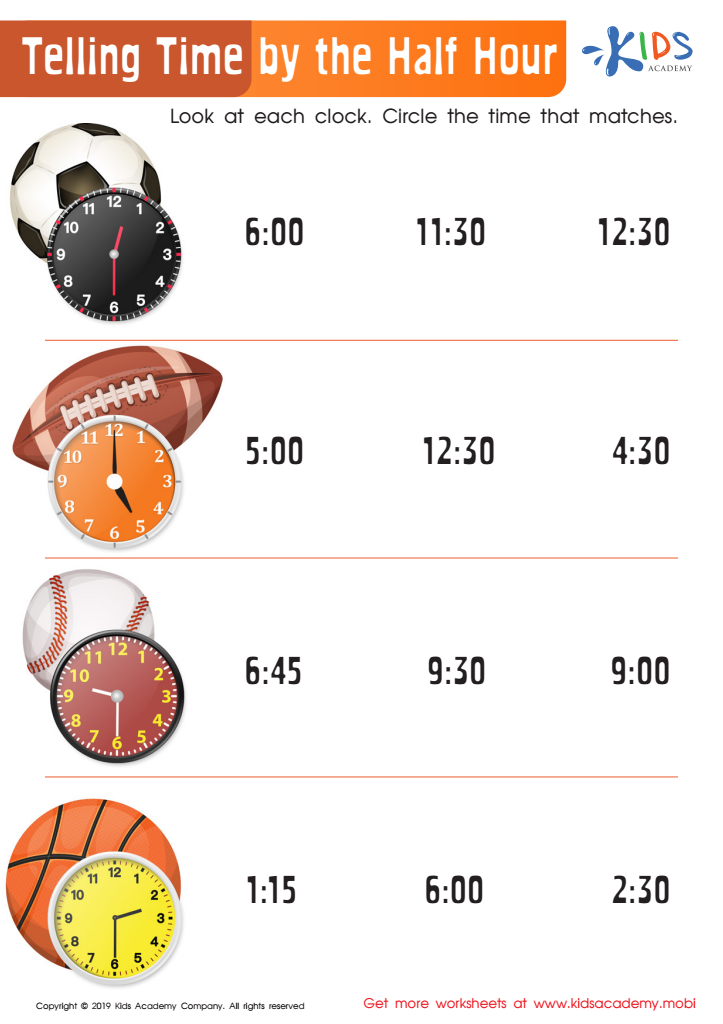
Telling Time by the Half Hour Worksheet
Teach kids to tell time with this worksheet! Four clocks are labeled with different times; help your child circle the right one. It's a great way to teach them to read analog and digital clocks, watches, and written times. Easy and fun learning!
Telling Time by the Half Hour Worksheet
Worksheet
Join Kids Academy for Free
Who is primarily going to use this learning content?








Parents and teachers should prioritize teaching children aged 5-6 how to read analog clocks because it aids their cognitive development in several key areas. Firstly, reading analog clocks helps young learners build basic arithmetic skills. They need to understand numbers and how to count by fives to determine the correct time, which strengthens their numerical abilities.
Secondly, mastering this skill improves their understanding of time management and daily routines. Children learn to associate specific times with actions, like knowing when it's time for lunch or play, fostering a sense of structure and responsibility.
Additionally, the analog clock is an important educational tool that introduces children to the concept of the passage of time. Unlike digital displays that show time at a glance, analog clocks visually represent the movement of time through the hands' progression, enhancing temporal awareness.
Moreover, engaging in this learning task also develops fine motor skills. Children manipulate the hands of toy clocks while they practice setting and reading the time, thereby improving their hand-eye coordination.
Lastly, learning to read analog clocks equips children with a life skill that, despite the prominence of digital devices, remains relevant. The ability to read both analog and digital formats ensures they're versatile and prepared for varied contexts.
By emphasizing the importance of this skill, parents and teachers lay a foundation for broader academic achievement and practical everyday functioning.








