
Encourage attention to detail Worksheets for Ages 5-7
3 filtered results
Difficulty Level
Grade
Age
-
From - To
Subject
Activity
Standards
Enhance your child's focus and precision with our "Encourage Attention to Detail Worksheets for Ages 5-7." Ideal for young learners, these worksheets engage children with fun and educational activities designed to sharpen their observation and problem-solving skills. Through interactive games, spot-the-difference exercises, and meticulous coloring tasks, your child will learn the importance of paying attention to detail while having fun. Boost their cognitive development and prepare them for academic success with resources that make learning an exciting adventure. Perfect for both classroom and at-home practice, these worksheets are a valuable addition to any learning toolkit.
Favorites
With answer key
Interactive
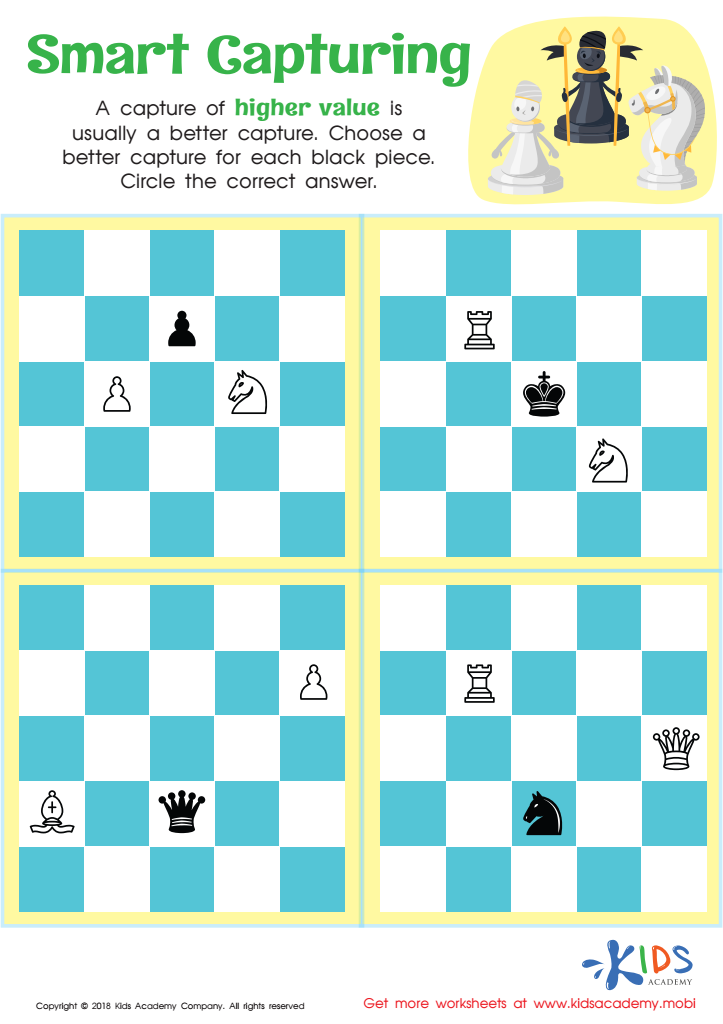
Smart Capturing Worksheet
Chess is a game of strategy and calculation. When presented with two captures, a player should always go for the one that yields the highest value. For example, taking a knight over a pawn. In this worksheet, your children will choose the best capture for each black piece. Ask them to circle the correct answers. (80 words)
 Assign to My Students
Smart Capturing Worksheet
Worksheet
Join Kids Academy for Free
Who is primarily going to use this learning content?


.jpg)





Encouraging attention to detail in children aged 5-7 is crucial for several reasons related to their overall development and future success. At this early stage, children's brains are rapidly developing, and fostering a knack for detail helps them enhance their cognitive abilities. Attentiveness to detail nurtures focused observation, critical thinking, and problem-solving skills, laying a foundation for lifelong learning and academic achievement.
When children pay attention to detail, they are more likely to excel in key areas such as reading, mathematics, and writing. They can follow directions more accurately, create well-organized work, and detect errors that need correcting, which boosts their confidence and self-reliance. For instance, in reading, noticing small nuances in text can significantly improve comprehension and vocabulary. In mathematics, careful attention prevents careless mistakes and solidifies basic concepts.
Moreover, paying attention to details supports emotional and social development. When children notice details in social interactions, they become more empathetic and responsive to others' feelings and needs, fostering better relationships. It also helps them follow complex instructions and rules in group settings like classrooms, enhancing cooperative learning and positive behavior.
Encouraging careful observation and attention to detail in young children equips them with valuable skills for school and beyond, promoting strong academic foundations, improved social interactions, and personal growth.








