Critical Thinking Adding up to 100 Without Regrouping Worksheets for Ages 5-7
3 filtered results
-
From - To
Explore our "Critical Thinking Adding Up to 100 Without Regrouping Worksheets" designed specifically for children aged 5-7. These engaging worksheets help young learners develop essential math skills while enhancing their critical thinking abilities. By practicing addition up to 100, students will build confidence in their arithmetic skills without the need for regrouping. Our worksheets feature a variety of challenges, from simple addition problems to creative scenarios that stimulate problem-solving. Ideal for both classroom and at-home learning, these resources will empower your child to think critically while mastering key mathematical concepts. Foster a love for learning and watch your child excel!
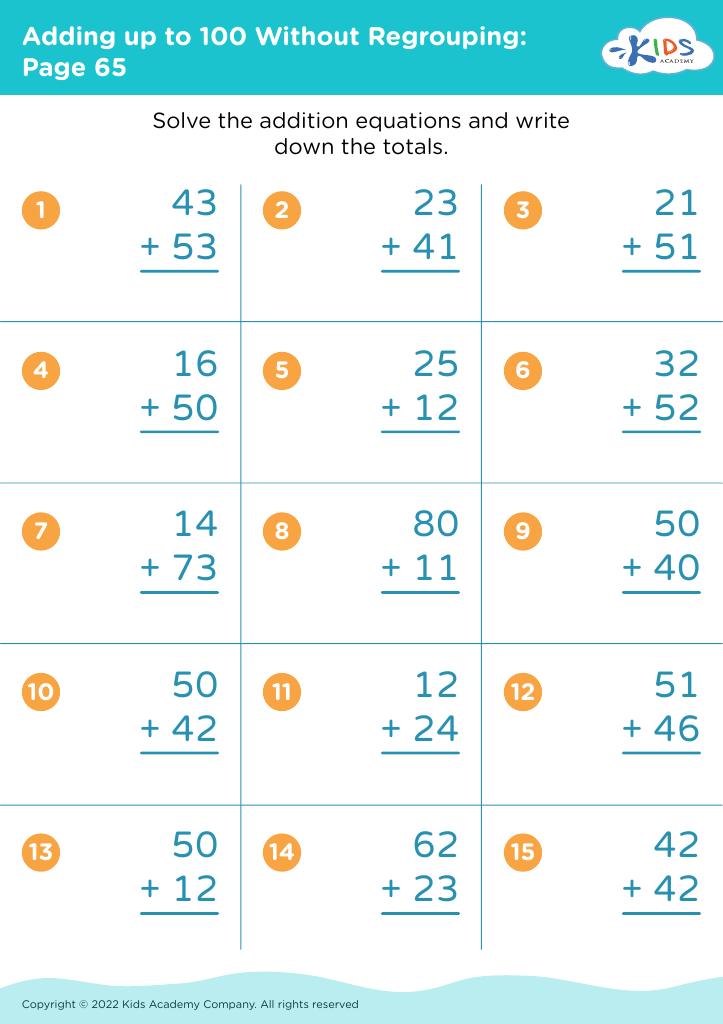
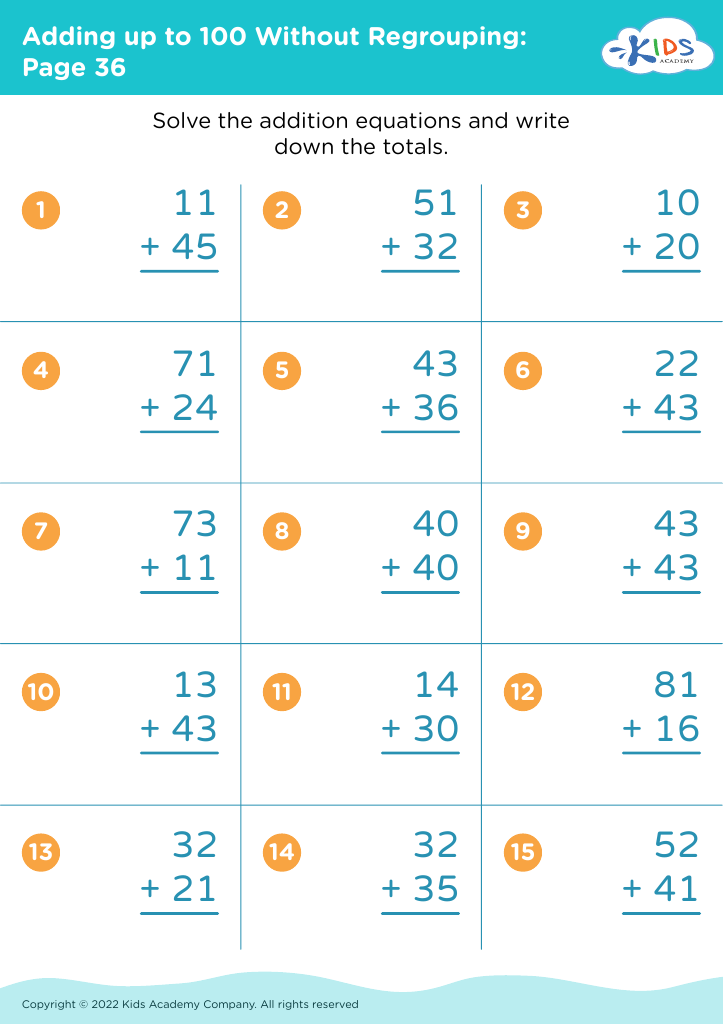
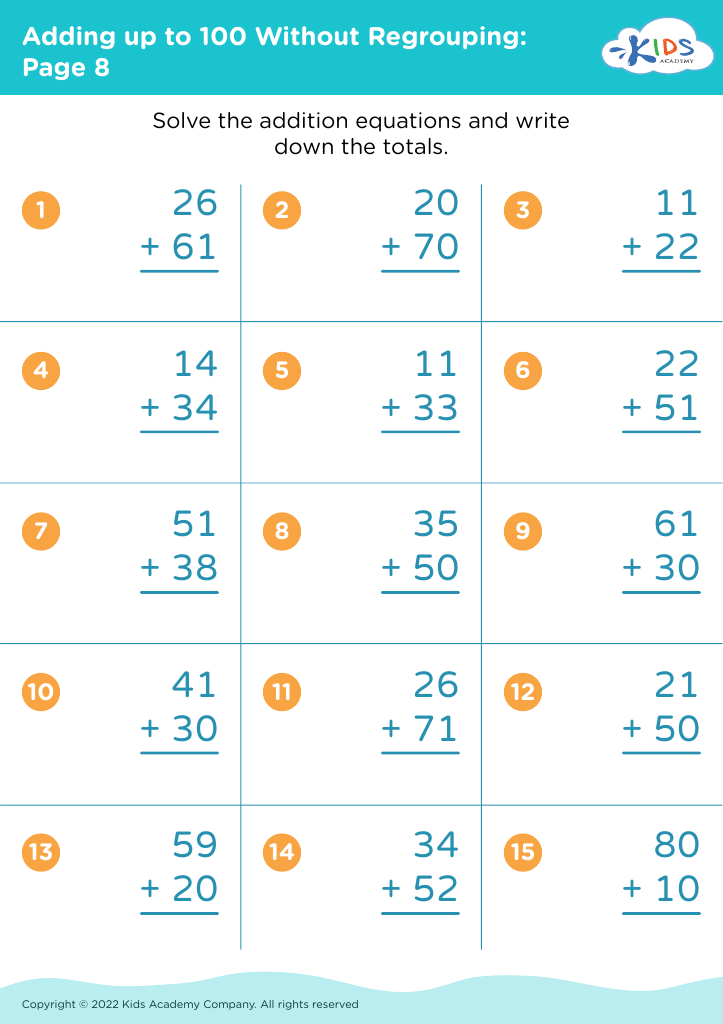




Critical thinking is essential for young learners, particularly as they engage with foundational skills like adding numbers up to 100 without regrouping. Parents and teachers should care about fostering this ability because it lays the groundwork for effective problem-solving and decision-making later in life. By encouraging children to analyze, evaluate, and synthesize information, we empower them to make sense of the mathematical concepts they are learning.
Teaching addition without regrouping at this age not only reinforces basic arithmetic skills but also invites children to explore various strategies, fostering a deeper understanding of numbers and relationships. It helps cultivate self-confidence in their abilities, allowing them to tackle new and more complex challenges as they progress in their education.
Moreover, critical thinking skills lead to improved academic performance across disciplines, from math and science to literacy and social studies. When children learn to think critically, they become more engaged and curious learners, creating a love for learning that extends beyond the classroom.
Ultimately, parents and teachers play a crucial role in guiding children’s developmental journey. By emphasizing critical thinking in early math skills, we equip our young learners with essential tools for lifelong success, helping them become inquisitive and resourceful members of society.