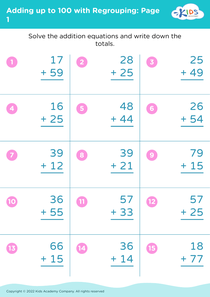
Develop critical thinking Adding up to 100 Without Regrouping Worksheets for Ages 5-7
3 filtered results
-
From - To
Enhance your child’s critical thinking skills with our "Adding up to 100 Without Regrouping Worksheets" tailored for ages 5-7. These worksheets are designed to help young learners improve their addition skills by practicing problems that do not require regrouping. As kids solve these straightforward equations, they develop a strong mathematical foundation and an ability to approach problems logically. Perfect for classroom use or at-home practice, these engaging activities make math enjoyable and accessible. Set your child on the path to math success with carefully structured exercises that encourage logical reasoning and critical thinking. Discover more at Kids Academy!
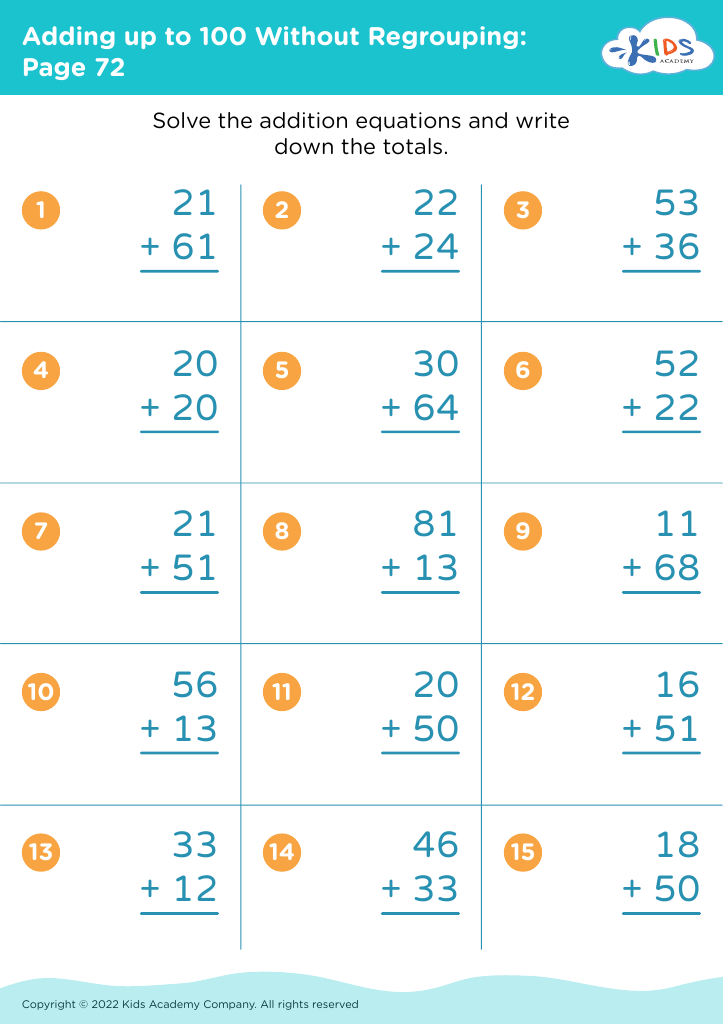
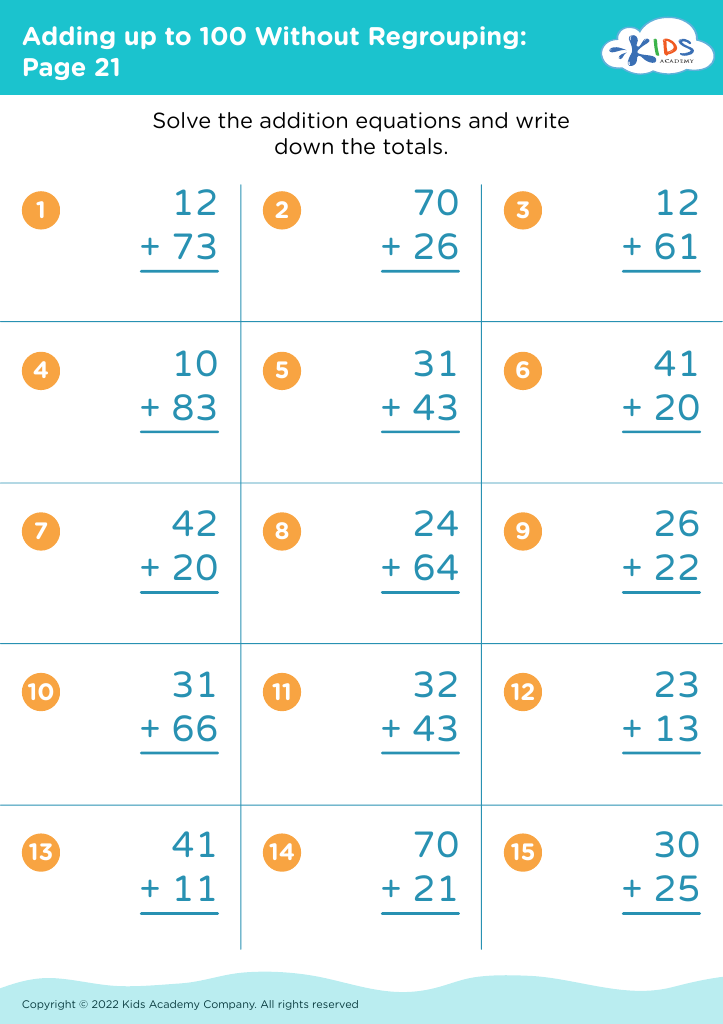
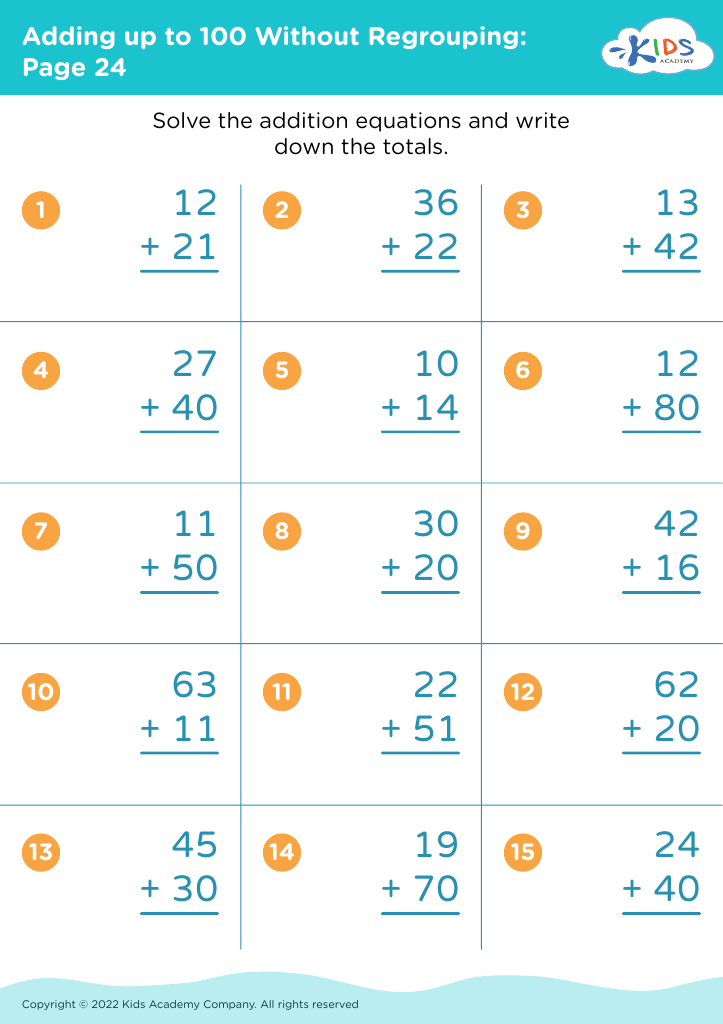




Parents and teachers should prioritize developing critical thinking skills and mastery of basic arithmetic, such as adding up to 100 without regrouping, for ages 5-7 because it lays the foundation for future academic success and everyday problem-solving. Critical thinking nurtures children's ability to analyze, evaluate, and synthesize information, which is essential across all subjects. It encourages curiosity, helps children to understand cause and effect, and enables them to make reasoned decisions, preparing them for more complex cognitive tasks as they grow.
Mastering arithmetic skills such as adding numbers up to 100 without needing to regroup is equally critical at this developmental stage. It builds a solid understanding of number sense and basic operations, which are pivotal for more challenging mathematical concepts in the future. By learning to add confidently, children develop a sense of numerical fluency, laying a crucial groundwork for other math skills including subtraction, multiplication, and division.
Integrating these skills into early education nurtures cognitive growth and boosts self-confidence. Children who excel in these areas are better prepared for more advanced studies and can approach learning as a series of rewarding challenges rather than daunting obstacles. Therefore, fostering critical thinking and arithmetic proficiency empowers children with essential tools for academic and life-long success.