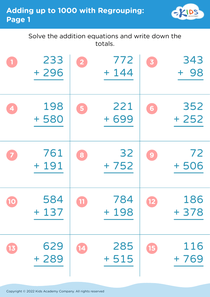
Enhance comprehension Adding up to 1000 Without Regrouping Worksheets for Ages 5-7
4 filtered results
-
From - To
Boost your child's math skills with our Adding up to 1000 Without Regrouping Worksheets designed for ages 5-7. These expertly crafted worksheets focus on enhancing comprehension and building confidence in young learners. Through engaging exercises, students will effortlessly grasp addition principles, honing their calculation abilities without the complex process of regrouping. Perfect for reinforcing classroom learning or practicing at home, these worksheets cater to various learning styles, making math both fun and educational. Help your child develop a strong foundation in essential math skills with Kids Academy's comprehensive and accessible resources.
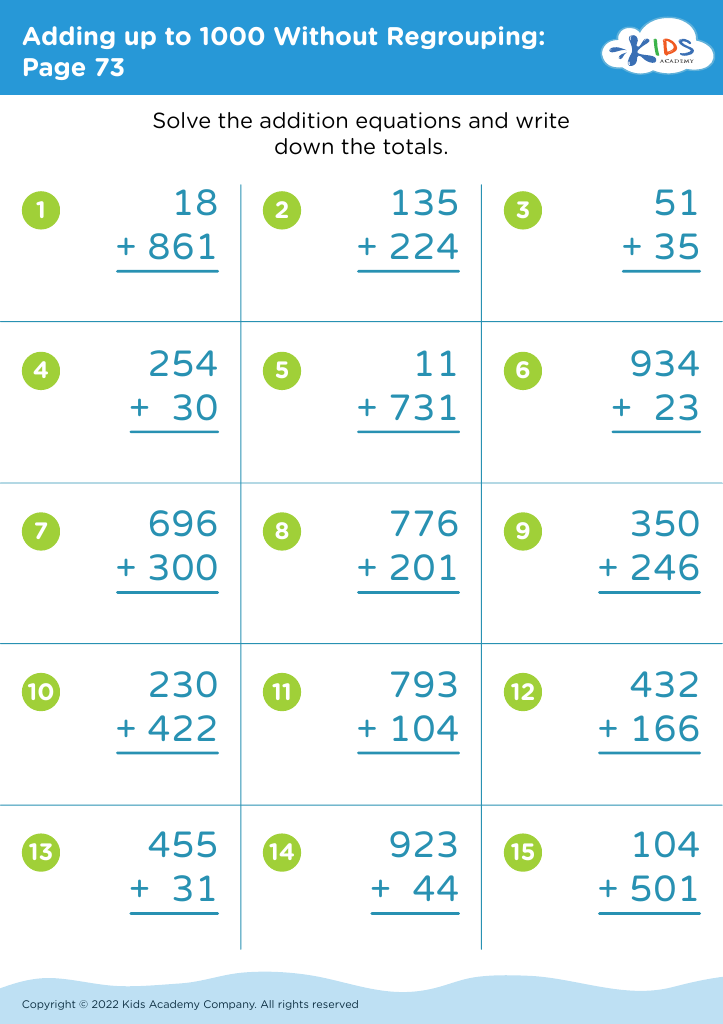
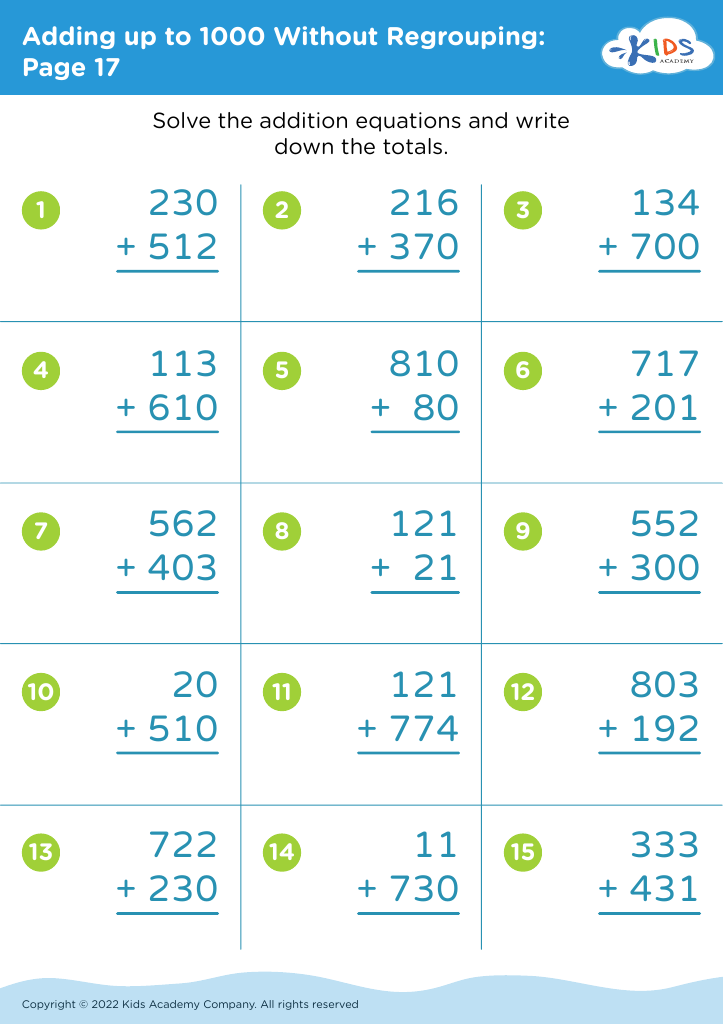
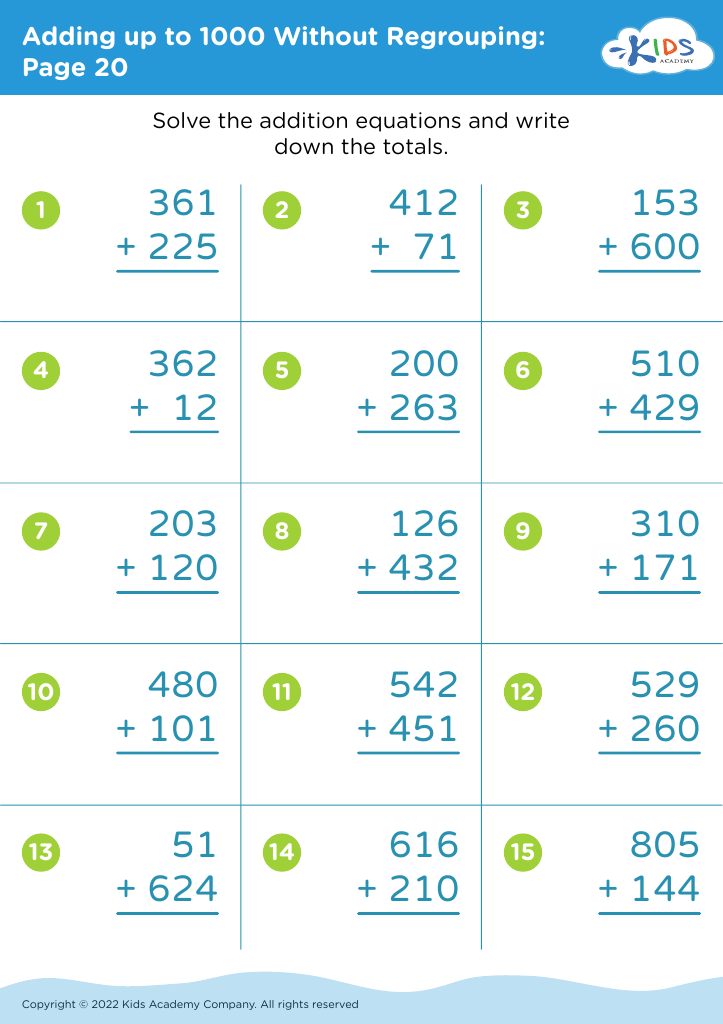
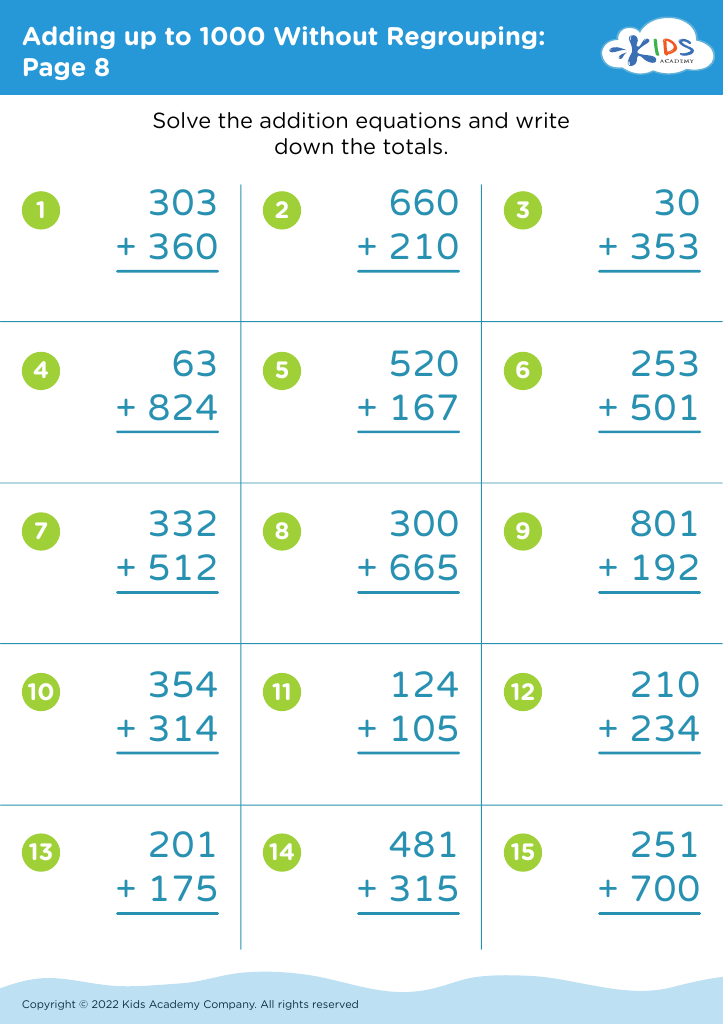


Enhancing comprehension of addition up to 1000 without regrouping for children aged 5-7 is crucial as it lays a vital foundation for their mathematical understanding and cognitive development. At this age, mastering basic addition fosters number sense, which is the ability to understand and work with numbers in a flexible and intuitive manner. This skill is important not only for future mathematical concepts but also for everyday problem-solving tasks.
Parents and teachers should care about this development because it builds a child's confidence in handling numbers, making them more comfortable and less anxious with math as they grow. Comprehending addition in this range also reinforces pattern recognition and logical thinking, and these skills are transferable to other academic areas. Moreover, achieving this understanding without regrouping makes the process less complex and serves as a natural stepping stone to more advanced arithmetic, such as addition with regrouping and multi-digit subtraction.
Children who grasp these fundamental skills early tend to perform better academically over time. Therefore, incorporating structured, yet enjoyable, learning activities around addition in the early grades can significantly impact a child's long-term academic success and foster a positive attitude towards learning and intellectual challenges.