Understanding number relationships Adding Up to 5 Worksheets for Ages 5-7
3 filtered results
-
From - To
Discover our comprehensive "Understanding Number Relationships Adding Up to 5 Worksheets" tailor-made for children ages 5-7. These engaging exercises focus on introducing and solidifying fundamental math skills by helping young learners explore number relationships and mastering basic addition up to five. Featuring colorful illustrations and interactive problems, our worksheets make learning enjoyable while enhancing their number sense, problem-solving abilities, and foundational mathematics understanding. Perfect for at-home practice or classroom use, these resources are designed to boost confidence and build a solid foundation for future math success. Explore now and watch your child’s math skills flourish!
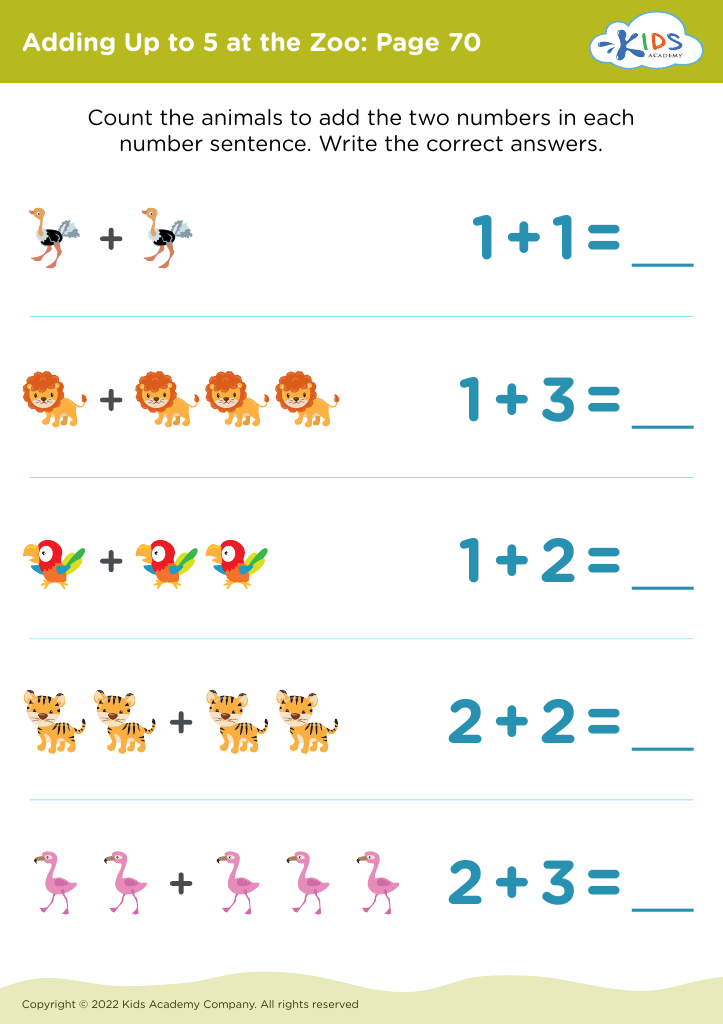
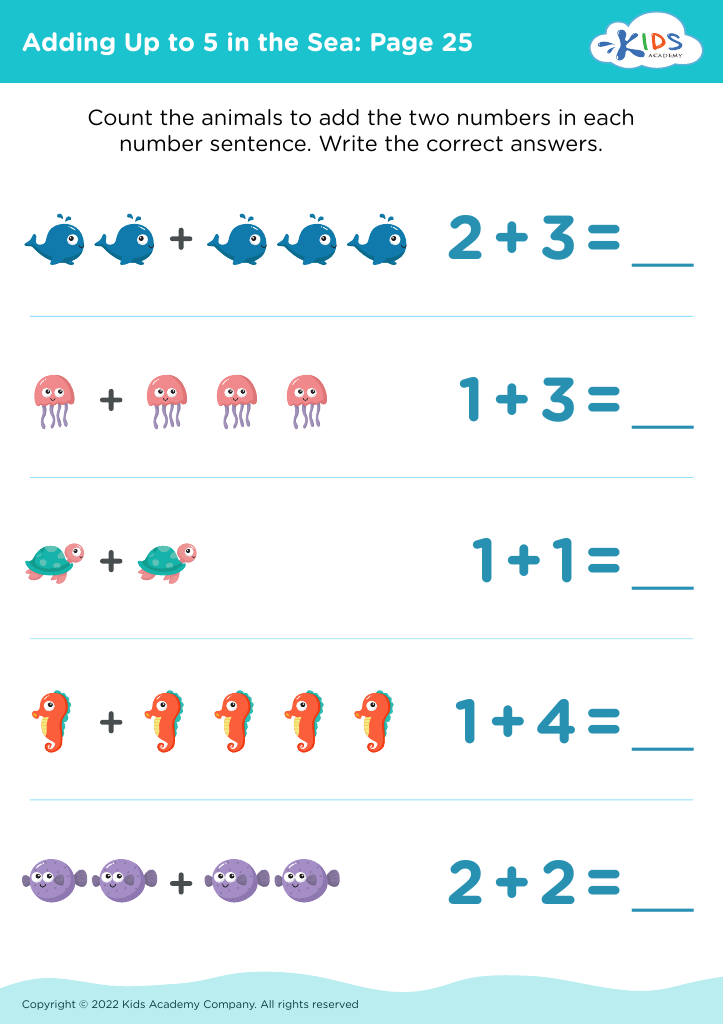
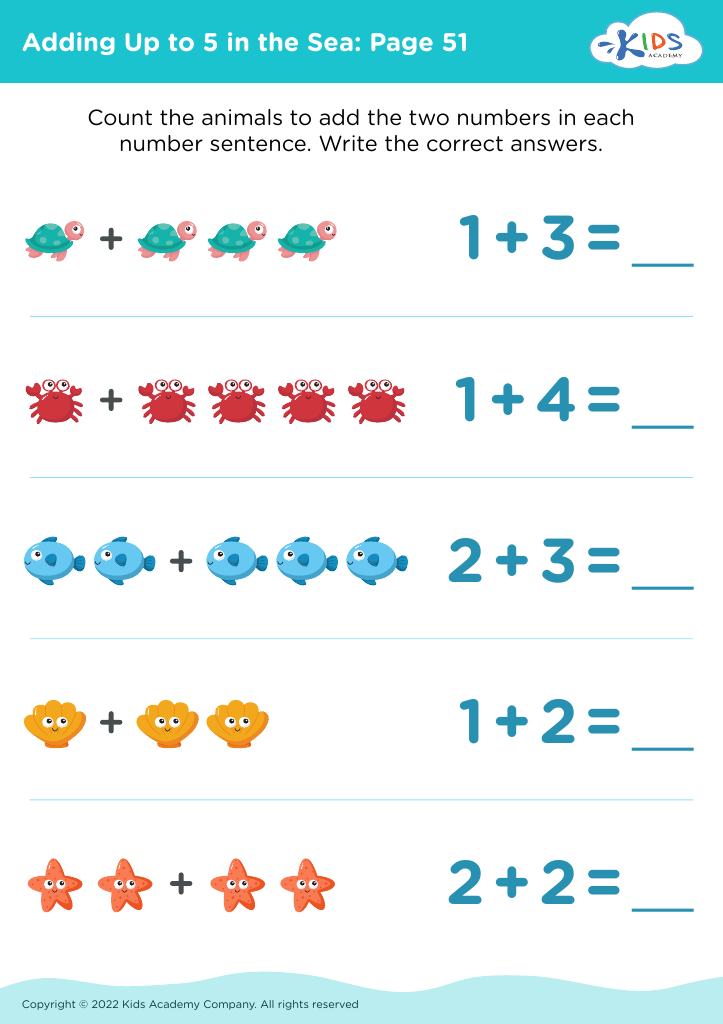








Understanding number relationships that add up to 5 is crucial for children aged 5-7 as it forms the foundation for their mathematical knowledge and cognitive development. At this early stage, concepts such as addition and number bonds are introduced, which are pivotal for future complex arithmetic and problem-solving skills.
Firstly, mastering these relationships fosters number sense, which is the ability to understand, relate, and connect numbers in a meaningful way. For example, knowing that 2 and 3 make 5 helps children comprehend commutative properties (2+3 is the same as 3+2). This, in turn, nurtures mental math skills, allowing them to solve problems more efficiently.
Secondly, early success in understanding these basic mathematical concepts builds confidence and reduces anxiety towards math. When children feel competent in their ability to manipulate small numbers, they are more likely to engage enthusiastically with future mathematical challenges.
Additionally, learning number relationships enhances children's ability to see patterns and make predictions. This critical thinking skill is applicable not only in math but across all areas of learning and daily life.
Parents and teachers play a vital role in this process by providing interactive and engaging activities, reinforcing the significance of math in a child's everyday environment. Their active involvement ensures that learning numbers becomes a fun and integral part of the child's development journey.








